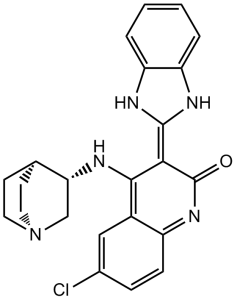
CHIR-124 (CHIR124; CHIR 124) is a novel, potent and selective quinolone-based small molecule Chk1 (Checkpoint kinase1) inhibitor with potential anticancer activity. In a cell-free assay, it inhibits Chk1 with an IC50 of 0.3 nM. The structure of CHIR-124 differs from that of other recognized Chk1 inhibitors. It exhibits 500–5,000 times less activity against CDK2/4 and Cdc2, and 2,000 times selectivity against Chk2. Based on isobologram or response surface analysis, CHIR-124 interacts synergistically with topoisomerase poisons (e.g., camptothecin and/or SN-38) to inhibit growth in a number of p53-mutant solid tumor cell lines. A new and powerful inhibitor of Chk1, CHIR-124 shows promise as an antitumor agent when combined with topoisomerase I poisons.
Physicochemical Properties
| Molecular Formula | C23H22CLN5O | |
| Molecular Weight | 419.91 | |
| Exact Mass | 419.151 | |
| Elemental Analysis | C, 65.79; H, 5.28; Cl, 8.44; N, 16.68; O, 3.81 | |
| CAS # | 405168-58-3 | |
| Related CAS # |
|
|
| PubChem CID | 135399748 | |
| Appearance | Light yellow to brown solid powder | |
| Density | 1.5±0.1 g/cm3 | |
| Index of Refraction | 1.750 | |
| LogP | 3.86 | |
| Hydrogen Bond Donor Count | 3 | |
| Hydrogen Bond Acceptor Count | 4 | |
| Rotatable Bond Count | 3 | |
| Heavy Atom Count | 30 | |
| Complexity | 720 | |
| Defined Atom Stereocenter Count | 1 | |
| SMILES | ClC1=CC2=C(NC(C(C3=NC4=C(C=CC=C4)N3)=C2N[C@@H]5CN6CCC5CC6)=O)C=C1 |
|
| InChi Key | MOVBBVMDHIRCTG-LJQANCHMSA-N | |
| InChi Code | InChI=1S/C23H22ClN5O/c24-14-5-6-16-15(11-14)21(25-19-12-29-9-7-13(19)8-10-29)20(23(30)28-16)22-26-17-3-1-2-4-18(17)27-22/h1-6,11,13,19H,7-10,12H2,(H,26,27)(H2,25,28,30)/t19-/m1/s1 | |
| Chemical Name | 4-[[(3S)-1-azabicyclo[2.2.2]octan-3-yl]amino]-3-(1H-benzimidazol-2-yl)-6-chloro-1H-quinolin-2-one | |
| Synonyms |
|
|
| HS Tariff Code | 2934.99.9001 | |
| Storage |
Powder-20°C 3 years 4°C 2 years In solvent -80°C 6 months -20°C 1 month |
|
| Shipping Condition | Room temperature (This product is stable at ambient temperature for a few days during ordinary shipping and time spent in Customs) |
Biological Activity
| Targets | Chk1 (IC50 = 0.3 nM); Chk2 (IC50 = 697.4 nM); PDGFR (IC50 = 6.6 nM); FLT3 (IC50 = 5.8 nM); Cdk4/cyclin D (IC50 = 2.05 μM); CDC2/cyclin B (IC50 = 0.5057 μM); Cdk2/cyclin A (IC50 = 0.1911 μM); bFGFR (IC50 = 2.01 μM); FGFR3 (IC50 = 1.29 μM); VEGFR2 FLK1 (IC50 = 0.5779 μM); VEGFR1 FLT1 (IC50 = 0.4636 μM); PKCα (IC50 = 0.58 μM); PKAβ I (IC50 = 2.25 μM); PKCβ II (IC50 = 0.58 μM); PKCγ (IC50 = 0.11 μM); ERK2 (IC50 = 4.31 μM); PKA (IC50 = 0.1031 μM); GSK3 (IC50 = 0.0233 μM) | |
| ln Vitro |
|
|
| ln Vivo |
|
|
| Enzyme Assay | The kinase domain of Sf9 insect cells is used to express the Chk1 assay, and the substrate is a biotinylated cdc25c peptide that contains the consensus Chk1/Chk2 phosphorylation site (*) (biotin-[AHX]SGSGS*GLYRSPSMP-ENLNRPR[CONH2]). A kinase reaction buffer containing 30 mM Tris-HCl (pH 7.5), 10 mM MgCl2, 2 mM DTT, 4 mM EDTA, 25 mMβ-glycerophosphate, 5 mM MnCl2, 0.01% bovine serum albumin, 1.35 nM CHK1 kinase domain, 0.5 μM peptide substrate, 1 AM unlabeled ATP, plus 5 nM 33Pγ-labeled ATP (specific activity = 2,000 Ci/mmol) is combined with a series of CHIR-124 dilutions. A radioactive technique is used to carry out the reactions and detect the phosphate transfer. For one to four hours, reactions are incubated at room temperature. The phosphorylated peptide is then captured on microtiter plates coated with streptavidin and containing stop reaction buffer (pH 7.5, 25 mM ethylenediaminetetraacetic acid, 50 mMHEPES). Using an anti-phosphotyrosine antibody (PT66) labeled with europium, the DELFIA TRF system measures phosphorylated peptide. Using nonlinear regression and the data analysis program XL-Fit, the concentration of CHIR-124 for IC50 is determined. | |
| Cell Assay | In log-phase, MDA-MB-231, MDA-MB-435, SW-620, and COLO 205 cells are plated into 96-well microplates. Six distinct concentrations of camptothecin or 0 nM camptothecin are added to serially diluted CHIR-124. If CHIR-124 is not present, camptothecin is also serially diluted. In 96-well plates, cells are treated with CHIR-124, and they are then incubated for 48 hours at 37 °C. Every therapeutic condition is completed in three copies. The 3-(4,5-dimethylthiazol-2-yl)-5-(3-carboxymethoxyphenyl)-2-(4-sulfophenyl)-2H-tetrazolium (MTS), inner salt assay is used to track cell proliferation. After adding MTS inner salt and letting the microplates sit for an additional three hours, the absorbance at 490 nm is measured using a plate reader. To create the isoboles, the drug concentrations in the combinations needed to produce 50% inhibition are plotted. The basis for isobologram analysis of drug interaction is the Loewe additivity equation (1= D A /IC50, A + DB/IC50, B), where DA and DB are the concentrations of each drug in the combination that produce 50% overall inhibition, and IC50, A and B are the concentrations of drugs to result in 50% inhibition for each drug alone. Each graph includes a diagonal line that represents Loewe additivity. Data points that lie above the line will indicate antagonism, while those that fall below the line will show synergy. | |
| Animal Protocol | The following ten treatment groups are randomly assigned to severe combined immunodeficient mice bearing MDA-MD-435 tumor xenografts: the vehicle (captisol) by itself, 5 mg/kg CPT-11, 10 mg/kg CHIR-124, 20 mg/kg CHIR-124, 5 mg/kg CPT-11 plus 10 mg/kg CHIR-124, or 5 mg/kg CPT-11 plus 20 mg/kg CHIR-124. Day 1 (the day following randomization) is when treatment begins. CPT-11 is administered intraperitoneally (i.p.) four times a day (×5) on days 1 through 5, while CHIR-124 is administered orally four times a day ×6 in captisol on days 2 through 7. The formula for calculating percent tumor growth inhibition is T/C, where T is the treatment group mean and C is the control group mean. In a related study, tumor samples taken from mice that were sacrificed on the fourth day of treatment are analyzed for mitotic index using immunofluorescence labeling with phospho-histone H3 antibody and for apoptosis using terminal deoxynucleotidyl transferase-mediated nick-end labeling staining. | |
| References |
[1]. Clin Cancer Res . 2007 Jan 15;13(2 Pt 1):591-602. [2]. Clin Cancer Res . 2010 Jan 15;16(2):376-83. |
|
| Additional Infomation | CHIR-124 is a potent inhibitor of Chk1 that potentiates the cytotoxicity of topoisomerase I poisons in vitro and in vivo. |
Solubility Data
| Solubility (In Vitro) |
|
|||
| Solubility (In Vivo) |
Solubility in Formulation 1: ≥ 0.71 mg/mL (1.69 mM) (saturation unknown) in 10% DMSO + 40% PEG300 + 5% Tween80 + 45% Saline (add these co-solvents sequentially from left to right, and one by one), clear solution. For example, if 1 mL of working solution is to be prepared, you can add 100 μL of 7.1 mg/mL clear DMSO stock solution to 400 μL PEG300 and mix evenly; then add 50 μL Tween-80 to the above solution and mix evenly; then add 450 μL normal saline to adjust the volume to 1 mL. Preparation of saline: Dissolve 0.9 g of sodium chloride in 100 mL ddH₂ O to obtain a clear solution. Solubility in Formulation 2: ≥ 0.71 mg/mL (1.69 mM) (saturation unknown) in 10% DMSO + 90% Corn Oil (add these co-solvents sequentially from left to right, and one by one), clear solution. For example, if 1 mL of working solution is to be prepared, you can add 100 μL of 7.1 mg/mL clear DMSO stock solution to 900 μL of corn oil and mix evenly. Solubility in Formulation 3: 1% DMSO +30% polyethylene glycol+1% Tween 80 : 30mg/mL (Please use freshly prepared in vivo formulations for optimal results.) |
| Preparing Stock Solutions | 1 mg | 5 mg | 10 mg | |
| 1 mM | 2.3815 mL | 11.9073 mL | 23.8146 mL | |
| 5 mM | 0.4763 mL | 2.3815 mL | 4.7629 mL | |
| 10 mM | 0.2381 mL | 1.1907 mL | 2.3815 mL |