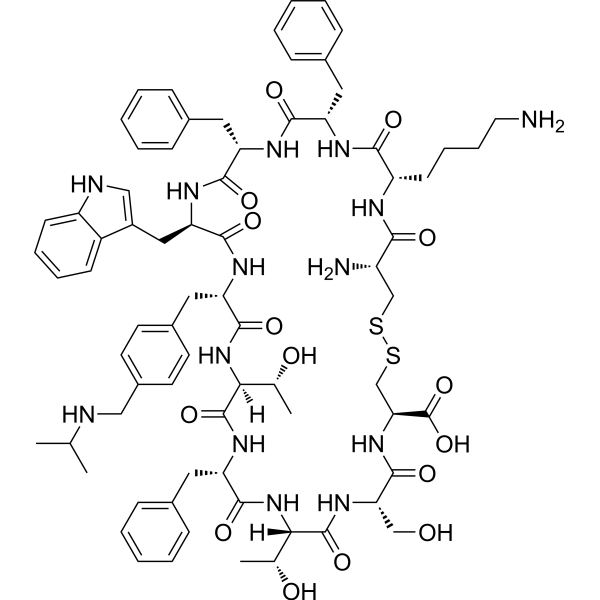
Physicochemical Properties
| Molecular Formula | C74H96N14O15S2 |
| Molecular Weight | 1485.76885509491 |
| Exact Mass | 1470.682 |
| CAS # | 174688-78-9 |
| PubChem CID | 90488765 |
| Appearance | White to off-white solid powder |
| LogP | 1.3 |
| Hydrogen Bond Donor Count | 18 |
| Hydrogen Bond Acceptor Count | 20 |
| Rotatable Bond Count | 21 |
| Heavy Atom Count | 104 |
| Complexity | 2720 |
| Defined Atom Stereocenter Count | 13 |
| SMILES | C([C@H]1NC([C@@H](NC([C@@]([H])(NC([C@@H](NC([C@]([H])(CSSC[C@@H](C(=O)O)NC(=O)[C@H](CO)NC(=O)C([C@H](O)C)NC(=O)[C@H](CC2C=CC=CC=2)NC(=O)C([C@H](O)C)NC(=O)[C@H](CC2C=CC(CNC(C)C)=CC=2)NC1=O)N)=O)CCCCN)=O)CC1C=CC=CC=1)=O)CC1C=CC=CC=1)=O)C1=CNC2C=CC=CC1=2 |
| InChi Key | LFOPEPKKBBIGHF-RXUBGYFDSA-N |
| InChi Code | InChI=1S/C74H98N14O14S2/c1-43(2)77-37-50-29-27-49(28-30-50)35-59-70(97)88-64(45(4)91)73(100)86-60(34-48-22-12-7-13-23-48)71(98)87-63(44(3)90)72(99)80-52(40-89)39-79-62(74(101)102)42-104-103-41-54(76)65(92)81-56(26-16-17-31-75)66(93)82-57(32-46-18-8-5-9-19-46)67(94)83-58(33-47-20-10-6-11-21-47)68(95)85-61(69(96)84-59)36-51-38-78-55-25-15-14-24-53(51)55/h5-15,18-25,27-30,38,43-45,52,54,56-64,77-79,89-91H,16-17,26,31-37,39-42,75-76H2,1-4H3,(H,80,99)(H,81,92)(H,82,93)(H,83,94)(H,84,96)(H,85,95)(H,86,100)(H,87,98)(H,88,97)(H,101,102)/t44-,45-,52-,54+,56-,57+,58+,59-,60+,61+,62+,63-,64-/m1/s1 |
| Chemical Name | (4R,7R,10R,13S,16R,19R,22S,25S,28S,31R,34R)-34-amino-31-(4-aminobutyl)-13,25,28-tribenzyl-10,16-bis[(1R)-1-hydroxyethyl]-7-(hydroxymethyl)-22-(1H-indol-3-ylmethyl)-9,12,15,18,21,24,27,30,33-nonaoxo-19-[[4-[(propan-2-ylamino)methyl]phenyl]methyl]-1,2-dithia-5,8,11,14,17,20,23,26,29,32-decazacyclopentatriacontane-4-carboxylic acid |
| HS Tariff Code | 2934.99.9001 |
| Storage |
Powder-20°C 3 years 4°C 2 years In solvent -80°C 6 months -20°C 1 month Note: Please store this product in a sealed and protected environment (e.g. under nitrogen), avoid exposure to moisture and light. |
| Shipping Condition | Room temperature (This product is stable at ambient temperature for a few days during ordinary shipping and time spent in Customs) |
Biological Activity
| Targets | SSTR1 |
| ln Vitro | Neprilysin activity is activated by CH275 (100 nM), but cyclo-SRIF administration can finish this activation in vitro in primary neuron-based cell culture system, which is a mixture of cortical, striatal, and wildtype hippocampus neurons[3]. |
| ln Vivo | In the App knock-in mice, CH275 (osmotic pump injection; 56 μM; two weeks) lowers the level of neprilysin/SRIF[3]. For four months, CH275 is injected directly into the Lacunosum molecular layer (Lmol) of two-month-old AppNL-GF mice. Aβ plaques are first seen in AppNL-GF mice at two months of age. However, CH275 causes a significant rise in neprilysin expression in the hippocampal region, which is accompanied by a noticeable decrease in the amount of Aβ plaques in the same area, all without having any harmful side effects[3]. |
| References |
[1]. Structural basis for the binding specificity of a SSTR1-selective analog of somatostatin. Biochem Biophys Res Commun. 1999 May 19;258(3):689-94. [2]. Potent somatostatin undecapeptide agonists selective for somatostatin receptor 1 (sst1). J Med Chem. 2001 Jun 21;44(13):2238-46. [3]. Somatostatin receptor subtypes 1 and 4 redundantly regulate neprilysin, the major amyloid β-degrading enzyme, in brain. |
Solubility Data
| Solubility (In Vitro) |
DMSO: 100 mg/mL (67.31 mM) H2O: 50 mg/mL (33.65 mM) |
| Solubility (In Vivo) |
Note: Listed below are some common formulations that may be used to formulate products with low water solubility (e.g. < 1 mg/mL), you may test these formulations using a minute amount of products to avoid loss of samples. Injection Formulations (e.g. IP/IV/IM/SC) Injection Formulation 1: DMSO : Tween 80: Saline = 10 : 5 : 85 (i.e. 100 μL DMSO stock solution → 50 μL Tween 80 → 850 μL Saline) *Preparation of saline: Dissolve 0.9 g of sodium chloride in 100 mL ddH ₂ O to obtain a clear solution. Injection Formulation 2: DMSO : PEG300 :Tween 80 : Saline = 10 : 40 : 5 : 45 (i.e. 100 μL DMSO → 400 μLPEG300 → 50 μL Tween 80 → 450 μL Saline) Injection Formulation 3: DMSO : Corn oil = 10 : 90 (i.e. 100 μL DMSO → 900 μL Corn oil) Example: Take the Injection Formulation 3 (DMSO : Corn oil = 10 : 90) as an example, if 1 mL of 2.5 mg/mL working solution is to be prepared, you can take 100 μL 25 mg/mL DMSO stock solution and add to 900 μL corn oil, mix well to obtain a clear or suspension solution (2.5 mg/mL, ready for use in animals). Injection Formulation 4: DMSO : 20% SBE-β-CD in saline = 10 : 90 [i.e. 100 μL DMSO → 900 μL (20% SBE-β-CD in saline)] *Preparation of 20% SBE-β-CD in Saline (4°C,1 week): Dissolve 2 g SBE-β-CD in 10 mL saline to obtain a clear solution. Injection Formulation 5: 2-Hydroxypropyl-β-cyclodextrin : Saline = 50 : 50 (i.e. 500 μL 2-Hydroxypropyl-β-cyclodextrin → 500 μL Saline) Injection Formulation 6: DMSO : PEG300 : castor oil : Saline = 5 : 10 : 20 : 65 (i.e. 50 μL DMSO → 100 μLPEG300 → 200 μL castor oil → 650 μL Saline) Injection Formulation 7: Ethanol : Cremophor : Saline = 10: 10 : 80 (i.e. 100 μL Ethanol → 100 μL Cremophor → 800 μL Saline) Injection Formulation 8: Dissolve in Cremophor/Ethanol (50 : 50), then diluted by Saline Injection Formulation 9: EtOH : Corn oil = 10 : 90 (i.e. 100 μL EtOH → 900 μL Corn oil) Injection Formulation 10: EtOH : PEG300:Tween 80 : Saline = 10 : 40 : 5 : 45 (i.e. 100 μL EtOH → 400 μLPEG300 → 50 μL Tween 80 → 450 μL Saline) Oral Formulations Oral Formulation 1: Suspend in 0.5% CMC Na (carboxymethylcellulose sodium) Oral Formulation 2: Suspend in 0.5% Carboxymethyl cellulose Example: Take the Oral Formulation 1 (Suspend in 0.5% CMC Na) as an example, if 100 mL of 2.5 mg/mL working solution is to be prepared, you can first prepare 0.5% CMC Na solution by measuring 0.5 g CMC Na and dissolve it in 100 mL ddH2O to obtain a clear solution; then add 250 mg of the product to 100 mL 0.5% CMC Na solution, to make the suspension solution (2.5 mg/mL, ready for use in animals). Oral Formulation 3: Dissolved in PEG400 Oral Formulation 4: Suspend in 0.2% Carboxymethyl cellulose Oral Formulation 5: Dissolve in 0.25% Tween 80 and 0.5% Carboxymethyl cellulose Oral Formulation 6: Mixing with food powders Note: Please be aware that the above formulations are for reference only. InvivoChem strongly recommends customers to read literature methods/protocols carefully before determining which formulation you should use for in vivo studies, as different compounds have different solubility properties and have to be formulated differently. (Please use freshly prepared in vivo formulations for optimal results.) |
| Preparing Stock Solutions | 1 mg | 5 mg | 10 mg | |
| 1 mM | 0.6731 mL | 3.3653 mL | 6.7305 mL | |
| 5 mM | 0.1346 mL | 0.6731 mL | 1.3461 mL | |
| 10 mM | 0.0673 mL | 0.3365 mL | 0.6731 mL |