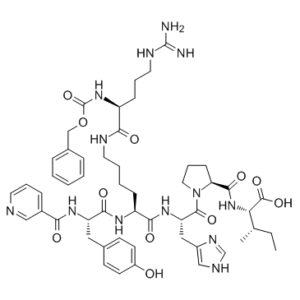
CGP-42112(also known as CGP-42112A) is a novel, potent and selective Angiotensin-II subtype 2 receptor(AT2 R) agonist. Angiotensin II subtype 2 receptor (AT(2)-R) is highly expressed in adrenal medullary chromaffin cells. What is still unknown, though, are AT(2)-R's physiological functions in chromaffin cells. From the baseline, cGMP production was markedly inhibited by CGP42112 (>==1 nM). Both TH-synthesis and TH-enzyme activity control the activity of tyrosine hydroxylase (TH), a rate-limiting enzyme in the biosynthesis of catecholamines. From the baseline value, TH-enzyme activity was markedly inhibited by CGP42112 (>==1 nM). PD123319 (an AT(2)-R antagonist) eliminated the inhibitory effects of CGP42112 on TH-enzyme activity and cGMP production, whereas CV-11974 (an AT(1)-R antagonist) had no effect.
Physicochemical Properties
| Molecular Formula | C52H69N13O11 | |
| Molecular Weight | 1052.19 | |
| Exact Mass | 1051.523 | |
| Elemental Analysis | C, 59.36; H, 6.61; N, 17.31; O, 16.73 | |
| CAS # | 127060-75-7 | |
| Related CAS # |
|
|
| PubChem CID | 123794 | |
| Appearance | White to off-white solid powder | |
| Density | 1.4±0.1 g/cm3 | |
| Index of Refraction | 1.659 | |
| LogP | 2.38 | |
| Hydrogen Bond Donor Count | 11 | |
| Hydrogen Bond Acceptor Count | 14 | |
| Rotatable Bond Count | 30 | |
| Heavy Atom Count | 76 | |
| Complexity | 1930 | |
| Defined Atom Stereocenter Count | 7 | |
| SMILES | CC[C@H](C)[C@@H](C(O)=O)NC([C@H]1N(C([C@H](CC2=CNC=N2)NC([C@H](CCCCNC([C@H](CCCNC(N)=N)NC(OCC3=CC=CC=C3)=O)=O)NC([C@H](CC4=CC=C(C=C4)O)NC(C5=CC=CN=C5)=O)=O)=O)=O)CCC1)=O |
|
| InChi Key | UXGNARZDONUMMK-LRMQDCNJSA-N | |
| InChi Code | InChI=1S/C52H69N13O11/c1-3-32(2)43(50(73)74)64-48(71)42-17-11-25-65(42)49(72)41(27-36-29-56-31-59-36)62-46(69)39(60-47(70)40(26-33-18-20-37(66)21-19-33)61-44(67)35-14-9-22-55-28-35)15-7-8-23-57-45(68)38(16-10-24-58-51(53)54)63-52(75)76-30-34-12-5-4-6-13-34/h4-6,9,12-14,18-22,28-29,31-32,38-43,66H,3,7-8,10-11,15-17,23-27,30H2,1-2H3,(H,56,59)(H,57,68)(H,60,70)(H,61,67)(H,62,69)(H,63,75)(H,64,71)(H,73,74)(H4,53,54,58)/t32-,38-,39-,40-,41-,42-,43-/m0/s1 | |
| Chemical Name | (2S,3S)-2-[[(2S)-1-[(2S)-2-[[(2S)-6-[[(2S)-5-(diaminomethylideneamino)-2-(phenylmethoxycarbonylamino)pentanoyl]amino]-2-[[(2S)-3-(4-hydroxyphenyl)-2-(pyridine-3-carbonylamino)propanoyl]amino]hexanoyl]amino]-3-(1H-imidazol-5-yl)propanoyl]pyrrolidine-2-carbonyl]amino]-3-methylpentanoic acid | |
| Synonyms |
|
|
| HS Tariff Code | 2934.99.03.00 | |
| Storage |
Powder-20°C 3 years 4°C 2 years In solvent -80°C 6 months -20°C 1 month |
|
| Shipping Condition | Room temperature (This product is stable at ambient temperature for a few days during ordinary shipping and time spent in Customs) |
Biological Activity
| ln Vitro | CGP-42112 (≥1 nM) significantly reduces the basal value of cGMP production. From the basal value, CGP-42112 (≥1 nM) significantly inhibits TH-enzyme activity. PD123319 (an AT(2)-R antagonist) completely eliminates the inhibitory effects of CGP-42112 on TH-enzyme activity and cGMP production, whereas CV-11974 (an AT(1)-R antagonist) has no effect[1]. [1255I] CGP-42112 selectively binds to the subtype of angiotensin II receptor known as AT2. [1255I] Compared to the adrenal, the brain is where CGP-42112 binds more strongly. Although it does not change its binding in the adrenal gland, beta-Mercaptoethanol increased the binding of [1255I]CGP-42112 in the brain[2]. High affinity binding is observed for [1255I]CGP-42112 (Kd = 0.07-0.3 nM, depending on the region studied). [1255I]CGP-42112 binding is selective for AT2 receptors, as shown by the non-selective peptides Ang II and angiotensin III (Ang III) as well as competition from the AT2 ligands PD 123177, unlabeled CGP-42112, and losartan, the AT1 ligand[4]. |
| ln Vivo | The upper limit of CBF autoregulation was shifted toward higher blood pressures by intravenous infusions of PD 123319 (0.36 and 1 mg kg-1 min-1) and CGP-42112 (0.1 and 1 mg kg-1 min-1) without changing baseline CBF[3]. |
| References |
[1]. Angiotensin-II subtype 2 receptor agonist (CGP-42112) inhibits catecholamine biosynthesis in cultured porcine adrenal medullary chromaffin cells. Biochem Biophys Res Commun. 2000 Jun 7;272(2):544-50. [2]. [125I]CGP 42112 binding reveals differences between rat brain and adrenal AT2 receptor binding sites. Regul Pept. 1993 Mar 19;44(2):189-97. [3]. Angiotensin II AT2 receptor stimulation extends the upper limit of cerebral blood flow autoregulation: agonist effects of CGP 42112 and PD 123319. J Cereb Blood Flow Metab. 1994 Jan;14(1):38-44. [4]. Quantitative autoradiography of angiotensin II AT2 receptors with [125I]CGP 42112. Brain Res. 1995 Apr 17;677(1):29-38. |
| Additional Infomation | CGP-42112A is a hexapeptide consisting of L-tyrosine, L-lysine, L-histidine, L-proline and L-isoleucine amino acid residues coupled in sequence and in which the amino group of the L-tyrosyl residue is substituted by a (pyridin-3-ylcarbonyl)nitrilo group and in which the L-lysyl side chain amino group is substituted by a {N(2)-[(benzyloxy)carbonyl]-L-arginyl}nitrilo group. It is a potent angiotensin II receptor type 2 (AT2 receptor) agonist. It has a role as an angiotensin receptor agonist, a vasodilator agent, an antineoplastic agent, an anti-inflammatory agent and a neuroprotective agent. It is an oligopeptide, a benzyl ester and a pyridinecarboxamide. |
Solubility Data
| Solubility (In Vitro) |
|
|||
| Solubility (In Vivo) |
Solubility in Formulation 1: 2.5 mg/mL (2.38 mM) in 10% DMSO + 40% PEG300 + 5% Tween80 + 45% Saline (add these co-solvents sequentially from left to right, and one by one), clear solution; with sonication. For example, if 1 mL of working solution is to be prepared, you can add 100 μL of 25.0 mg/mL clear DMSO stock solution to 400 μL PEG300 and mix evenly; then add 50 μL Tween-80 to the above solution and mix evenly; then add 450 μL normal saline to adjust the volume to 1 mL. Preparation of saline: Dissolve 0.9 g of sodium chloride in 100 mL ddH₂ O to obtain a clear solution. Solubility in Formulation 2: 2.5 mg/mL (2.38 mM) in 10% DMSO + 90% (20% SBE-β-CD in Saline) (add these co-solvents sequentially from left to right, and one by one), clear solution; with ultrasonication. For example, if 1 mL of working solution is to be prepared, you can add 100 μL of 25.0 mg/mL clear DMSO stock solution to 900 μL of 20% SBE-β-CD physiological saline solution and mix evenly. Preparation of 20% SBE-β-CD in Saline (4°C,1 week): Dissolve 2 g SBE-β-CD in 10 mL saline to obtain a clear solution. Solubility in Formulation 3: 2.5 mg/mL (2.38 mM) in 10% DMSO + 90% Corn Oil (add these co-solvents sequentially from left to right, and one by one), clear solution; with ultrasonication. For example, if 1 mL of working solution is to be prepared, you can add 100 μL of 25.0 mg/mL clear DMSO stock solution to 900 μL of corn oil and mix evenly. (Please use freshly prepared in vivo formulations for optimal results.) |
| Preparing Stock Solutions | 1 mg | 5 mg | 10 mg | |
| 1 mM | 0.9504 mL | 4.7520 mL | 9.5040 mL | |
| 5 mM | 0.1901 mL | 0.9504 mL | 1.9008 mL | |
| 10 mM | 0.0950 mL | 0.4752 mL | 0.9504 mL |