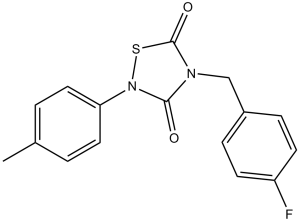
CCG 50014 is a novel, potent and selective inhibitor of RGS4 with IC50 of 30 nM, and exhibits 20~100-fold selectivity for inhibiting RGS4 over other RGS proteins. CCG-50014 is highly potent at inhibiting RGS4 and it also moderately inhibits several other RGS proteins, including RGS8, -16, and -19, but does not have activity on RGS7. Moreover, CCG-50014 exhibits no effect on RGS4Cys−, a mutant variant of RGS4 lacking cysteine residues in the RGS homology domain. An adduct is formed on two cysteine residues in an allosteric regulatory site by CCG-50014's covalent binding to the RGS. In a living cell, CCG-50014 can block the RGS4-Gαo protein-protein interaction. The first member of a new class of small molecule RGS inhibitors that work inside of cells is CCG-50014.
Physicochemical Properties
| Molecular Formula | C16H13FN2O2S | |
| Molecular Weight | 316.35 | |
| Exact Mass | 316.068 | |
| Elemental Analysis | C, 60.75; H, 4.14; F, 6.01; N, 8.86; O, 10.11; S, 10.13 | |
| CAS # | 883050-24-6 | |
| Related CAS # |
|
|
| PubChem CID | 2733079 | |
| Appearance | White to light yellow solid powder | |
| LogP | 2.556 | |
| Hydrogen Bond Donor Count | 0 | |
| Hydrogen Bond Acceptor Count | 4 | |
| Rotatable Bond Count | 3 | |
| Heavy Atom Count | 22 | |
| Complexity | 432 | |
| Defined Atom Stereocenter Count | 0 | |
| SMILES | O=C1N(CC2C=CC(F)=CC=2)C(=O)N(C2C=CC(C)=CC=2)S1 |
|
| InChi Key | QUIIIYITNGOFEI-UHFFFAOYSA-N | |
| InChi Code | InChI=1S/C16H13FN2O2S/c1-11-2-8-14(9-3-11)19-15(20)18(16(21)22-19)10-12-4-6-13(17)7-5-12/h2-9H,10H2,1H3 | |
| Chemical Name | 4-[(4-fluorophenyl)methyl]-2-(4-methylphenyl)-1,2,4-thiadiazolidine-3,5-dione | |
| Synonyms |
|
|
| HS Tariff Code | 2934.99.9001 | |
| Storage |
Powder-20°C 3 years 4°C 2 years In solvent -80°C 6 months -20°C 1 month |
|
| Shipping Condition | Room temperature (This product is stable at ambient temperature for a few days during ordinary shipping and time spent in Customs) |
Biological Activity
| Targets | RGS4 ( IC50 = 30 nM ); RGS8 ( IC50 = 11 μM ); RGS16 ( IC50 = 3.5 μM ); RGS19 ( IC50 = 0.12 μM ) |
| ln Vitro | CCG-50014 does not have any effect on RGS7, but it is very effective at inhibiting RGS4 and completely inhibits RGS8, -16, and -19, among other RGS proteins. Moreover, CCG-50014 exhibits no effect on RGS4Cys−, a mutant variant of RGS4 lacking cysteine residues in the RGS homology domain. An adduct is formed on two cysteine residues in an allosteric regulatory site by CCG-50014's covalent binding to the RGS. In a living cell, CCG-50014 can block the RGS4-Gαo protein-protein interaction. CCG-50014 is the first member of a new class of small-molecule RGS inhibitors with cellular activity. [1] [2] |
| ln Vivo | CCG50014 (10, 30 or 100 nM) attenuates late nociceptive responses in a dose-dependent manner [3]. Mice that received the formalin injection exhibited typical biphasic nociceptive behaviors. The nociceptive responses in RGS4-knockout mice were significantly decreased during the late phase but not during the early phase. Similarly, intrathecally administered CCG50014 (10, 30, or 100 nmol) attenuated the nociceptive responses during the late phase in a dose-dependent manner. The antinociceptive effect of the RGS4 inhibitor was totally blocked by naloxone (5 mg/kg). In contrast, intrathecal injection of DAMGO achieved a dose-dependent reduction of the nociceptive responses at the early and late phases. This analgesic effect of DAMGO was significantly enhanced by the genetic depletion of RGS4 or by coadministration of CCG50014 (10 nmol). |
| Enzyme Assay | Here we describe the pharmacologic properties and mechanism of action of CCG-50014, the most potent small molecule RGS inhibitor to date. It has an IC(50) for RGS4 of 30 nM and is >20-fold selective for RGS4 over other RGS proteins. CCG-50014 binds covalently to the RGS, forming an adduct on two cysteine residues located in an allosteric regulatory site. It is not a general cysteine alkylator as it does not inhibit activity of the cysteine protease papain at concentrations >3000-fold higher than those required to inhibit RGS4 function. It is also >1000-fold more potent as an RGS4 inhibitor than are the cysteine alkylators N-ethylmaleimide and iodoacetamide. Analysis of the cysteine reactivity of the compound shows that compound binding to Cys(107) in RGS8 inhibits Gα binding in a manner that can be reversed by cleavage of the compound-RGS disulfide bond. If the compound reacts with Cys(160) in RGS8, the adduct induces RGS denaturation, and activity cannot be restored by removal of the compound. The high potency and good selectivity of CCG-50014 make it a useful tool for studying the functional roles of RGS4 [2]. |
| Cell Assay |
Effect of compounds on carbachol-simulated Ca++ responses [2]. HEK-293 cells stably transfected with the human M3 muscarinic receptor were plated in black, clear-bottomed, 96-well plates overnight. They were loaded with Fluo4-NW according to the manufacturer's instructions. After 30 min of loading at 37 °C, the indicated compounds were added at a concentration of 10 μM (with 1% DMSO). After 30–45 min, the baseline fluorescence was measured in a Flex-3 plate reader (Molecular Devices). Then, carbachol (10 nM final) was injected into the wells, and the increase in intracellular Ca++ was measured and is expressed as the percentage of the baseline Ca++ level. Values are the mean ± SD of triplicate determinations (compounds) and 16 determinations (DMSO). |
| Animal Protocol |
Intrathecal Drug Treatment[3] Each drug was administered by intrathecal injection based on the technique developed by Hylden and Wilcox.20 Drugs were dissolved in 5 µL of vehicle. We injected a 5-µL volume intrathecally because data suggest that this is likely to be the upper limit that can be reliably injected into a mouse without appreciable redistribution of the drug through the cerebrospinal fluid to the basal cisterns of the brain. In brief, for mouse intrathecal injections, a 30-gauge needle (length: 0.5 inch) connected to a 50-µL Hamilton syringe was inserted into the subarachnoid space between the lumbar vertebrae L5 and L6. A flick of the mouse’s tail provided a reliable indicator that the needle had penetrated the dura mater. The syringe was held in position for a few seconds after the injection of 5 µL/mouse.[3] Formalin-Induced Pain Behaviors[3] Mice were first acclimatized for 30 minutes in an acrylic observation chamber (size ranges 12 × 12× 12 cm); 20 µL of 1% formalin was then injected subcutaneously into the plantar surface of the right hindpaw with a 30-gauge needle, as previously described.21 After injection of formalin, mice were immediately placed in a test chamber; nociceptive responses were digitally videotaped from underneath a glass floor for 40 minutes. The summation of time (in seconds) spent licking and biting the formalin-injected hindpaw during each 5-minute block was measured as an indicator of nociception. The duration of the responses during the first 10-minute period represented the early phase, whereas the duration of responses during the subsequent 30-minute period (from 10 to 40 minutes after injection) represented the late phase of the formalin test. In this experiment, CCG50014 (10, 30, or 100 nmol) or DAMGO (0.03, 0.1, 0.3, 1, 3, 10, 30, or 100 pmol) was intrathecally injected 5 minutes before the formalin injection. Naloxone (5 mg/kg) was administered intraperitoneally 30 minutes before intrathecal administration of CCG50014 (100 nmol). The dose of naloxone was selected based on previously published work. |
| References |
[1]. Biochemistry. 2011 Apr 19;50(15):3181-92. [2]. ACS Med Chem Lett. 2012 Feb 9;3(2):146-150. [3]. Anesth Analg. 2015 Mar;120(3):671-677. |
| Additional Infomation | 4-(4-Fluorobenzyl)-2-p-tolyl-1,2,4-thiadiazolidine-3,5-dione has been reported in Curculigo orchioides with data available. |
Solubility Data
| Solubility (In Vitro) |
|
|||
| Solubility (In Vivo) |
Note: Listed below are some common formulations that may be used to formulate products with low water solubility (e.g. < 1 mg/mL), you may test these formulations using a minute amount of products to avoid loss of samples. Injection Formulations (e.g. IP/IV/IM/SC) Injection Formulation 1: DMSO : Tween 80: Saline = 10 : 5 : 85 (i.e. 100 μL DMSO stock solution → 50 μL Tween 80 → 850 μL Saline) *Preparation of saline: Dissolve 0.9 g of sodium chloride in 100 mL ddH ₂ O to obtain a clear solution. Injection Formulation 2: DMSO : PEG300 :Tween 80 : Saline = 10 : 40 : 5 : 45 (i.e. 100 μL DMSO → 400 μLPEG300 → 50 μL Tween 80 → 450 μL Saline) Injection Formulation 3: DMSO : Corn oil = 10 : 90 (i.e. 100 μL DMSO → 900 μL Corn oil) Example: Take the Injection Formulation 3 (DMSO : Corn oil = 10 : 90) as an example, if 1 mL of 2.5 mg/mL working solution is to be prepared, you can take 100 μL 25 mg/mL DMSO stock solution and add to 900 μL corn oil, mix well to obtain a clear or suspension solution (2.5 mg/mL, ready for use in animals). Injection Formulation 4: DMSO : 20% SBE-β-CD in saline = 10 : 90 [i.e. 100 μL DMSO → 900 μL (20% SBE-β-CD in saline)] *Preparation of 20% SBE-β-CD in Saline (4°C,1 week): Dissolve 2 g SBE-β-CD in 10 mL saline to obtain a clear solution. Injection Formulation 5: 2-Hydroxypropyl-β-cyclodextrin : Saline = 50 : 50 (i.e. 500 μL 2-Hydroxypropyl-β-cyclodextrin → 500 μL Saline) Injection Formulation 6: DMSO : PEG300 : castor oil : Saline = 5 : 10 : 20 : 65 (i.e. 50 μL DMSO → 100 μLPEG300 → 200 μL castor oil → 650 μL Saline) Injection Formulation 7: Ethanol : Cremophor : Saline = 10: 10 : 80 (i.e. 100 μL Ethanol → 100 μL Cremophor → 800 μL Saline) Injection Formulation 8: Dissolve in Cremophor/Ethanol (50 : 50), then diluted by Saline Injection Formulation 9: EtOH : Corn oil = 10 : 90 (i.e. 100 μL EtOH → 900 μL Corn oil) Injection Formulation 10: EtOH : PEG300:Tween 80 : Saline = 10 : 40 : 5 : 45 (i.e. 100 μL EtOH → 400 μLPEG300 → 50 μL Tween 80 → 450 μL Saline) Oral Formulations Oral Formulation 1: Suspend in 0.5% CMC Na (carboxymethylcellulose sodium) Oral Formulation 2: Suspend in 0.5% Carboxymethyl cellulose Example: Take the Oral Formulation 1 (Suspend in 0.5% CMC Na) as an example, if 100 mL of 2.5 mg/mL working solution is to be prepared, you can first prepare 0.5% CMC Na solution by measuring 0.5 g CMC Na and dissolve it in 100 mL ddH2O to obtain a clear solution; then add 250 mg of the product to 100 mL 0.5% CMC Na solution, to make the suspension solution (2.5 mg/mL, ready for use in animals). Oral Formulation 3: Dissolved in PEG400 Oral Formulation 4: Suspend in 0.2% Carboxymethyl cellulose Oral Formulation 5: Dissolve in 0.25% Tween 80 and 0.5% Carboxymethyl cellulose Oral Formulation 6: Mixing with food powders Note: Please be aware that the above formulations are for reference only. InvivoChem strongly recommends customers to read literature methods/protocols carefully before determining which formulation you should use for in vivo studies, as different compounds have different solubility properties and have to be formulated differently. (Please use freshly prepared in vivo formulations for optimal results.) |
| Preparing Stock Solutions | 1 mg | 5 mg | 10 mg | |
| 1 mM | 3.1611 mL | 15.8053 mL | 31.6106 mL | |
| 5 mM | 0.6322 mL | 3.1611 mL | 6.3221 mL | |
| 10 mM | 0.3161 mL | 1.5805 mL | 3.1611 mL |