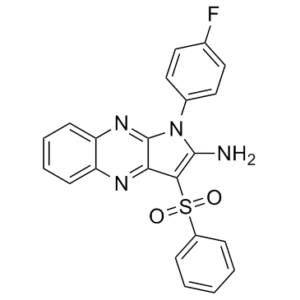
CAY10602 (CAY-10602) is a novel and potent SIRT1 activator. The nicotinamide adenine dinucleotide (NAD(+))-dependent protein deacetylase SIRT1 has been linked to fatty acid metabolism via suppression of peroxysome proliferator-activated receptor gamma (PPAR-gamma) and to inflammatory processes by deacetylating the transcription factor NF-kappaB. First, modulation of SIRT1 activity affects lipid accumulation in adipocytes, which has an impact on the etiology of a variety of human metabolic diseases such as obesity and insulin-resistant diabetes. Second, activation of SIRT1 suppresses inflammation via regulation of cytokine expression. Using high-throughput screening, the authors identified compounds with SIRT1 activating and inhibiting potential. The biological activity of these SIRT1-modulating compounds was confirmed in cell-based assays using mouse adipocytes, as well as human THP-1 monocytes. SIRT1 activators were found to be potent lipolytic agents, reducing the overall lipid content of fully differentiated NIH L1 adipocytes. In addition, the same compounds have anti-inflammatory properties, as became evident by the reduction of the proinflammatory cytokine tumor necrosis factor-alpha (TNF-alpha). In contrast, a SIRT1 inhibitory compound showed a stimulatory activity on the differentiation of adipocytes, a feature often linked to insulin sensitization.
Physicochemical Properties
| Molecular Formula | C22H15FN4O2S | |
| Molecular Weight | 418.45 | |
| Exact Mass | 418.089 | |
| CAS # | 374922-43-7 | |
| Related CAS # |
|
|
| PubChem CID | 1915791 | |
| Appearance | White to gray solid powder | |
| Density | 1.5±0.1 g/cm3 | |
| Boiling Point | 596.2±50.0 °C at 760 mmHg | |
| Melting Point | 270 °C | |
| Flash Point | 314.3±30.1 °C | |
| Vapour Pressure | 0.0±1.7 mmHg at 25°C | |
| Index of Refraction | 1.725 | |
| LogP | 4.27 | |
| Hydrogen Bond Donor Count | 1 | |
| Hydrogen Bond Acceptor Count | 6 | |
| Rotatable Bond Count | 3 | |
| Heavy Atom Count | 30 | |
| Complexity | 702 | |
| Defined Atom Stereocenter Count | 0 | |
| InChi Key | CSFVFDHRYKBBPD-UHFFFAOYSA-N | |
| InChi Code | InChI=1S/C22H15FN4O2S/c23-14-10-12-15(13-11-14)27-21(24)20(30(28,29)16-6-2-1-3-7-16)19-22(27)26-18-9-5-4-8-17(18)25-19/h1-13H,24H2 | |
| Chemical Name |
|
|
| Synonyms |
|
|
| HS Tariff Code | 2934.99.9001 | |
| Storage |
Powder-20°C 3 years 4°C 2 years In solvent -80°C 6 months -20°C 1 month |
|
| Shipping Condition | Room temperature (This product is stable at ambient temperature for a few days during ordinary shipping and time spent in Customs) |
Biological Activity
| ln Vitro | The mobilization of fat in differentiated adipocytes is significantly influenced by compounds (such as compound 1) and CAY10602/compound 1) that have SIRT1-activating capabilities. These compounds also have antiobesity and/or antidiabetic activities. At doses between 20 and 60 μM, compounds (like CAY10602) possessing SIRT1 activation potential strongly reduce the production of TNF-α[1]. | ||
| ln Vivo |
|
||
| Animal Protocol |
|
||
| References |
[1]. SIRT1 modulating compounds from high-throughput screening as anti-inflammatory and insulin-sensitizing agents. J Biomol Screen. 2006 Dec;11(8):959-67. |
Solubility Data
| Solubility (In Vitro) |
|
|||
| Solubility (In Vivo) |
Solubility in Formulation 1: ≥ 2.08 mg/mL (4.97 mM) (saturation unknown) in 10% DMSO + 40% PEG300 +5% Tween-80 + 45% Saline (add these co-solvents sequentially from left to right, and one by one), clear solution. For example, if 1 mL of working solution is to be prepared, you can add 100 μL of 20.8 mg/mL clear DMSO stock solution to 400 μL PEG300 and mix evenly; then add 50 μL Tween-80 + to the above solution and mix evenly; then add 450 μL normal saline to adjust the volume to 1 mL. Preparation of saline: Dissolve 0.9 g of sodium chloride in 100 mL ddH₂ O to obtain a clear solution. (Please use freshly prepared in vivo formulations for optimal results.) |
| Preparing Stock Solutions | 1 mg | 5 mg | 10 mg | |
| 1 mM | 2.3898 mL | 11.9489 mL | 23.8977 mL | |
| 5 mM | 0.4780 mL | 2.3898 mL | 4.7795 mL | |
| 10 mM | 0.2390 mL | 1.1949 mL | 2.3898 mL |