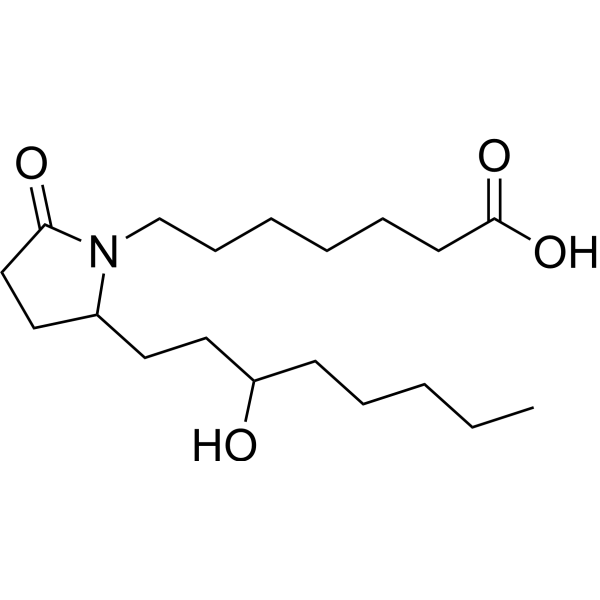
Physicochemical Properties
| Molecular Formula | C19H35NO4 |
| Molecular Weight | 341.49 |
| Exact Mass | 341.256 |
| CAS # | 64054-40-6 |
| PubChem CID | 44269516 |
| Appearance | Colorless to light yellow liquid |
| Density | 1.0±0.1 g/cm3 |
| Boiling Point | 534.4±25.0 °C at 760 mmHg |
| Flash Point | 277.0±23.2 °C |
| Vapour Pressure | 0.0±3.2 mmHg at 25°C |
| Index of Refraction | 1.494 |
| LogP | 2.88 |
| Hydrogen Bond Donor Count | 2 |
| Hydrogen Bond Acceptor Count | 4 |
| Rotatable Bond Count | 14 |
| Heavy Atom Count | 24 |
| Complexity | 372 |
| Defined Atom Stereocenter Count | 0 |
| SMILES | CCCCCC(CCC1CCC(=O)N1CCCCCCC(=O)O)O |
| InChi Key | CBWGHEDGUILASE-UHFFFAOYSA-N |
| InChi Code | InChI=1S/C19H35NO4/c1-2-3-6-9-17(21)13-11-16-12-14-18(22)20(16)15-8-5-4-7-10-19(23)24/h16-17,21H,2-15H2,1H3,(H,23,24) |
| Chemical Name | 7-[2-(3-hydroxyoctyl)-5-oxopyrrolidin-1-yl]heptanoic acid |
| HS Tariff Code | 2934.99.9001 |
| Storage |
Powder-20°C 3 years 4°C 2 years In solvent -80°C 6 months -20°C 1 month |
| Shipping Condition | Room temperature (This product is stable at ambient temperature for a few days during ordinary shipping and time spent in Customs) |
Biological Activity
| Targets | EP4 35 nM (Ki) EP2 3000 nM (Ki) EP3 2000 nM (Ki) EP1 >3000 nM (Ki) |
| ln Vitro | In MDCK cells, CAY10580 (10–10,000 nM; 40 min) dramatically raises the apical membrane abundance of AQP2 at 100–10,000 nM[2]. |
| ln Vivo | For three weeks, CAY10580 (200 μg/kg body weight; i.p.) successfully avoids diet-induced hypercholesterolemia and improves the production of endogenous bile acids and their excretion in the feces[3]. |
| Animal Protocol |
Animal/Disease Models: Six-week old male EP4+/+ mice (Treating high fat diet-challenged mice)[3] Doses: 200 μg/kg body weight Route of Administration: intraperitoneal (ip) injection; daily for remaining three weeks Experimental Results: High fat diet fed mice demonstrated lower total cholesterol levels compared to the vehicle group by 28.5%. Total Cholesterol levels diminished from 137.4 to 98.2 mg/dl, restoring plasma cholesterol back to near-normal values. |
| References |
[1]. Discovery of a potent and selective agonist of the prostaglandin EP4 receptor. Bioorg Med Chem Lett. 2003;13(6):1129-1132. [2]. Vasopressin-independent targeting of aquaporin-2 by selective E-prostanoid receptor agonists alleviates nephrogenic diabetes insipidus. Proc Natl Acad Sci U S A. 2011;108(31):12949-12954. [3]. EP4 emerges as a novel regulator of bile acid synthesis and its activation protects against hypercholesterolemia. Biochim Biophys Acta Mol Cell Biol Lipids. 2018;1863(9):1029-1040. |
| Additional Infomation | 2-(3-hydroxyoctyl)-5-oxo-1-pyrrolidineheptanoic acid is a pyrrolidin-2-one substituted by 6-carboxyhexyl and 3-hydroxyoctyl groups at positions 1 and 2, respectively. It is a potent prostaglandin EP4 receptor agonist (Ki=35 nM). It has a role as a prostaglandin receptor agonist. It is a member of pyrrolidin-2-ones, a hydroxy monocarboxylic acid and a secondary alcohol. |
Solubility Data
| Solubility (In Vitro) | May dissolve in DMSO (in most cases), if not, try other solvents such as H2O, Ethanol, or DMF with a minute amount of products to avoid loss of samples |
| Solubility (In Vivo) |
Note: Listed below are some common formulations that may be used to formulate products with low water solubility (e.g. < 1 mg/mL), you may test these formulations using a minute amount of products to avoid loss of samples. Injection Formulations (e.g. IP/IV/IM/SC) Injection Formulation 1: DMSO : Tween 80: Saline = 10 : 5 : 85 (i.e. 100 μL DMSO stock solution → 50 μL Tween 80 → 850 μL Saline) *Preparation of saline: Dissolve 0.9 g of sodium chloride in 100 mL ddH ₂ O to obtain a clear solution. Injection Formulation 2: DMSO : PEG300 :Tween 80 : Saline = 10 : 40 : 5 : 45 (i.e. 100 μL DMSO → 400 μLPEG300 → 50 μL Tween 80 → 450 μL Saline) Injection Formulation 3: DMSO : Corn oil = 10 : 90 (i.e. 100 μL DMSO → 900 μL Corn oil) Example: Take the Injection Formulation 3 (DMSO : Corn oil = 10 : 90) as an example, if 1 mL of 2.5 mg/mL working solution is to be prepared, you can take 100 μL 25 mg/mL DMSO stock solution and add to 900 μL corn oil, mix well to obtain a clear or suspension solution (2.5 mg/mL, ready for use in animals). Injection Formulation 4: DMSO : 20% SBE-β-CD in saline = 10 : 90 [i.e. 100 μL DMSO → 900 μL (20% SBE-β-CD in saline)] *Preparation of 20% SBE-β-CD in Saline (4°C,1 week): Dissolve 2 g SBE-β-CD in 10 mL saline to obtain a clear solution. Injection Formulation 5: 2-Hydroxypropyl-β-cyclodextrin : Saline = 50 : 50 (i.e. 500 μL 2-Hydroxypropyl-β-cyclodextrin → 500 μL Saline) Injection Formulation 6: DMSO : PEG300 : castor oil : Saline = 5 : 10 : 20 : 65 (i.e. 50 μL DMSO → 100 μLPEG300 → 200 μL castor oil → 650 μL Saline) Injection Formulation 7: Ethanol : Cremophor : Saline = 10: 10 : 80 (i.e. 100 μL Ethanol → 100 μL Cremophor → 800 μL Saline) Injection Formulation 8: Dissolve in Cremophor/Ethanol (50 : 50), then diluted by Saline Injection Formulation 9: EtOH : Corn oil = 10 : 90 (i.e. 100 μL EtOH → 900 μL Corn oil) Injection Formulation 10: EtOH : PEG300:Tween 80 : Saline = 10 : 40 : 5 : 45 (i.e. 100 μL EtOH → 400 μLPEG300 → 50 μL Tween 80 → 450 μL Saline) Oral Formulations Oral Formulation 1: Suspend in 0.5% CMC Na (carboxymethylcellulose sodium) Oral Formulation 2: Suspend in 0.5% Carboxymethyl cellulose Example: Take the Oral Formulation 1 (Suspend in 0.5% CMC Na) as an example, if 100 mL of 2.5 mg/mL working solution is to be prepared, you can first prepare 0.5% CMC Na solution by measuring 0.5 g CMC Na and dissolve it in 100 mL ddH2O to obtain a clear solution; then add 250 mg of the product to 100 mL 0.5% CMC Na solution, to make the suspension solution (2.5 mg/mL, ready for use in animals). Oral Formulation 3: Dissolved in PEG400 Oral Formulation 4: Suspend in 0.2% Carboxymethyl cellulose Oral Formulation 5: Dissolve in 0.25% Tween 80 and 0.5% Carboxymethyl cellulose Oral Formulation 6: Mixing with food powders Note: Please be aware that the above formulations are for reference only. InvivoChem strongly recommends customers to read literature methods/protocols carefully before determining which formulation you should use for in vivo studies, as different compounds have different solubility properties and have to be formulated differently. (Please use freshly prepared in vivo formulations for optimal results.) |
| Preparing Stock Solutions | 1 mg | 5 mg | 10 mg | |
| 1 mM | 2.9283 mL | 14.6417 mL | 29.2834 mL | |
| 5 mM | 0.5857 mL | 2.9283 mL | 5.8567 mL | |
| 10 mM | 0.2928 mL | 1.4642 mL | 2.9283 mL |