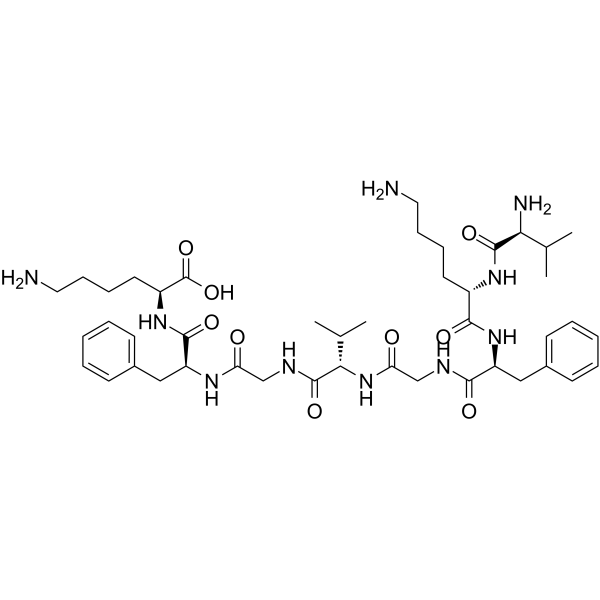
Physicochemical Properties
| Molecular Formula | C₄₄H₆₈N₁₀O₉ |
| Molecular Weight | 881.07 |
| Exact Mass | 880.517 |
| CAS # | 261969-05-5 |
| PubChem CID | 10033623 |
| Appearance | White to off-white solid powder |
| LogP | 3.947 |
| Hydrogen Bond Donor Count | 11 |
| Hydrogen Bond Acceptor Count | 12 |
| Rotatable Bond Count | 29 |
| Heavy Atom Count | 63 |
| Complexity | 1470 |
| Defined Atom Stereocenter Count | 6 |
| SMILES | CC(C)[C@@H](C(=O)N[C@@H](CCCCN)C(=O)N[C@@H](CC1=CC=CC=C1)C(=O)NCC(=O)N[C@@H](C(C)C)C(=O)NCC(=O)N[C@@H](CC2=CC=CC=C2)C(=O)N[C@@H](CCCCN)C(=O)O)N |
| InChi Key | OBMFGXCPBIYSPH-FFIZALLVSA-N |
| InChi Code | InChI=1S/C44H68N10O9/c1-27(2)37(47)42(60)51-31(19-11-13-21-45)40(58)53-33(23-29-15-7-5-8-16-29)39(57)48-26-36(56)54-38(28(3)4)43(61)49-25-35(55)50-34(24-30-17-9-6-10-18-30)41(59)52-32(44(62)63)20-12-14-22-46/h5-10,15-18,27-28,31-34,37-38H,11-14,19-26,45-47H2,1-4H3,(H,48,57)(H,49,61)(H,50,55)(H,51,60)(H,52,59)(H,53,58)(H,54,56)(H,62,63)/t31-,32-,33-,34-,37-,38-/m0/s1 |
| Chemical Name | (2S)-6-amino-2-[[(2S)-2-[[2-[[(2S)-2-[[2-[[(2S)-2-[[(2S)-6-amino-2-[[(2S)-2-amino-3-methylbutanoyl]amino]hexanoyl]amino]-3-phenylpropanoyl]amino]acetyl]amino]-3-methylbutanoyl]amino]acetyl]amino]-3-phenylpropanoyl]amino]hexanoic acid |
| Synonyms | CALP-3; CALP 3 |
| HS Tariff Code | 2934.99.9001 |
| Storage |
Powder-20°C 3 years 4°C 2 years In solvent -80°C 6 months -20°C 1 month Note: Please store this product in a sealed and protected environment, avoid exposure to moisture. |
| Shipping Condition | Room temperature (This product is stable at ambient temperature for a few days during ordinary shipping and time spent in Customs) |
Biological Activity
| ln Vitro | Glutamate-induced substantial and sustained increase in [Ca2+]i is inhibited in a dose-dependent manner (IC50=37.25 μM) by CALP3 (50, 100, 150, 200 μM) in neuronal cells loaded with Fura-2 [1]. In cultured rat neocortical neurons, CALP3 (50, 100, 150, and 200 μM) reduces glutamate-induced cytotoxicity in a dose-dependent manner (IC50=50.97 μM). Apoptosis is dose-dependently inhibited by CALP3 (IC50 = 33.41 μM) [1]. Human T cell apoptosis mediated by HIV gp120 and SAg is inhibited by CALP3 (100 μM) [1]. Gossypol-induced necrosis is decreased and the percentage of viable cells is increased by CALP3 (100 μM; 15 min pretreatment) [2]. Fmoc-Asp(PEG-PS)-OA1 was the starting point for the synthesis of Cyclic-CALP3. Ca21 inflow was not inhibited by cyclic CALP3, and this peptide was used as a negative control. Glutamate's actions are not inhibited by cyclic CALP3 [1]. |
| References |
[1]. A new type of Ca(2+) channel blocker that targets Ca(2+) sensors and prevents Ca(2+)-mediated apoptosis. FASEB J. 2000 Jul;14(10):1297-306. [2]. BH3 mimetic-elicited Ca2+ signals in pancreatic acinar cells are dependent on Bax and can be reduced by Ca2+-like peptides. Cell Death Dis. 2017 Mar 2;8(3):e2640. |
Solubility Data
| Solubility (In Vitro) | DMSO : ~12.5 mg/mL (~14.19 mM) |
| Solubility (In Vivo) |
Solubility in Formulation 1: ≥ 1.25 mg/mL (1.42 mM) (saturation unknown) in 10% DMSO + 40% PEG300 + 5% Tween80 + 45% Saline (add these co-solvents sequentially from left to right, and one by one), clear solution. For example, if 1 mL of working solution is to be prepared, you can add 100 μL of 12.5 mg/mL clear DMSO stock solution to 400 μL PEG300 and mix evenly; then add 50 μL Tween-80 to the above solution and mix evenly; then add 450 μL normal saline to adjust the volume to 1 mL. Preparation of saline: Dissolve 0.9 g of sodium chloride in 100 mL ddH₂ O to obtain a clear solution. Solubility in Formulation 2: ≥ 1.25 mg/mL (1.42 mM) (saturation unknown) in 10% DMSO + 90% (20% SBE-β-CD in Saline) (add these co-solvents sequentially from left to right, and one by one), clear solution. For example, if 1 mL of working solution is to be prepared, you can add 100 μL of 12.5 mg/mL clear DMSO stock solution to 900 μL of 20% SBE-β-CD physiological saline solution and mix evenly. Preparation of 20% SBE-β-CD in Saline (4°C,1 week): Dissolve 2 g SBE-β-CD in 10 mL saline to obtain a clear solution. Solubility in Formulation 3: ≥ 1.25 mg/mL (1.42 mM) (saturation unknown) in 10% DMSO + 90% Corn Oil (add these co-solvents sequentially from left to right, and one by one), clear solution. For example, if 1 mL of working solution is to be prepared, you can add 100 μL of 12.5 mg/mL clear DMSO stock solution to 900 μL of corn oil and mix evenly. (Please use freshly prepared in vivo formulations for optimal results.) |
| Preparing Stock Solutions | 1 mg | 5 mg | 10 mg | |
| 1 mM | 1.1350 mL | 5.6749 mL | 11.3498 mL | |
| 5 mM | 0.2270 mL | 1.1350 mL | 2.2700 mL | |
| 10 mM | 0.1135 mL | 0.5675 mL | 1.1350 mL |