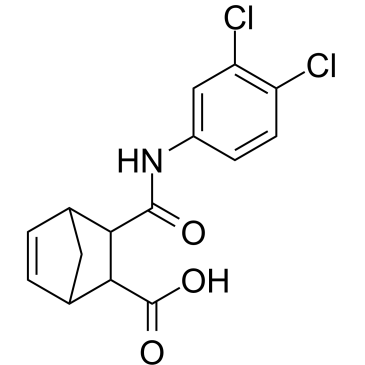
CADD522 is a novel and potent inhibitor of runt-related transcription factor-2 (RUNX2)-DNA binding with an IC50 of 10 nM. CADD522 has potential antitumor activity.
Physicochemical Properties
| Molecular Formula | C15H13CL2NO3 |
| Molecular Weight | 326.174622297287 |
| Exact Mass | 325.027 |
| CAS # | 199735-88-1 |
| PubChem CID | 2834870 |
| Appearance | White to off-white solid powder |
| LogP | 2.9 |
| Hydrogen Bond Donor Count | 2 |
| Hydrogen Bond Acceptor Count | 3 |
| Rotatable Bond Count | 3 |
| Heavy Atom Count | 21 |
| Complexity | 482 |
| Defined Atom Stereocenter Count | 0 |
| SMILES | ClC1=C(C=CC(=C1)NC(C1C(C(=O)O)[C@@H]2C=C[C@H]1C2)=O)Cl |
| InChi Key | YSDNWNOGHQYWPK-UHFFFAOYSA-N |
| InChi Code | InChI=1S/C15H13Cl2NO3/c16-10-4-3-9(6-11(10)17)18-14(19)12-7-1-2-8(5-7)13(12)15(20)21/h1-4,6-8,12-13H,5H2,(H,18,19)(H,20,21) |
| Chemical Name | 3-[(3,4-dichlorophenyl)carbamoyl]bicyclo[2.2.1]hept-5-ene-2-carboxylic acid |
| Synonyms | CADD 522 CADD-522 CADD522 |
| HS Tariff Code | 2934.99.9001 |
| Storage |
Powder-20°C 3 years 4°C 2 years In solvent -80°C 6 months -20°C 1 month Note: Please store this product in a sealed and protected environment (e.g. under nitrogen), avoid exposure to moisture. |
| Shipping Condition | Room temperature (This product is stable at ambient temperature for a few days during ordinary shipping and time spent in Customs) |
Biological Activity
| ln Vitro | BC cell proliferation and quartering are strongly inhibited by CADD522 (0-100 μM; 24-72 h) [1]. CADD522 (50 μM; 72 h) induces the G1 phase of the cell cycle, which has anti-replication effects. Tumor sphere formation is inhibited by CADD522 (50 μM; 8 days) and in vitro BC cytotoxicity is not observed (50 μM; 24 hours). [1]. 52, 10, 25, 50, 100 μM; 48) in CADD522. h) RUNX2-DNA binding in T47D-Empty cells and transcription of T47D-RUNX2 to regulate RUNX2 transcription [1]. By making RUNX2 more stable in cells, CADD522 (50 μM; 72 h) increases RUNX2 levels [1]. In MCF7 and MDA-468 cells, CADD522 (50 μM; 6 or 24 h) enhances the formation of ROS within the mitochondria [2]. In MDA-231 and MDA-468 cells, the mitochondrial cell viability assay is inhibited by CADD522 (0 -2000 nM, 30 min) [1]. |
| ln Vivo | Tumor growth is inhibited and tumor start is delayed in mice when CADD522 (1, 5, and 20 mg/kg) is administered intraperitoneally twice a week for 45 days [1]. CADD522 (10 mg/kg; twice weekly intraperitoneal injection) |
| Cell Assay |
Cell Viability Assay[1] Cell Types: MDA-MB-468, MCF7, MCF10A, IEC-6, GES-1 and C2C12 cells Tested Concentrations: 0-100 μM Incubation Duration: 24-72 h. Experimental Results: Dose- and time-dependent cell growth inhibition was demonstrated within 72 hrs (hours). Exhibits low cytotoxicity to normal cell growth. Cell cycle analysis[1] Cell Types: MCF7, MDA-468 and MDA-231 Cell Tested Concentrations: 50 μM Incubation Duration: 72 hrs (hours) Experimental Results: MDA-231 cells were induced to accumulate in G1 and G2/M phases, while MCF7 and MDA-468 Cells accumulate in G1 and G2/M phases. Cells are in G1 phase. Cell viability assay [1] Cell Types: MCF7, MCF7-tet-off Cell Tested Concentrations: 50 μM Incubation Duration: 8 days Experimental Results: The size and number of tumor spheres were Dramatically diminished, and the tumor spheres were severely destroyed on the 4th day. Relatively selective effect on BC cells (no significant effect on mammosphere formation of MCF10A non-malignant mammary epithelial cells). Cell invasion test[1] Cell Types: MCF7-tet-off (+Doxy), MCF7-tet-of |
| Animal Protocol |
Animal/Disease Models: Female mice (6 weeks old; MMTV-PyMT transgenic model) [1]. twice for 11 days). Doses: 1, 5 and 20 mg/kg Route of Administration: intraperitoneal (ip) injection; twice weekly for 45 days. Experimental Results: Delayed tumor onset, delayed tumor development and diminished tumor burden in transgenic MMTV-PyMT mice. Reduce tumor weight in mice. Animal/Disease Models: Female NOD scid gamma (NSG) mice and nude mice (TNBC-PDX Br-001 model) [1]. Doses: 10 mg/kg Route of Administration: intraperitoneal (ip) injection; twice weekly for 11 days. Experimental Results: Tumor volume was Dramatically diminished, and Ki-67 expression was Dramatically inhibited. Inhibits experimental in vivo metastasis of BC cells (without Dramatically reducing body weight or affecting the overall health of the animal). |
| References |
[1]. Characterization of CADD522, a small molecule that inhibits RUNX2-DNA binding and exhibits antitumor activity. Oncotarget. 2017 Aug 10;8(41):70916-70940. [2]. Targeting breast cancer metabolism with a novel inhibitor of mitochondrial ATP synthesis. Oncotarget. 2020 Oct 27;11(43):3863-3885. |
Solubility Data
| Solubility (In Vitro) | DMSO : ~250 mg/mL (~766.47 mM) |
| Solubility (In Vivo) |
Solubility in Formulation 1: ≥ 2.17 mg/mL (6.65 mM) (saturation unknown) in 10% DMSO + 40% PEG300 + 5% Tween80 + 45% Saline (add these co-solvents sequentially from left to right, and one by one), clear solution. For example, if 1 mL of working solution is to be prepared, you can add 100 μL of 21.7 mg/mL clear DMSO stock solution to 400 μL PEG300 and mix evenly; then add 50 μL Tween-80 to the above solution and mix evenly; then add 450 μL normal saline to adjust the volume to 1 mL. Preparation of saline: Dissolve 0.9 g of sodium chloride in 100 mL ddH₂ O to obtain a clear solution. Solubility in Formulation 2: ≥ 2.17 mg/mL (6.65 mM) (saturation unknown) in 10% DMSO + 90% Corn Oil (add these co-solvents sequentially from left to right, and one by one), clear solution. For example, if 1 mL of working solution is to be prepared, you can add 100 μL of 21.7 mg/mL clear DMSO stock solution to 900 μL of corn oil and mix evenly. (Please use freshly prepared in vivo formulations for optimal results.) |
| Preparing Stock Solutions | 1 mg | 5 mg | 10 mg | |
| 1 mM | 3.0659 mL | 15.3294 mL | 30.6589 mL | |
| 5 mM | 0.6132 mL | 3.0659 mL | 6.1318 mL | |
| 10 mM | 0.3066 mL | 1.5329 mL | 3.0659 mL |