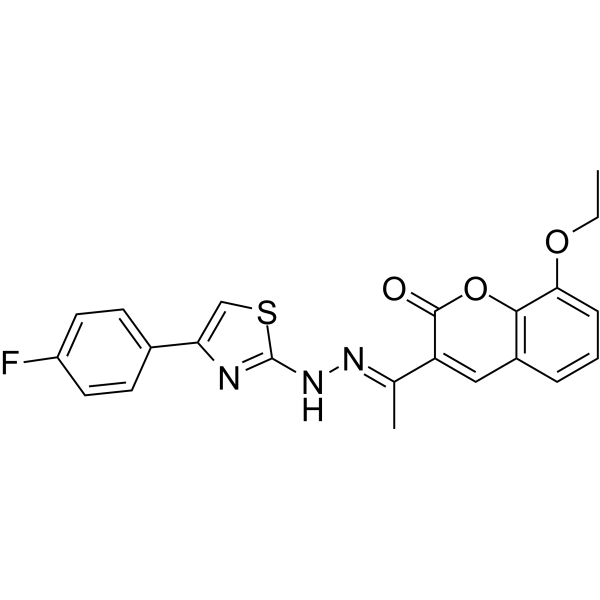
Physicochemical Properties
| Molecular Formula | C22H18FN3O3S |
| Molecular Weight | 423.46 |
| Appearance | Typically exists as solid at room temperature |
| HS Tariff Code | 2934.99.9001 |
| Storage |
Powder-20°C 3 years 4°C 2 years In solvent -80°C 6 months -20°C 1 month |
| Shipping Condition | Room temperature (This product is stable at ambient temperature for a few days during ordinary shipping and time spent in Customs) |
Biological Activity
| Targets | VEGFR-2 32.1 nM (IC50) CA Ⅸ 3.1 μM (Ki) |
| ln Vitro | CA IX/VEGFR-2-IN-2 (compound 5e) showed selectivity for reactive tumor cells in the order of PANC1, followed by MCF7 and PC3 and reduced the migration of PANC1 cells[1]. CA IX/VEGFR-2-IN-2 (compound 5e) induced upregulation of p53, BAX, cytochrome C and caspases 3, 8, 9 expression and downregulation of Bcl-2 gene expression in pancreatic cancer cells, leading to cell apoptosis[1]. CA IX/VEGFR-2-IN-2 (compound 5e) inhibited HIF-1α expression from 6.1±0.13 ng/mL to 3.7±0.09 ng/mL, with an inhibition amplitude of more than 1.5-fold in PANC1 cells[1]. CA IX/VEGFR-2-IN-2 (compound 5e) caused abnormal increase in ROS formation leading to cell cycle arrest or apoptosis in PANC1 cells[1]. Cell Proliferation Assay[1] Cell Line: PANC1 , MCF7 and PC3 cell lines Concentration: Incubation Time: Result: Had a better growthinhibition effect on PANC1 and MCF7 cell lines, with IC50 values of 1.04 μM and 1.40 μM, had lower inhibitory effects against PC3, with an IC50 greater than 5 μM. Cell Cycle Analysis[1] Cell Line: PANC1 lines Concentration: Incubation Time: 24 h Result: Increased the early apoptosis ratio from 0.37% (DMSO) to 21.39%, as did the late apoptosis ratio from 0.18 → 11.11. |
| ln Vivo | CA IX/VEGFR-2-IN-2 (compound 5e) (5 and 10 mg/kg, i.p. for two weeks) reduces tumor volume and weight in female Swiss albino mice more than the standard drug DOX (10 mg/ kg) are more effective [1]. CA IX/VEGFR-2-IN-2 (compound 5e) (5 and 10 mg/kg, i.p. for 2 weeks) Injection of 10 mg/kg into female Swiss albino mice results in VEGF, MMP-2 and MMP-9 further decrease in concentration [1]. CA IX/VEGFR-2-IN-2 (compound 5e) (5 and 10 mg/kg, i.p., for two weeks) Injection of 5 mg/kg into female Swiss albino mice resulted in the formation of necrotic areas dispersed with different of tumor cells, while there was a significant improvement at the dose of 10 mg/kg. The diffuse and extensive necrotic areas in the muscle bundles were replaced, and the number of tumor cells was significantly reduced, indicating a substantial effect on viable tumor cells. Inhibit[1]. |
| Animal Protocol |
Animal/Disease Models:solid Ehrlich carcinoma (SEC) Doses: 5 and 10 mg/kg Route of Administration: Experimental Results: Led to a 47.28% decrease in tumor volume and a 55.42% decrease in tumor weight at a dose of 5 mg/kg compared to the solid Ehrlich carcinoma. Led to a 65.88% reduction in the volume of the tumor and a 75.71% decrease in tumor weight at a dose of 10 mg/kg relative to the control group of SEC. |
| References |
[1]. Discovery and Mechanistic Studies of Dual-Target Hits for Carbonic Anhydrase IX and VEGFR-2 as Potential Agents for Solid Tumors: X-ray, In Vitro, In Vivo, and In Silico Investigations of Coumarin-Based Thiazoles[J]. Journal of Medicinal Chemistry, 2024. |
Solubility Data
| Solubility (In Vitro) | May dissolve in DMSO (in most cases), if not, try other solvents such as H2O, Ethanol, or DMF with a minute amount of products to avoid loss of samples |
| Solubility (In Vivo) |
Note: Listed below are some common formulations that may be used to formulate products with low water solubility (e.g. < 1 mg/mL), you may test these formulations using a minute amount of products to avoid loss of samples. Injection Formulations (e.g. IP/IV/IM/SC) Injection Formulation 1: DMSO : Tween 80: Saline = 10 : 5 : 85 (i.e. 100 μL DMSO stock solution → 50 μL Tween 80 → 850 μL Saline) *Preparation of saline: Dissolve 0.9 g of sodium chloride in 100 mL ddH ₂ O to obtain a clear solution. Injection Formulation 2: DMSO : PEG300 :Tween 80 : Saline = 10 : 40 : 5 : 45 (i.e. 100 μL DMSO → 400 μLPEG300 → 50 μL Tween 80 → 450 μL Saline) Injection Formulation 3: DMSO : Corn oil = 10 : 90 (i.e. 100 μL DMSO → 900 μL Corn oil) Example: Take the Injection Formulation 3 (DMSO : Corn oil = 10 : 90) as an example, if 1 mL of 2.5 mg/mL working solution is to be prepared, you can take 100 μL 25 mg/mL DMSO stock solution and add to 900 μL corn oil, mix well to obtain a clear or suspension solution (2.5 mg/mL, ready for use in animals). Injection Formulation 4: DMSO : 20% SBE-β-CD in saline = 10 : 90 [i.e. 100 μL DMSO → 900 μL (20% SBE-β-CD in saline)] *Preparation of 20% SBE-β-CD in Saline (4°C,1 week): Dissolve 2 g SBE-β-CD in 10 mL saline to obtain a clear solution. Injection Formulation 5: 2-Hydroxypropyl-β-cyclodextrin : Saline = 50 : 50 (i.e. 500 μL 2-Hydroxypropyl-β-cyclodextrin → 500 μL Saline) Injection Formulation 6: DMSO : PEG300 : castor oil : Saline = 5 : 10 : 20 : 65 (i.e. 50 μL DMSO → 100 μLPEG300 → 200 μL castor oil → 650 μL Saline) Injection Formulation 7: Ethanol : Cremophor : Saline = 10: 10 : 80 (i.e. 100 μL Ethanol → 100 μL Cremophor → 800 μL Saline) Injection Formulation 8: Dissolve in Cremophor/Ethanol (50 : 50), then diluted by Saline Injection Formulation 9: EtOH : Corn oil = 10 : 90 (i.e. 100 μL EtOH → 900 μL Corn oil) Injection Formulation 10: EtOH : PEG300:Tween 80 : Saline = 10 : 40 : 5 : 45 (i.e. 100 μL EtOH → 400 μLPEG300 → 50 μL Tween 80 → 450 μL Saline) Oral Formulations Oral Formulation 1: Suspend in 0.5% CMC Na (carboxymethylcellulose sodium) Oral Formulation 2: Suspend in 0.5% Carboxymethyl cellulose Example: Take the Oral Formulation 1 (Suspend in 0.5% CMC Na) as an example, if 100 mL of 2.5 mg/mL working solution is to be prepared, you can first prepare 0.5% CMC Na solution by measuring 0.5 g CMC Na and dissolve it in 100 mL ddH2O to obtain a clear solution; then add 250 mg of the product to 100 mL 0.5% CMC Na solution, to make the suspension solution (2.5 mg/mL, ready for use in animals). Oral Formulation 3: Dissolved in PEG400 Oral Formulation 4: Suspend in 0.2% Carboxymethyl cellulose Oral Formulation 5: Dissolve in 0.25% Tween 80 and 0.5% Carboxymethyl cellulose Oral Formulation 6: Mixing with food powders Note: Please be aware that the above formulations are for reference only. InvivoChem strongly recommends customers to read literature methods/protocols carefully before determining which formulation you should use for in vivo studies, as different compounds have different solubility properties and have to be formulated differently. (Please use freshly prepared in vivo formulations for optimal results.) |
| Preparing Stock Solutions | 1 mg | 5 mg | 10 mg | |
| 1 mM | 2.3615 mL | 11.8075 mL | 23.6150 mL | |
| 5 mM | 0.4723 mL | 2.3615 mL | 4.7230 mL | |
| 10 mM | 0.2361 mL | 1.1807 mL | 2.3615 mL |