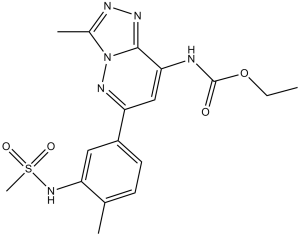
Bromosporine is a novel, potent and broad spectrum inhibitor against BET bromodomains with potential use as a chemical probe for bromodomain functional assays. It inhibits BRD2, BRD4, BRD9 and CECR2 with IC50s of 0.41 μM, 0.29 μM, 0.122 μM and 0.017 μM, respectively. Bromodomains (BRDs) are protein interaction modules that read epigenetic marks recognizing ε-N-lysine acetylation motifs. Bromodomains is a 110 amino acid protein domain which can recognize monoacetylated lysine residues and play a pivotal role in the targeting of chromatin-modifying enzymes to specific sites. It has been revealed that proteins contained BRDs involves in the development of many diseases, including cancers, inflammatory diseases and neurological diseases.
Physicochemical Properties
| Molecular Formula | C17H20N6O4S | |
| Molecular Weight | 404.44 | |
| Exact Mass | 404.126 | |
| CAS # | 1619994-69-2 | |
| Related CAS # |
|
|
| PubChem CID | 72943187 | |
| Appearance | White to off-white solid powder | |
| Density | 1.5±0.1 g/cm3 | |
| Index of Refraction | 1.677 | |
| LogP | 1.21 | |
| Hydrogen Bond Donor Count | 2 | |
| Hydrogen Bond Acceptor Count | 8 | |
| Rotatable Bond Count | 6 | |
| Heavy Atom Count | 28 | |
| Complexity | 657 | |
| Defined Atom Stereocenter Count | 0 | |
| InChi Key | UYBRROMMFMPJAN-UHFFFAOYSA-N | |
| InChi Code | InChI=1S/C17H20N6O4S/c1-5-27-17(24)18-15-9-14(21-23-11(3)19-20-16(15)23)12-7-6-10(2)13(8-12)22-28(4,25)26/h6-9,22H,5H2,1-4H3,(H,18,24) | |
| Chemical Name | Ethyl (3-methyl-6-(4-methyl-3-(methylsulfonamido)phenyl)-[1,2,4]triazolo[4,3-b]pyridazin-8-yl)carbamate | |
| Synonyms | Bromosporine | |
| HS Tariff Code | 2934.99.9001 | |
| Storage |
Powder-20°C 3 years 4°C 2 years In solvent -80°C 6 months -20°C 1 month |
|
| Shipping Condition | Room temperature (This product is stable at ambient temperature for a few days during ordinary shipping and time spent in Customs) |
Biological Activity
| ln Vitro | Bromosporine (0-1000 nM; 72 hours) synergizes with 5-FU to reduce the proliferation of CRC cells [1]. Bromosporine (various concentrations; 48 hours) when coupled with 5-FU results in a considerable increase in the number of cells arrested in the G1 phase [1]. Bromosporine (various concentrations; 48 h) decreases PARP, caspase 3 and 9 expression [1]. Bromosporine (0.1, 0.5 and 1 μM; 6-10 days) suppresses AML cells in a dose-dependent manner [3]. Bromosporine (2.5 μM; 72 hours) triggers HIV-1 replication in latent HIV-1 J-Lat clone C11 cells in vitro [4]. Bromosporine (1-50 μM; 48 h) did not generate substantial toxicity in primary CD4+ T cells [4]. |
| ln Vivo | Bromosporine (100 mg/kg; intraperitoneal injection; once daily for 10 days) shown superior anti-tumor effectiveness when used in conjunction with 5-FU as opposed to when used alone [1]. |
| Cell Assay |
Cell Proliferation Assay[1] Cell Types: HCT116 and HT29 Tested Concentrations: 0, 30, 60, 120, 240, 480 and 1000 nM Incubation Duration: 72 h Experimental Results: Synergistically inhibited cell growth in CRC cells with 5-FU (0-16 μg/mL) and demonstrated a dose-dependent manner. Cell Cycle Analysis[1] Cell Types: HCT116 and HT29 Tested Concentrations: Various concentration Incubation Duration: 48 h Experimental Results: Caused a distinct increase in the cells arrested at G1 phase when combined with 5 -FU. Western Blot Analysis[1] Cell Types: HCT116 and HT29 Tested Concentrations: Various concentration Incubation Duration: 48 h Experimental Results: Elevated the level of apoptosis in both cell lines through cleavage of PARP, caspase 3, and 9. Cell Proliferation Assay[3] Cell Types: MV4;11, KASUMI-1, OCI-AML3 and K562 Tested Concentrations: 0.1, 0.5 and 1 μM Incubation Duration: 6-10 days Experimental Results: Inhibited these AML cells in a dose-dependent manner. Cell Cytotoxicity Assay[4] Cell Types: PBMCs Tested Concentrations: 1 μM, 2.5 μM, 5 μM, 10 μM, 25 μM and 50 μM Incubation Duration: 48 h Experimental Results: Did |
| Animal Protocol |
Animal/Disease Models: Female BALB/c nude mice (5-6 weeks; injected with 1 × 10⁶ cells/100 μL of HT116 cells)[1] Doses: 100 mg/kg Route of Administration: ip; daily for 10 days Experimental Results: demonstrated better antitumor activity than individual Bromosporine or 5-FU when co-treated with the two agents. |
| References |
[1]. BET inhibitor bromosporine enhances 5-FU effect in colorectal cancer cells. Biochem Biophys Res Commun. 2020 Jan 22;521(4):840-845. [2]. From triazolophthalazines to triazoloquinazolines: A bioisosterism-guided approach toward the identification of novel PCAF inhibitors with potential anticancer activity. Bioorg Med Chem. 2021 Jul 15;42:116266. [3]. Promiscuous targeting of bromodomains by bromosporine identifies BET proteins as master regulators of primary transcription response in leukemia. Sci Adv. 2016 Oct 12;2(10):e1600760. [4]. The bromodomain and extraterminal domain inhibitor bromosporine synergistically reactivates latent HIV-1 in latently infected cells. Oncotarget. 2017 Oct 6;8(55):94104-94116. |
Solubility Data
| Solubility (In Vitro) |
|
|||
| Solubility (In Vivo) |
Solubility in Formulation 1: ≥ 2.5 mg/mL (6.18 mM) (saturation unknown) in 10% DMSO + 90% Corn Oil (add these co-solvents sequentially from left to right, and one by one), clear solution. For example, if 1 mL of working solution is to be prepared, you can add 100 μL of 25.0 mg/mL clear DMSO stock solution to 900 μL of corn oil and mix evenly. (Please use freshly prepared in vivo formulations for optimal results.) |
| Preparing Stock Solutions | 1 mg | 5 mg | 10 mg | |
| 1 mM | 2.4726 mL | 12.3628 mL | 24.7255 mL | |
| 5 mM | 0.4945 mL | 2.4726 mL | 4.9451 mL | |
| 10 mM | 0.2473 mL | 1.2363 mL | 2.4726 mL |