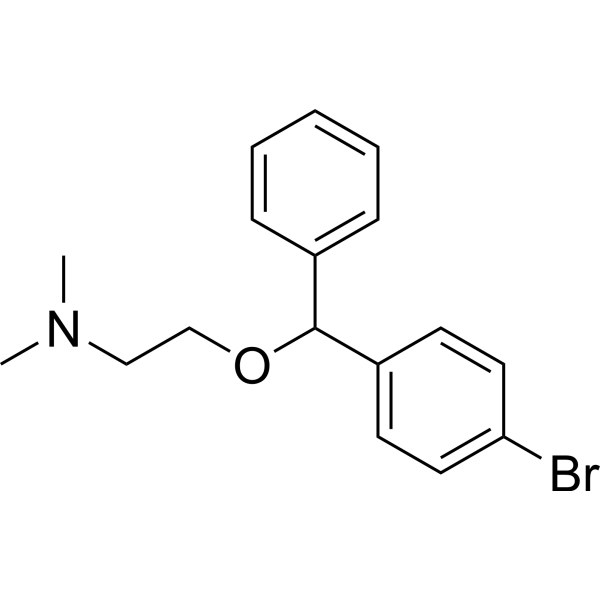
Physicochemical Properties
| Molecular Formula | C17H20NOBR |
| Molecular Weight | 334.2508 |
| Exact Mass | 333.073 |
| CAS # | 118-23-0 |
| Related CAS # | Bromodiphenhydramine hydrochloride;1808-12-4 |
| PubChem CID | 2444 |
| Appearance | Typically exists as solid at room temperature |
| Density | 1.259g/cm3 |
| Boiling Point | 397.3ºC at 760mmHg |
| Flash Point | 194.1ºC |
| LogP | 4.116 |
| Hydrogen Bond Donor Count | 0 |
| Hydrogen Bond Acceptor Count | 2 |
| Rotatable Bond Count | 6 |
| Heavy Atom Count | 20 |
| Complexity | 258 |
| Defined Atom Stereocenter Count | 0 |
| SMILES | CN(CCOC(C1=CC=CC=C1)C2=CC=CC=C2)CBr |
| InChi Key | NUNIWXHYABYXKF-UHFFFAOYSA-N |
| InChi Code | InChI=1S/C17H20BrNO/c1-19(2)12-13-20-17(14-6-4-3-5-7-14)15-8-10-16(18)11-9-15/h3-11,17H,12-13H2,1-2H3 |
| Chemical Name | 2-[(4-bromophenyl)-phenylmethoxy]-N,N-dimethylethanamine |
| HS Tariff Code | 2934.99.9001 |
| Storage |
Powder-20°C 3 years 4°C 2 years In solvent -80°C 6 months -20°C 1 month |
| Shipping Condition | Room temperature (This product is stable at ambient temperature for a few days during ordinary shipping and time spent in Customs) |
Biological Activity
| ln Vivo | Bromdiphenhydramine (1.5 and 3 μg/g, single dose) prevents mice from being challenged with a virulent strain of Salmonella typhimurium and causes the liver, spleen, and kidneys of protected animals to significantly decrease in comparison to unprotected controls. as well as the microbial growth in the blood [2]. |
| ADME/Pharmacokinetics |
Absorption, Distribution and Excretion Well absorbed in the digestive tract. Metabolism / Metabolites Hepatic (cytochrome P-450 system); some renal. Hepatic (cytochrome P-450 system); some renal. Half Life: 1 to 4 hours Biological Half-Life 1 to 4 hours |
| Toxicity/Toxicokinetics |
Toxicity Summary Bromodiphenhydramine competes with free histamine for binding at HA-receptor sites. This antagonizes the effects of histamine on HA-receptors, leading to a reduction of the negative symptoms brought on by histamine HA-receptor binding. Protein Binding 96% |
| References |
[1]. MOLINA EB. [A new antihistaminic, bromodiphenhydramine hydrochloride, in the control of cutaneous allergies]. Sem Med. 1960 Jul 11;117:151-2. Spanish. [2]. Antibacterial activity of ambodryl and benadryl. J Appl Bacteriol. 1976 Oct;41(2):209-14. [3]. Studies on synergism between penicillins and ambodryl (bromodiphenhydramine HCl), an antihistamine with antimicrobial property. Indian J Exp Biol. 1990 Mar;28(3):253-8. |
| Additional Infomation |
Bromazine is a tertiary amino compound that is the 4-bromobenzhydryl ether of 2-(dimethylamino)ethanol. An antihistamine with antimicrobial properties, it is used in the control of cutaneous allergies. It has a role as an antimicrobial agent, a muscarinic antagonist and a H1-receptor antagonist. It is a tertiary amino compound and an organobromine compound. It contains a bromazine hydrochloride. Bromodiphenhydramine is an ethanolamine antihistamine with antimicrobial property. Bromodiphenhydramine is used in the control of cutaneous allergies. Ethanolamine antihistamines produce marked sedation in most patients. Bromodiphenhydramine is a brominated derivative of diphenhydramine, an ethanolamine derivative and histamine H1 receptor antagonist with anti-allergic, sedative, antiemetic and anticholinergic properties. Bromazine competitively and selectively blocks central and peripheral histamine H1 receptors, thereby alleviating the symptoms caused by endogenous histamine on bronchial, capillary and gastrointestinal (GI) smooth muscles. This prevents histamine-induced bronchoconstriction, vasodilation, increased capillary permeability, itching, and spasmodic contractions of GI smooth muscle. In addition, bromazine binds to and blocks peripheral and central muscarinic receptors. Bromodiphenhydramine is only found in individuals that have used or taken this drug. It is an ethanolamine antihistamine with antimicrobial property. Bromodiphenhydramine is used in the control of cutaneous allergies. Ethanolamine antihistamines produce marked sedation in most patients. Bromodiphenhydramine competes with free histamine for binding at HA-receptor sites. This antagonizes the effects of histamine on HA-receptors, leading to a reduction of the negative symptoms brought on by histamine HA-receptor binding. Drug Indication For management of symptoms related to hay fever and other types of allergy and used to help bring up phlegm, thin secretions, and make a cough productive. Mechanism of Action Bromodiphenhydramine competes with free histamine for binding at HA-receptor sites. This antagonizes the effects of histamine on HA-receptors, leading to a reduction of the negative symptoms brought on by histamine HA-receptor binding. Pharmacodynamics Bromodiphenhydramine is an antihistamine of the ethanolamine class. Ethanolamine antihistamines have significant antimuscarinic activity and produce marked sedation in most patients. In addition to the usual allergic symptoms, the drug also treats irritant cough and nausea, vomiting, and vertigo associated with motion sickness. It also is used commonly to treat drug-induced extrapyramidal symptoms as well as to treat mild cases of Parkinson's disease. Rather than preventing the release of histamine, as do cromolyn and nedocromil, Bromodiphenhydramine competes with free histamine for binding at HA-receptor sites. Bromodiphenhydramine competitively antagonizes the effects of histamine on HA-receptors in the GI tract, uterus, large blood vessels, and bronchial muscle. Ethanolamine derivatives have greater anticholinergic activity than do other antihistamines, which probably accounts for the antidyskinetic action of Bromodiphenhydramine. This anticholinergic action appears to be due to a central antimuscarinic effect, which also may be responsible for its antiemetic effects, although the exact mechanism is unknown. |
Solubility Data
| Solubility (In Vitro) | May dissolve in DMSO (in most cases), if not, try other solvents such as H2O, Ethanol, or DMF with a minute amount of products to avoid loss of samples |
| Solubility (In Vivo) |
Note: Listed below are some common formulations that may be used to formulate products with low water solubility (e.g. < 1 mg/mL), you may test these formulations using a minute amount of products to avoid loss of samples. Injection Formulations (e.g. IP/IV/IM/SC) Injection Formulation 1: DMSO : Tween 80: Saline = 10 : 5 : 85 (i.e. 100 μL DMSO stock solution → 50 μL Tween 80 → 850 μL Saline) *Preparation of saline: Dissolve 0.9 g of sodium chloride in 100 mL ddH ₂ O to obtain a clear solution. Injection Formulation 2: DMSO : PEG300 :Tween 80 : Saline = 10 : 40 : 5 : 45 (i.e. 100 μL DMSO → 400 μLPEG300 → 50 μL Tween 80 → 450 μL Saline) Injection Formulation 3: DMSO : Corn oil = 10 : 90 (i.e. 100 μL DMSO → 900 μL Corn oil) Example: Take the Injection Formulation 3 (DMSO : Corn oil = 10 : 90) as an example, if 1 mL of 2.5 mg/mL working solution is to be prepared, you can take 100 μL 25 mg/mL DMSO stock solution and add to 900 μL corn oil, mix well to obtain a clear or suspension solution (2.5 mg/mL, ready for use in animals). Injection Formulation 4: DMSO : 20% SBE-β-CD in saline = 10 : 90 [i.e. 100 μL DMSO → 900 μL (20% SBE-β-CD in saline)] *Preparation of 20% SBE-β-CD in Saline (4°C,1 week): Dissolve 2 g SBE-β-CD in 10 mL saline to obtain a clear solution. Injection Formulation 5: 2-Hydroxypropyl-β-cyclodextrin : Saline = 50 : 50 (i.e. 500 μL 2-Hydroxypropyl-β-cyclodextrin → 500 μL Saline) Injection Formulation 6: DMSO : PEG300 : castor oil : Saline = 5 : 10 : 20 : 65 (i.e. 50 μL DMSO → 100 μLPEG300 → 200 μL castor oil → 650 μL Saline) Injection Formulation 7: Ethanol : Cremophor : Saline = 10: 10 : 80 (i.e. 100 μL Ethanol → 100 μL Cremophor → 800 μL Saline) Injection Formulation 8: Dissolve in Cremophor/Ethanol (50 : 50), then diluted by Saline Injection Formulation 9: EtOH : Corn oil = 10 : 90 (i.e. 100 μL EtOH → 900 μL Corn oil) Injection Formulation 10: EtOH : PEG300:Tween 80 : Saline = 10 : 40 : 5 : 45 (i.e. 100 μL EtOH → 400 μLPEG300 → 50 μL Tween 80 → 450 μL Saline) Oral Formulations Oral Formulation 1: Suspend in 0.5% CMC Na (carboxymethylcellulose sodium) Oral Formulation 2: Suspend in 0.5% Carboxymethyl cellulose Example: Take the Oral Formulation 1 (Suspend in 0.5% CMC Na) as an example, if 100 mL of 2.5 mg/mL working solution is to be prepared, you can first prepare 0.5% CMC Na solution by measuring 0.5 g CMC Na and dissolve it in 100 mL ddH2O to obtain a clear solution; then add 250 mg of the product to 100 mL 0.5% CMC Na solution, to make the suspension solution (2.5 mg/mL, ready for use in animals). Oral Formulation 3: Dissolved in PEG400 Oral Formulation 4: Suspend in 0.2% Carboxymethyl cellulose Oral Formulation 5: Dissolve in 0.25% Tween 80 and 0.5% Carboxymethyl cellulose Oral Formulation 6: Mixing with food powders Note: Please be aware that the above formulations are for reference only. InvivoChem strongly recommends customers to read literature methods/protocols carefully before determining which formulation you should use for in vivo studies, as different compounds have different solubility properties and have to be formulated differently. (Please use freshly prepared in vivo formulations for optimal results.) |
| Preparing Stock Solutions | 1 mg | 5 mg | 10 mg | |
| 1 mM | 2.9918 mL | 14.9589 mL | 29.9177 mL | |
| 5 mM | 0.5984 mL | 2.9918 mL | 5.9835 mL | |
| 10 mM | 0.2992 mL | 1.4959 mL | 2.9918 mL |