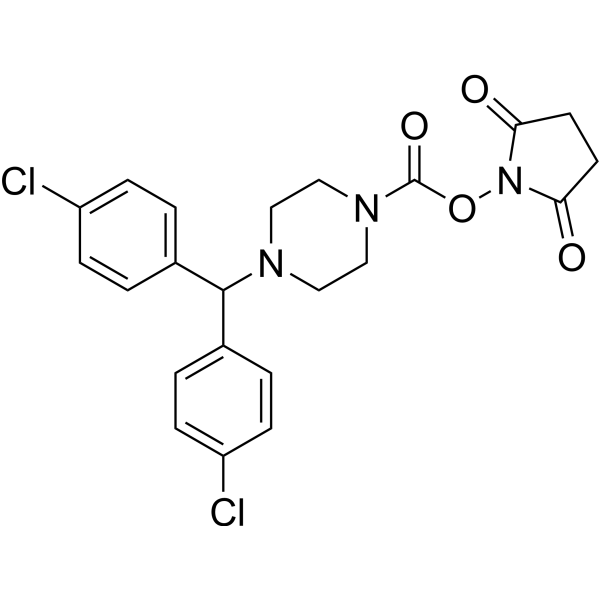
Physicochemical Properties
| Molecular Formula | C22H21CL2N3O4 |
| Molecular Weight | 462.327 |
| Exact Mass | 461.091 |
| CAS # | 1438416-21-7 |
| PubChem CID | 71722059 |
| Appearance | White to off-white solid powder |
| Density | 1.47±0.1 g/cm3 |
| Boiling Point | 561.5±60.0 °C |
| LogP | 3.714 |
| Hydrogen Bond Donor Count | 0 |
| Hydrogen Bond Acceptor Count | 5 |
| Rotatable Bond Count | 5 |
| Heavy Atom Count | 31 |
| Complexity | 632 |
| Defined Atom Stereocenter Count | 0 |
| InChi Key | BEADRWVIFHOSGN-UHFFFAOYSA-N |
| InChi Code | InChI=1S/C22H21Cl2N3O4/c23-17-5-1-15(2-6-17)21(16-3-7-18(24)8-4-16)25-11-13-26(14-12-25)22(30)31-27-19(28)9-10-20(27)29/h1-8,21H,9-14H2 |
| Chemical Name | (2,5-dioxopyrrolidin-1-yl) 4-[bis(4-chlorophenyl)methyl]piperazine-1-carboxylate |
| Synonyms | MJN110; MJN 110; MJN-110 |
| HS Tariff Code | 2934.99.9001 |
| Storage |
Powder-20°C 3 years 4°C 2 years In solvent -80°C 6 months -20°C 1 month |
| Shipping Condition | Room temperature (This product is stable at ambient temperature for a few days during ordinary shipping and time spent in Customs) |
Biological Activity
| ln Vitro | The main target of serine hydrolase, hMAGL, is MJN110 (0.01-1000 nM; 4 hours); its IC50 is about 1 nM, and its selectivity window is 10- and 100-fold greater than that of ABHD6 and LYPLA1/2, respectively [2]. |
| ln Vivo | In a dose-dependent manner, MJN110 (ip; 0.0818 mg/kg; twice daily for 5.5 days) reverses the effects of chronic constriction injury (CCI) on mechanical allodynia and thermal hyperalgesia. 0.430 (0.233-0.793) mg/kg is the comparable ED50 value (95% confidence limit)[1]. |
| Cell Assay |
Western blot analysis[2] Cell Types: Human PC3 cells Tested Concentrations: 0.01, 0.1, 1, 10, 100, 1000 nM Incubation Duration: 4 hrs (hours) Experimental Results: HMAGL acts as a major serine hydrolase target with an IC50 of approximately 1 nM. |
| Animal Protocol |
Animal/Disease Models: Male C57BL/6J mice, body weight range 18 to 35 g[1] Doses: 0.0818 mg/kg Route of Administration: intraperitoneal (ip) injection; twice (two times) daily for 5.5 days Experimental Results: Reversal of CCI-induced disease in a dose-dependent manner of mechanical allodynia and thermal hyperalgesia. |
| References |
[1]. The Selective Monoacylglycerol Lipase Inhibitor MJN110 Produces Opioid-Sparing Effects in a Mouse Neuropathic Pain Model. J Pharmacol Exp Ther. 2016 Apr;357(1):145-56. [2]. Evaluation of NHS carbamates as a potent and selective class of endocannabinoid hydrolase inhibitors. ACS Chem Neurosci. 2013 Sep 18;4(9):1322-32. |
| Additional Infomation | MJN110 is a diarylmethane. |
Solubility Data
| Solubility (In Vitro) | DMSO : ~250 mg/mL (~540.74 mM) |
| Solubility (In Vivo) |
Solubility in Formulation 1: ≥ 2.08 mg/mL (4.50 mM) (saturation unknown) in 10% DMSO + 40% PEG300 + 5% Tween80 + 45% Saline (add these co-solvents sequentially from left to right, and one by one), clear solution. For example, if 1 mL of working solution is to be prepared, you can add 100 μL of 20.8 mg/mL clear DMSO stock solution to 400 μL PEG300 and mix evenly; then add 50 μL Tween-80 to the above solution and mix evenly; then add 450 μL normal saline to adjust the volume to 1 mL. Preparation of saline: Dissolve 0.9 g of sodium chloride in 100 mL ddH₂ O to obtain a clear solution. Solubility in Formulation 2: ≥ 2.08 mg/mL (4.50 mM) (saturation unknown) in 10% DMSO + 90% (20% SBE-β-CD in Saline) (add these co-solvents sequentially from left to right, and one by one), clear solution. For example, if 1 mL of working solution is to be prepared, you can add 100 μL of 20.8 mg/mL clear DMSO stock solution to 900 μL of 20% SBE-β-CD physiological saline solution and mix evenly. Preparation of 20% SBE-β-CD in Saline (4°C,1 week): Dissolve 2 g SBE-β-CD in 10 mL saline to obtain a clear solution. Solubility in Formulation 3: ≥ 2.08 mg/mL (4.50 mM) (saturation unknown) in 10% DMSO + 90% Corn Oil (add these co-solvents sequentially from left to right, and one by one), clear solution. For example, if 1 mL of working solution is to be prepared, you can add 100 μL of 20.8 mg/mL clear DMSO stock solution to 900 μL of corn oil and mix evenly. (Please use freshly prepared in vivo formulations for optimal results.) |
| Preparing Stock Solutions | 1 mg | 5 mg | 10 mg | |
| 1 mM | 2.1630 mL | 10.8148 mL | 21.6296 mL | |
| 5 mM | 0.4326 mL | 2.1630 mL | 4.3259 mL | |
| 10 mM | 0.2163 mL | 1.0815 mL | 2.1630 mL |