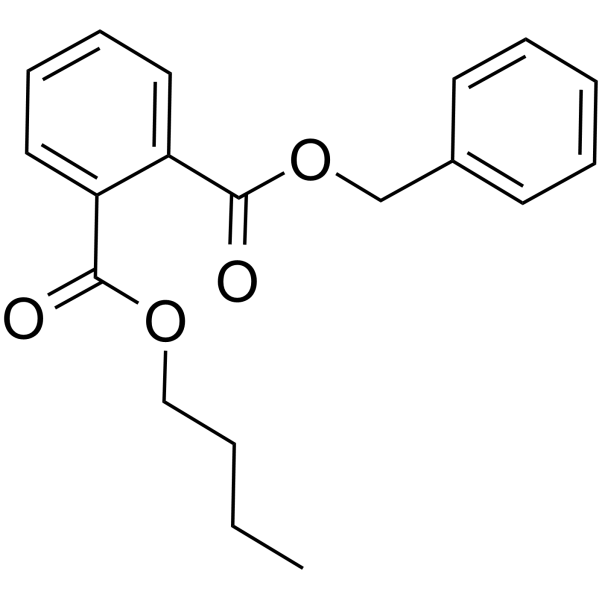
Physicochemical Properties
| Molecular Formula | C19H20O4 |
| Molecular Weight | 312.36 |
| Exact Mass | 312.136 |
| CAS # | 85-68-7 |
| Related CAS # | Benzyl butyl phthalate-d4;93951-88-3 |
| PubChem CID | 2347 |
| Appearance | Colorless to light yellow liquid |
| Density | 1.1±0.1 g/cm3 |
| Boiling Point | 408.3±20.0 °C at 760 mmHg |
| Melting Point | <-35ºC |
| Flash Point | 198.3±20.2 °C |
| Vapour Pressure | 0.0±1.0 mmHg at 25°C |
| Index of Refraction | 1.553 |
| LogP | 5 |
| Hydrogen Bond Donor Count | 0 |
| Hydrogen Bond Acceptor Count | 4 |
| Rotatable Bond Count | 9 |
| Heavy Atom Count | 23 |
| Complexity | 374 |
| Defined Atom Stereocenter Count | 0 |
| SMILES | O=C(C1C(C(OCCCC)=O)=CC=CC=1)OCC1C=CC=CC=1 |
| InChi Key | IRIAEXORFWYRCZ-UHFFFAOYSA-N |
| InChi Code | InChI=1S/C19H20O4/c1-2-3-13-22-18(20)16-11-7-8-12-17(16)19(21)23-14-15-9-5-4-6-10-15/h4-12H,2-3,13-14H2,1H3 |
| Chemical Name | 2-O-benzyl 1-O-butyl benzene-1,2-dicarboxylate |
| HS Tariff Code | 2934.99.9001 |
| Storage |
Powder-20°C 3 years 4°C 2 years In solvent -80°C 6 months -20°C 1 month |
| Shipping Condition | Room temperature (This product is stable at ambient temperature for a few days during ordinary shipping and time spent in Customs) |
Biological Activity
| ln Vitro | In order to improve elasticity and flexibility during the plastic production process, butyl phthalate (BBP) is frequently used [1]. Histone changes are induced by butyl phthalate in S1PR3 side population (SP) cells, but not in SP cells [3]. |
| ADME/Pharmacokinetics |
Absorption, Distribution and Excretion This study examined the extent of dermal absorption of a series of phthalate diesters in the rat. Those tested were dimethyl, diethyl, dibutyl, diisobutyl, dihexyl, di(2-ethylhexyl), diisodecyl, and benzyl butyl phthalate. Hair from a skin area (1.3 cm in diameter) on the back of male F344 rats was clipped, the 14C-phthalate diester was applied in a dose of 157 umol/kg, and the area of application was covered with a perforated cap. The rat was restrained and housed for 7 days in a metabolic cage that allowed separate collection of urine and feces. Urine and feces were collected every 24 hr, and the amount of carbon-14 excreted was taken as an index of the percutaneous absorption. At 24 hr, diethyl phthalate showed the greatest excretion (26%). As the length of the alkyl side chain increased, the amount of carbon-14 excreted in the first 24 hr decreased significantly. The cumulative percentage dose excreted in 7 days was greatest for diethyl, dibutyl, and diisobutyl phthalate, about 50-60% of the applied 14C; and intermediate (20-40%) for dimethyl, benzyl butyl, and dihexyl phthalate. Urine was the major route of excretion of all phthalate diesters except for diisodecyl phthalate. This compound was poorly absorbed and showed almost no urinary excretion. After 7 days, the percentage dose for each phthalate that remained in the body was minimal and showed no specific tissue distribution. Most of the unexcreted dose remained in the area of application. These data show that the structure of the phthalate diester determines the degree of dermal absorption. Absorption maximized with diethyl phthalate and then decreased significantly as the alkyl side chain length increased. ... Male Fischer-344 rats were dosed with (14)C-labeled butyl benzyl phthalate (BBP) at 2, 20, 200, or 2000 mg/kg orally or 20 mg/kg iv to detect the effects of dose on rates and routes of excretion. In 24 hr, 61-74% of the dose was excreted in the urine and 13-19% in the feces at 2-200 mg/kg. At 2000-mg/kg, 16% of the (14)C was excreted in the urine and 57% in the feces. Urinary (14)C was composed of monophthalate glucuronides derivatives (MP: 10-42% of the dose) and monophthalate glucuronides (2-21% of the dose). At 4 hr after iv administration of BBP (20 mg/kg), 53-58% of the dose was excreted in the bile of anesthetized rats. BBP was not found in the bile, but monobutyl glucuronide and monobenzyl phthalate glucuronide (26 and 13% of the dose, respectively) and trace amts of free monoesters (2% of the dose) and unidentified metabolites (14% of the dose) were present. ... The half-lives of BBP, MP, and total (14)C in blood (20 mg/kg, iv) were 10 min, 5.9 hr, and 6.3 hr, respectively. ... Following intravenous administration of 20 mg/kg of (14)C-BBP, 55% of the dose was excreted into bile and 34% was excreted into the urine. Beagle dogs were given a 5 g/kg bw oral dose of butyl benzyl phthalate divided over a 4 hr period. Unchanged butyl benzyl phthalate in the feces comprised 88-91% of the dose. While butyl benzyl phthalate was not present in the urine, some 4.2% of the dose was present as phthalic acid For more Absorption, Distribution and Excretion (Complete) data for BUTYL BENZYL PHTHALATE (8 total), please visit the HSDB record page. Metabolism / Metabolites BBP was not found in the bile, but monobutyl glucuronide and monobenzyl phthalate glucuronide (26 and 13% of the dose, respectively) and trace amounts of free monoesters (2% of the dose) and unidentified metabolites (14% of the dose) were present. Although BBP is an asymetrical diester with the potential of forming equal amounts of monobutyl phthalate and monobenzyl phthalate, larger quantities of monobutyl phthalate were formed (monobutyl phthalate= 44% vs monobenzyl phthalate= 16% of the dose). ... The urinary monoester metabolites of seven commonly used phthalates /were measured/ in approximately 2,540 samples collected from participants of the National Health and Nutrition Examination Survey (NHANES), 1999-2000, who were greater than or equal to 6 years of age. ... Detectable levels of metabolites monoethyl phthalate (MEP), monobutyl phthalate (MBP), monobenzyl phthalate (MBzP), and mono-(2-ethylhexyl) phthalate (MEHP) /were found/ in > 75% of the samples, suggesting widespread exposure in the United States to diethyl phthalate, dibutyl phthalate or diisobutylphthalate, benzylbutyl phthalate, and di-(2-ethylhexyl) phthalate, respectively. ... Monoisononyl phthalate, mono-cyclohexyl phthalate, and mono-n-octyl phthalate /were detected infrequently/, suggesting that human exposures to di-isononyl phthalate, dioctylphthalate, and dicyclohexyl phthalate, respectively, are lower than those listed above, or the pathways, routes of exposure, or pharmacokinetic factors such as absorption, distribution, metabolism, and elimination are different. Non-Hispanic blacks had significantly higher concentrations of MEP than did Mexican Americans and non-Hispanic whites. Compared with adolescents and adults, children had significantly higher levels of MBP, MBzP, and MEHP but had significantly lower concentrations of MEP. Females had significantly higher concentrations of MEP and MBzP than did males, but similar MEHP levels. Of particular interest, females of all ages had significantly higher concentrations of the reproductive toxicant MBP than did males of all ages; however, women of reproductive age (i.e., 20-39 years of age) had concentrations similar to adolescent girls and women 40 years of age... Three groups of eight volunteers were administered stable isotope-labelled ... benzylbutylphthalate. ... For benzylbutylphthalate, 67% and 78% was eliminated as monobenzylphthalate and only 6% (measured for the high dose only) was eliminated as monobutylphthalate. ... n-Butyl benzyl phthalate (BBP) ... has been orally administered to female Wistar rats with four doses (150, 475, 780 and 1500 mg/kg body weight/day) for 3 consecutive days. Metabolites recovered in urine were analyzed by gas chromatography-mass spectrometry (GC-MS) after 24, 48 and 72 hours. Six metabolites were identified. Mono-n-butyl phthalate (MBuP) and mono-n-benzyl phthalate (MBeP) represented respectively 29-34% and 7-12% of the total recovered metabolites. Hippuric acid, the main metabolite of benzoic acid, represented the second major metabolite (51-56%). Phthalic acid, benzoic acid and an omega-oxidized metabolite of MBuP were also recovered in urine but in small quantities. BBP was never identified in urine. Total urinary metabolites recovery represented 56% of the dose administered in the first 24 hours. However, total recovery decreased when the dose increases (43% at 780 mg/kg body weight/day, only 30% at 1500 mg/kg body weight/day). Whatever the time was, BBP metabolites recovered in urine were all present and in the same proportions for the two lowest doses. Discrepancy in metabolites quantities expressed as percentages of the dose observed in urine of rat treated with the highest BBP dose disappeared with time as MBuP, MBeP and hippuric acid recovery has significantly increased at day 3. ... For more Metabolism/Metabolites (Complete) data for BUTYL BENZYL PHTHALATE (9 total), please visit the HSDB record page. Phthalate esters are first hydrolyzed to their monoester derivative. Once formed, the monoester derivative can be further hydrolyzed in vivo to phthalic acid or conjugated to glucuronide, both of which can then be excreted. The terminal or next-to-last carbon atom in the monoester can also be oxidized to an alcohol, which can be excreted as is or first oxidized to an aldehyde, ketone, or carboxylic acid. The monoester and oxidative metabolites are excreted in the urine and faeces. (A2884) Biological Half-Life The half-lives of butyl benzyl phthalate (BBP), monophthalate (MP), and total (14)C in blood (20 ng/kg, intravenously) were 10 min, 5.9 hr, and 6.3 hr, respectively. The half-life of BBP in blood is 10 min following an oral administration of 5 g/kg to dogs. |
| Toxicity/Toxicokinetics |
Toxicity Summary IDENTIFICATION AND USE: Butyl benzyl phthalate (BBP) is a clear oily liquid that is used as a plasticizer mainly in polyvinyl chloride for vinyl floor tile, vinyl foams and carpet backing and in cellulose plastics and polyurethane. HUMAN EXPOSURE AND TOXICITY: BBP was not observed to be a primary irritant or sensitizer in skin patch tests with volunteers. Prenatal exposure to BBP may influence the risk of developing eczema in early childhood. BBP was also positively associated with airway inflammation in children. BBP was positive in E-Screen assay used to measure the proliferation of MCF-7 cells, a human breast cancer cell line. In another study proteomic changes in proteins secreted by human hepatocellular carcinomas (HepG2) cells exposed to BBP were evaluated. These proteins were found to be involved in apoptosis, signaling, tumor progression, energy metabolism, and cell structure and motility. BBP treatment of plasmacytoid DC cells suppressed IFN-gamma but enhanced IL-13 production by CD4+ T cells. ANIMAL STUDIES: The acute toxicity of this compound is low, with oral LD50 values in rats being greater than 2 g/kg body weight. Target organs following acute exposure include the hematological and central nervous systems. Repeated dose toxicity studies of this compound in the rat show decreases in body weight gain and increases in organ to body weight ratios, particularly for the kidney and liver. Histopathological effects on the pancreas and kidney and hematological effects have also been observed. At higher doses, degenerative effects on the testes and, occasionally histopathological effects on the liver have been reported. In specialized investigations, peroximal proliferation in the liver has been noted. The chronic toxicity and carcinogenicity of BBP bioassays in rats and mice, indicated that there was some evidence of carcinogenicity in male rats, based on an increased incidence of pancreatic tumors, and equivocal evidence in female rats, based on marginal increases in pancreatic and bladder tumors. Dietary restriction prevented full expression of the pancreatic tumors. There was no evidence for the carcinogenicity of BBP in mice. BBP is not genotoxic. In a range of studies, including those designed to investigate the reproductive effects of BBP on the testes and endocrine hormone in male rats, a modified mating protocol and a one generation study, adverse effects on the testes and, consequently fertility have generally been observed only at doses higher than those that induce effects on other organs (such as the kidney and liver), although decreases in sperm counts have been observed at doses similar to those that induce effects in the kidney and liver. Reduction in testes weight and daily sperm production in the offspring were reported at relatively low level in rats exposed in utero and during lactation. Neither BBP nor its principal metabolites have been uteritrophic in vivo in rats or mice, In several well conducted studies in rats and mice, butyl benzyl phthalate induced marked developmental effects, but only at dose levels that induce significant maternal toxicity. BBP administration disrupts normal learning and social behavior in rats, and these effects could be related to alterations of amygdala function. ECOTOXICITY STUDIES: A range of toxicity tests with aquatic organisms has indicated the adverse effects occur at exposure concentrations greater than 100 ug/L. Behavioral changes in fish were noted after sublethal BBP exposure. Phthalate esters are endocrine disruptors. They decrease foetal testis testosterone production and reduce the expression of steroidogenic genes by decreasing mRNA expression. Some phthalates have also been shown to reduce the expression of insulin-like peptide 3 (insl3), an important hormone secreted by the Leydig cell necessary for development of the gubernacular ligament. Animal studies have shown that these effects disrupt reproductive development and can cause a number of malformations in affected young. (A2883) Toxicity Data LD50: 3160 mg/kg (Intraperitoneal, Mouse) (L1208) LD50: 2330 mg/kg (Oral, Rat) (L1208) LD50: 4170 mg/kg (Oral, Mouse) (L1208) Interactions Although risk assessments are typically conducted on a chemical-by-chemical basis, the 1996 Food Quality Protection Act (FQPA) required the Environmental Protection Agency (EPA) to consider cumulative risk of chemicals that act via a common mechanism of toxicity. To this end, we are conducting studies with mixtures to provide a framework for assessing the cumulative effects of "antiandrogenic" chemicals. Rats were dosed during pregnancy with antiandrogens singly or in pairs at dosage levels equivalent to about one half of the ED50 for hypospadias or epididymal agenesis. The pairs include: AR antagonists (vinclozolin plus procymidone), phthalate esters (DBP plus BBP and DEHP plus DBP), a phthalate ester plus an AR antagonist (DBP plus procymidone), and linuron plus BBP. We predicted that each chemical by itself would induce few malformations; however, by mixing any two chemicals together, about 50% of the males would be malformed. All binary combinations produced cumulative, dose-additive effects on the androgen-dependent tissues. We also conducted a mixture study combining seven "antiandrogens" together. These chemicals elicit antiandrogenic effects at two different sites in the androgen signaling pathway (i.e., AR antagonist or inhibition of androgen synthesis). In this study, the complex mixture behaved in a dose-additive manner. Our results indicate that compounds that act by disparate mechanisms of toxicity display cumulative, dose-additive effects when present in combination. /Mixtures/ Butyl benzyl phthalate (BBP), an endocrine disruptor present in the environment, exerts its genomic effects via intracellular steroid receptors and elicits non-genomic effects by interfering with membrane ion-channel receptors. We previously found that BBP blocks the calcium signaling coupled with P2X receptors in PC12 cells (Liu & Chen, 2006). Osteoblast P2X receptors were recently reported to play a role in cell proliferation and bone remodeling. In this present study, the effects of BBP on ATP-induced responses were investigated in human osteosarcoma HOS cells. These receptors mRNA had been detected, named P2X4, P2X7, P2Y2, P2Y4, P2Y5, P2Y9, and P2Y11, in human osteosarcoma HOS cells by RT-PCR. The enhancement of cell proliferation and the decrease of cytoviability had both been shown to be coupled to stimulation via different concentrations of ATP. BBP suppressed the ATP-induced calcium influx (mainly coupled with P2X) and cell proliferation but not the ATP-induced intracellular calcium release (mainly coupled with P2Y) and cytotoxicity in human osteosarcoma HOS cells. Suramin, a common P2 receptor's antagonist, blocked the ATP-induced calcium signaling, cell proliferation, and cytotoxicity. We suggest that P2X is mainly responsible for cell proliferation, and P2Y might be partially responsible for the observed cytotoxicity. BBP suppressed the calcium signaling coupled with P2X, suppressing cell proliferation. Since the importance of P2X receptors during bone metastasis has recently become apparent, the possible toxic risk of environmental BBP during bone remodeling is a public problem of concern. During recent decades the prevalence of IgE-mediated (atopic) allergic diseases in Western Europe and the USA has been increasing dramatically. It has been suggested that one possible cause is the presence in the environment of chemicals that may act as adjuvants, enhancing immune and allergic responses. Certain commonly used phthalate plasticizers such as butyl benzyl phthalate (BBP) have been implicated in this way. In the current experiments, the impact of BBP, applied by a physiologically relevant exposure route, on the vigour of immune responses induced in BALB/c strain mice has been examined. Mice were immunized via subcutaneous injection with the reference allergen ovalbumin (OVA) and received concurrent topical treatment with doses of BBP that induced significant changes in liver weight. The generation of specific anti-OVA IgE and IgG1 antibodies was measured by passive cutaneous anaphylaxis and by enzyme-linked immunosorbant assays, respectively. Topical administration of BBP was without impact on anti-OVA IgE antibody responses, regardless of whether BBP was applied locally or distant to the site of OVA immunization. However, same-site treatment with high-dose BBP (100 mg) did result in a modest elevation in anti-OVA IgG1 antibody production, a subclass of antibody used as a surrogate marker of IgE responses. Taken together with human exposure data, these results suggest that the doses of phthalate encountered in the home environment are unlikely to be a major factor contributing to the increased incidence of asthma and allergy in the developed world. Non-Human Toxicity Values LD50 Rat oral 2330 mg/kg LD50 Rat Oral 2-20 g/kg /2,000-20,000 mg/kg/ LD50 Rat dermal 6700 mg/kg LD50 Mouse oral 4170 mg/kg For more Non-Human Toxicity Values (Complete) data for BUTYL BENZYL PHTHALATE (10 total), please visit the HSDB record page. |
| References |
[1]. Developmental toxicity and cardiac effects of butyl benzyl phthalate in zebrafish embryos. Aquat Toxicol. 2017;192:165-170. [2]. Benzyl butyl phthalate (BBP) triggers the migration and invasion of hemangioma cells via upregulation of Zeb1. Toxicol In Vitro. 2019;60:323-329. [3]. Benzyl butyl phthalate promotes breast cancer stem cell expansion via SPHK1/S1P/S1PR3 signaling. Oncotarget. 2016;7(20):29563-29576. |
| Additional Infomation |
Butyl Benzyl Phthalate can cause developmental toxicity according to The National Toxicology Program's Center for the Evaluation of Risks to Human Reproduction. Butyl benzyl phthalate appears as a clear colorless liquid with a mild odor. Primary hazard is to the environment. Immediate steps should be taken to limit spread to the environment. Easily penetrates the soil to contaminate groundwater and nearby waterways. Butylbenzyl phthalate is a benzyl ester. Benzyl butyl phthalate has been reported in Festuca rubra and Mangifera indica with data available. Benzyl butyl phthalate (BBzP) is a phthalate ester mostly used as a plasticizer for PVC. Phthalate esters can cause reproductive and developmental toxicity. (A2883, L1902) |
Solubility Data
| Solubility (In Vitro) |
H2O : ~100 mg/mL (~320.14 mM) DMSO : ~100 mg/mL (~320.14 mM) |
| Solubility (In Vivo) |
Solubility in Formulation 1: 100 mg/mL (320.14 mM) in PBS (add these co-solvents sequentially from left to right, and one by one), clear solution; with sonication. (Please use freshly prepared in vivo formulations for optimal results.) |
| Preparing Stock Solutions | 1 mg | 5 mg | 10 mg | |
| 1 mM | 3.2014 mL | 16.0072 mL | 32.0143 mL | |
| 5 mM | 0.6403 mL | 3.2014 mL | 6.4029 mL | |
| 10 mM | 0.3201 mL | 1.6007 mL | 3.2014 mL |