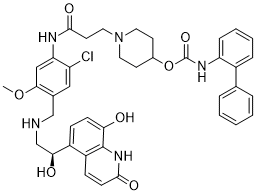
Batefenterol (formerly known as GSK961081 and TD-5959) is a novel, potent and selective muscarinic receptor antagonist and β2-adrenoceptor agonist; it displays high affinity for hM2, hM3 muscarinic and hβ2-adrenoceptor with Ki values of 1.4, 1.3 and 3.7 nM, respectively. In patients with moderate to severe chronic obstructive pulmonary disease (COPD), batefenterol produced numerically greater improvements in the primary end point of trough FEV1 compared to salmeterol after 4 weeks of dosing in a phase 2b trial. There were also statistically and clinically significant differences between placebo and batefenterol.
Physicochemical Properties
| Molecular Formula | C40H42CLN5O7 |
| Molecular Weight | 740.2438 |
| Exact Mass | 739.277 |
| Elemental Analysis | C, 64.90; H, 5.72; Cl, 4.79; N, 9.46; O, 15.13 |
| CAS # | 743461-65-6 |
| Related CAS # | 945905-37-3(succinate); 743461-65-6 |
| PubChem CID | 10372836 |
| Appearance | Light yellow to yellow solid powder |
| Density | 1.4±0.1 g/cm3 |
| Boiling Point | 948.3±65.0 °C at 760 mmHg |
| Flash Point | 527.3±34.3 °C |
| Vapour Pressure | 0.0±0.3 mmHg at 25°C |
| Index of Refraction | 1.692 |
| LogP | 5.26 |
| Hydrogen Bond Donor Count | 6 |
| Hydrogen Bond Acceptor Count | 9 |
| Rotatable Bond Count | 14 |
| Heavy Atom Count | 53 |
| Complexity | 1230 |
| Defined Atom Stereocenter Count | 1 |
| SMILES | ClC1C([H])=C(C(=C([H])C=1N([H])C(C([H])([H])C([H])([H])N1C([H])([H])C([H])([H])C([H])(C([H])([H])C1([H])[H])OC(N([H])C1=C([H])C([H])=C([H])C([H])=C1C1C([H])=C([H])C([H])=C([H])C=1[H])=O)=O)OC([H])([H])[H])C([H])([H])N([H])C([H])([H])[C@@]([H])(C1C([H])=C([H])C(=C2C=1C([H])=C([H])C(N2[H])=O)O[H])O[H] |
| InChi Key | URWYQGVSPQJGGB-DHUJRADRSA-N |
| InChi Code | InChI=1S/C40H42ClN5O7/c1-52-36-22-33(31(41)21-26(36)23-42-24-35(48)29-11-13-34(47)39-30(29)12-14-37(49)45-39)43-38(50)17-20-46-18-15-27(16-19-46)53-40(51)44-32-10-6-5-9-28(32)25-7-3-2-4-8-25/h2-14,21-22,27,35,42,47-48H,15-20,23-24H2,1H3,(H,43,50)(H,44,51)(H,45,49)/t35-/m0/s1 |
| Chemical Name | [1-[3-[2-chloro-4-[[[(2R)-2-hydroxy-2-(8-hydroxy-2-oxo-1H-quinolin-5-yl)ethyl]amino]methyl]-5-methoxyanilino]-3-oxopropyl]piperidin-4-yl] N-(2-phenylphenyl)carbamate |
| Synonyms | Batefenterol; GSK 961081; GSK961081; GSK-961081; TD5959; TD-5959; TD 5959 |
| HS Tariff Code | 2934.99.9001 |
| Storage |
Powder-20°C 3 years 4°C 2 years In solvent -80°C 6 months -20°C 1 month |
| Shipping Condition | Room temperature (This product is stable at ambient temperature for a few days during ordinary shipping and time spent in Customs) |
Biological Activity
| Targets | hM3 muscarinic receptor ( Ki = 1.3 nM ); hM2 muscarinic receptor ( Ki = 1.4 nM ); hβ2-adrenoceptor ( Ki = 3.7 nM ) |
| ln Vitro | Batefenterol is a new, first-of-its-kind inhaled bifunctional compound with both muscarinic antagonist (MA) and beta2-coupling absorber (BA) properties (MABA). In competitive analyte binding studies, batfenterol showed high affinity for hM2 (Ki=1.4 nM), hM3 muscarinic receptors (Ki=1.3 nM), and hβ 2-increase receptors (Ki= 3.7 nM) Batfenterol is a potent hβ2-syntropin receptor agonist (EC50=0.29 nM for stimulating cAMP levels) with 440-fold and 320-fold functional selectivity over hβ1- and hβ3- Simultaneous receptors [1]. |
| ln Vivo | In a guinea pig protection test, Batefenterol was inhaled via the MA (ED50=33.9 μg/mL), BA (ED50= 14.1 μg/mL), and MABA (ED50=6.4 μg/mL) mechanisms. After approximately up to 7 days, Batefenterol's significant fold-protective effect on guinea pigs is evident through the MA, BA and MABA mechanisms [1]. In isolated guinea pig tracheas expressing native muscarinic M3 and β2, batfenterol produced smooth muscle through a dual mechanism involving M3 absorptive local resistance to muscarinic receptors and β2 receptors. This function is more effective (EC50=10 nM). Batfenterol has a rapid clearance and a calming half-life [2]. |
| Cell Assay | For 20 minutes at 37°C, CHO-K1 cells that have been transfected with each receptor subtype and stable are exposed to escalating batefenterol concentrations. Oxotremorine, a muscarinic agonist, stimulates the cells at an EC90 concentration. A 488 nm laser light source is used to stimulate the calcium-sensitive dye, causing it to bind to calcium and fluoresce. Oxotremorine causes a Gq-mediated calcium-release event. In order to create the concentration-response curve for batefenterol, the fluorescence change is measured using the FLIPR for three minutes, and the peak height of the fluorescence is considered the maximal response[1]. |
| Animal Protocol | Guinea pigs: Dissolve batefenterol in water. We dissect and isolate the trachea of guinea pigs. Before inducing contraction, the tracheal rings are first tensioned to 1 g and given an hour to equilibrate. This allows researchers to assess relaxant effects via MA and BA mechanisms, respectively, using submaximal concentrations of histamine (HIS; 30 µM) or methylcholine (MCh; 10 µM) in the presence of propranolol (10 µM). In tissues precontracted with MCh and without propranolol, relaxation via the MABA mechanism is assessed. Batefenterol is added cumulatively in half log increments after the contractile tone reaches a plateau. Each concentration is added after a steady-state relaxation response to the preceding concentration is achieved. The concentrations range from 0.1 nM to 100 µM. Theophylline (2.2 mM) is added to the test compound after the final concentration to achieve maximum relaxation[1]. |
| References |
[1]. Pharmacologic characterization of GSK-961081 (TD-5959), a first-in-class inhaled bifunctional bronchodilator possessing muscarinic receptor antagonist and β2-adrenoceptor agonist properties. J Pharmacol Exp Ther. 2014 Oct;351(1):190-9. [2]. Discovery of (R)-1-(3-((2-chloro-4-(((2-hydroxy-2-(8-hydroxy-2-oxo-1,2-dihydroquinolin-5-yl)ethyl)amino)methyl)-5-methoxyphenyl)amino)-3-oxopropyl)piperidin-4-yl [1,1'-biphenyl]-2-ylcarbamate (TD-5959, GSK961081, batefenterol): first-in-class dual pharmacology multivalent muscarinic antagonist and β? agonist (MABA) for the treatment of chronic obstructive pulmonary disease (COPD). J Med Chem. 2015 Mar 26;58(6):2609-22. |
| Additional Infomation | Batefenterol has been used in trials studying the treatment of Pulmonary Disease, Chronic Obstructive. |
Solubility Data
| Solubility (In Vitro) | DMSO: ~100 mg/mL (~135.1 mM) |
| Solubility (In Vivo) |
Solubility in Formulation 1: ≥ 2.5 mg/mL (3.38 mM) (saturation unknown) in 10% DMSO + 40% PEG300 + 5% Tween80 + 45% Saline (add these co-solvents sequentially from left to right, and one by one), clear solution. For example, if 1 mL of working solution is to be prepared, you can add 100 μL of 25.0 mg/mL clear DMSO stock solution to 400 μL PEG300 and mix evenly; then add 50 μL Tween-80 to the above solution and mix evenly; then add 450 μL normal saline to adjust the volume to 1 mL. Preparation of saline: Dissolve 0.9 g of sodium chloride in 100 mL ddH₂ O to obtain a clear solution. Solubility in Formulation 2: ≥ 2.5 mg/mL (3.38 mM) (saturation unknown) in 10% DMSO + 90% Corn Oil (add these co-solvents sequentially from left to right, and one by one), clear solution. For example, if 1 mL of working solution is to be prepared, you can add 100 μL of 25.0 mg/mL clear DMSO stock solution to 900 μL of corn oil and mix evenly. (Please use freshly prepared in vivo formulations for optimal results.) |
| Preparing Stock Solutions | 1 mg | 5 mg | 10 mg | |
| 1 mM | 1.3509 mL | 6.7546 mL | 13.5091 mL | |
| 5 mM | 0.2702 mL | 1.3509 mL | 2.7018 mL | |
| 10 mM | 0.1351 mL | 0.6755 mL | 1.3509 mL |