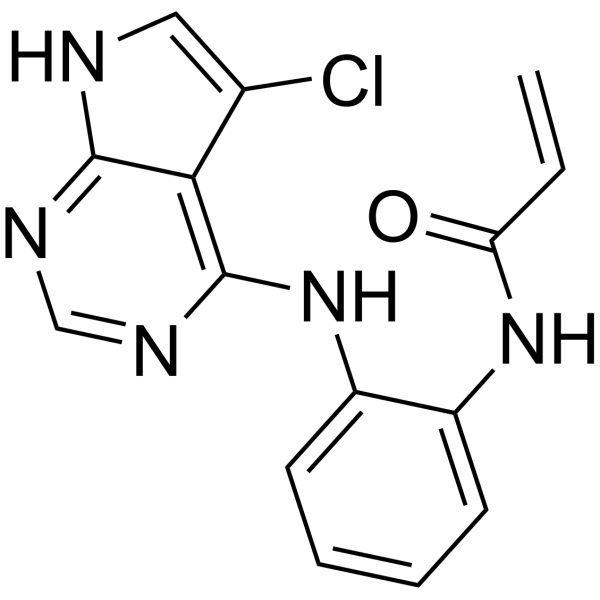
Physicochemical Properties
| Molecular Formula | C15H12CLN5O |
| Molecular Weight | 313.741681098938 |
| Exact Mass | 313.073 |
| CAS # | 2513289-74-0 |
| PubChem CID | 166642484 |
| Appearance | White to off-white solid powder |
| LogP | 2.9 |
| Hydrogen Bond Donor Count | 3 |
| Hydrogen Bond Acceptor Count | 4 |
| Rotatable Bond Count | 4 |
| Heavy Atom Count | 22 |
| Complexity | 421 |
| Defined Atom Stereocenter Count | 0 |
| SMILES | ClC1=CNC2C1=C(N=CN=2)NC1C=CC=CC=1NC(C=C)=O |
| InChi Key | LWXOPXNDPRPGMJ-UHFFFAOYSA-N |
| InChi Code | InChI=1S/C15H12ClN5O/c1-2-12(22)20-10-5-3-4-6-11(10)21-15-13-9(16)7-17-14(13)18-8-19-15/h2-8H,1H2,(H,20,22)(H2,17,18,19,21) |
| Chemical Name | N-[2-[(5-chloro-7H-pyrrolo[2,3-d]pyrimidin-4-yl)amino]phenyl]prop-2-enamide |
| Synonyms | BSJ-04-122; 2513289-74-0; SCHEMBL27051832; N-(2-((5-Chloro-7H-pyrrolo[2,3-d]pyrimidin-4-yl)amino)phenyl)acrylamide |
| HS Tariff Code | 2934.99.9001 |
| Storage |
Powder-20°C 3 years 4°C 2 years In solvent -80°C 6 months -20°C 1 month |
| Shipping Condition | Room temperature (This product is stable at ambient temperature for a few days during ordinary shipping and time spent in Customs) |
Biological Activity
| Targets | MKK4 (IC₅₀ = 4 nM); MKK7 (IC₅₀ = 181 nM)[1] |
| ln Vitro |
MKK4 and MKK7 are inhibited by BSJ-04-122, with IC50 values of 4 nM and 181 nM, respectively[1]. JNK phosphorylation is significantly reduced by BSJ-04-122 (1, 5, 10 μM; 6 h) [1]. When coupled with JNK-IN-8, BSJ-04-122 (0, 1.25, 2.5, 5, 10, 20 μM; 72 h) demonstrated increased antiproliferative effects [1]. Kinase activity inhibition: BSJ-04-122 covalently binds to the Cys247 residue of MKK4, dose-dependently inhibiting MKK4 and MKK7 kinase activities (IC₅₀: 4 nM for MKK4, 181 nM for MKK7). It directly blocks JNK phosphorylation by suppressing MKK4/7-mediated activation [1] Antiproliferative activity: In MDA-MB-231 triple-negative breast cancer cells, BSJ-04-122 (1-100 μM) exhibits concentration-dependent antiproliferative effects after 72-hour treatment. Its inhibitory effect is significantly enhanced when combined with JNK-IN-8, indicating a synergistic mechanism [1] Signal pathway regulation: Western blot analysis shows that BSJ-04-122 (1-10 μM) reduces the phosphorylation level of JNK at T183/Y185 in MDA-MB-231 cells after 6-hour treatment, confirming inhibition of the MKK4/7-JNK pathway [1] |
| Enzyme Assay | MKK4/7 kinase activity assay: Recombinant MKK4 or MKK7 proteins are incubated with ATP and substrates (JNK or p38 MAPK) in reaction buffer, followed by addition of BSJ-04-122 at different concentrations (0.1-1000 nM). Substrate phosphorylation levels are detected (via radiolabeling or fluorescence labeling) to evaluate inhibitory effects. Results show BSJ-04-122 has significantly higher inhibitory activity against MKK4 than MKK7 [1]. |
| Cell Assay |
Western Blot Analysis[1] Cell Types: MDA-MB-231 cells Tested Concentrations: 1, 5, 10 μM Incubation Duration: 6 h Experimental Results: Dramatically diminished levels of T183/Y185 pJNK at 5 μM. Cell Proliferation Assay[1] Cell Types: MDA-MB-231 cells Tested Concentrations: 1-100 μM; 0, 1.25, 2.5, 5, 10, 20 μM Incubation Duration: 72 h Experimental Results: demonstrated antiproliferative effects when combined with JNK-IN-8 in MDA-MB-231 cells. Cell proliferation assay: MDA-MB-231 cells are seeded in 96-well plates and treated with BSJ-04-122 (0-100 μM) alone or in combination with JNK-IN-8. After 72-hour incubation, cell viability is measured by MTT assay. Both single-agent and combined treatments significantly reduce cell viability, with the combination showing stronger effects [1] Apoptosis detection: Annexin V-FITC/PI double staining assay reveals that BSJ-04-122 (5-20 μM) increases the proportion of early apoptotic cells in MDA-MB-231 cells after 48-hour treatment, accompanied by elevated Caspase-3/7 activity, indicating an apoptosis-inducing mechanism [1] |
| References |
[1]. Discovery of Covalent MKK4/7 Dual Inhibitor. Cell Chem Biol. 2020 Dec 17;27(12):1553-1560.e8. |
| Additional Infomation |
Mechanism of action: BSJ-04-122 irreversibly inhibits the MKK4/7-JNK/p38 MAPK signaling pathway by covalently binding to the Cys247 residue of MKK4, thereby blocking tumor cell proliferation and inducing apoptosis [1] Potential indications: In vitro experiments suggest BSJ-04-122 has significant inhibitory activity against malignant tumor cells such as triple-negative breast cancer and glioma, indicating potential application in anticancer therapy [1] Innovation: As the first reported covalent dual inhibitor of MKK4/7, BSJ-04-122 provides a new chemical scaffold and mode of action for developing MAPK pathway-targeted anticancer drugs [1] |
Solubility Data
| Solubility (In Vitro) | DMSO: 100 mg/mL (318.74 mM) |
| Solubility (In Vivo) |
Note: Listed below are some common formulations that may be used to formulate products with low water solubility (e.g. < 1 mg/mL), you may test these formulations using a minute amount of products to avoid loss of samples. Injection Formulations (e.g. IP/IV/IM/SC) Injection Formulation 1: DMSO : Tween 80: Saline = 10 : 5 : 85 (i.e. 100 μL DMSO stock solution → 50 μL Tween 80 → 850 μL Saline) *Preparation of saline: Dissolve 0.9 g of sodium chloride in 100 mL ddH ₂ O to obtain a clear solution. Injection Formulation 2: DMSO : PEG300 :Tween 80 : Saline = 10 : 40 : 5 : 45 (i.e. 100 μL DMSO → 400 μLPEG300 → 50 μL Tween 80 → 450 μL Saline) Injection Formulation 3: DMSO : Corn oil = 10 : 90 (i.e. 100 μL DMSO → 900 μL Corn oil) Example: Take the Injection Formulation 3 (DMSO : Corn oil = 10 : 90) as an example, if 1 mL of 2.5 mg/mL working solution is to be prepared, you can take 100 μL 25 mg/mL DMSO stock solution and add to 900 μL corn oil, mix well to obtain a clear or suspension solution (2.5 mg/mL, ready for use in animals). Injection Formulation 4: DMSO : 20% SBE-β-CD in saline = 10 : 90 [i.e. 100 μL DMSO → 900 μL (20% SBE-β-CD in saline)] *Preparation of 20% SBE-β-CD in Saline (4°C,1 week): Dissolve 2 g SBE-β-CD in 10 mL saline to obtain a clear solution. Injection Formulation 5: 2-Hydroxypropyl-β-cyclodextrin : Saline = 50 : 50 (i.e. 500 μL 2-Hydroxypropyl-β-cyclodextrin → 500 μL Saline) Injection Formulation 6: DMSO : PEG300 : castor oil : Saline = 5 : 10 : 20 : 65 (i.e. 50 μL DMSO → 100 μLPEG300 → 200 μL castor oil → 650 μL Saline) Injection Formulation 7: Ethanol : Cremophor : Saline = 10: 10 : 80 (i.e. 100 μL Ethanol → 100 μL Cremophor → 800 μL Saline) Injection Formulation 8: Dissolve in Cremophor/Ethanol (50 : 50), then diluted by Saline Injection Formulation 9: EtOH : Corn oil = 10 : 90 (i.e. 100 μL EtOH → 900 μL Corn oil) Injection Formulation 10: EtOH : PEG300:Tween 80 : Saline = 10 : 40 : 5 : 45 (i.e. 100 μL EtOH → 400 μLPEG300 → 50 μL Tween 80 → 450 μL Saline) Oral Formulations Oral Formulation 1: Suspend in 0.5% CMC Na (carboxymethylcellulose sodium) Oral Formulation 2: Suspend in 0.5% Carboxymethyl cellulose Example: Take the Oral Formulation 1 (Suspend in 0.5% CMC Na) as an example, if 100 mL of 2.5 mg/mL working solution is to be prepared, you can first prepare 0.5% CMC Na solution by measuring 0.5 g CMC Na and dissolve it in 100 mL ddH2O to obtain a clear solution; then add 250 mg of the product to 100 mL 0.5% CMC Na solution, to make the suspension solution (2.5 mg/mL, ready for use in animals). Oral Formulation 3: Dissolved in PEG400 Oral Formulation 4: Suspend in 0.2% Carboxymethyl cellulose Oral Formulation 5: Dissolve in 0.25% Tween 80 and 0.5% Carboxymethyl cellulose Oral Formulation 6: Mixing with food powders Note: Please be aware that the above formulations are for reference only. InvivoChem strongly recommends customers to read literature methods/protocols carefully before determining which formulation you should use for in vivo studies, as different compounds have different solubility properties and have to be formulated differently. (Please use freshly prepared in vivo formulations for optimal results.) |
| Preparing Stock Solutions | 1 mg | 5 mg | 10 mg | |
| 1 mM | 3.1874 mL | 15.9368 mL | 31.8735 mL | |
| 5 mM | 0.6375 mL | 3.1874 mL | 6.3747 mL | |
| 10 mM | 0.3187 mL | 1.5937 mL | 3.1874 mL |