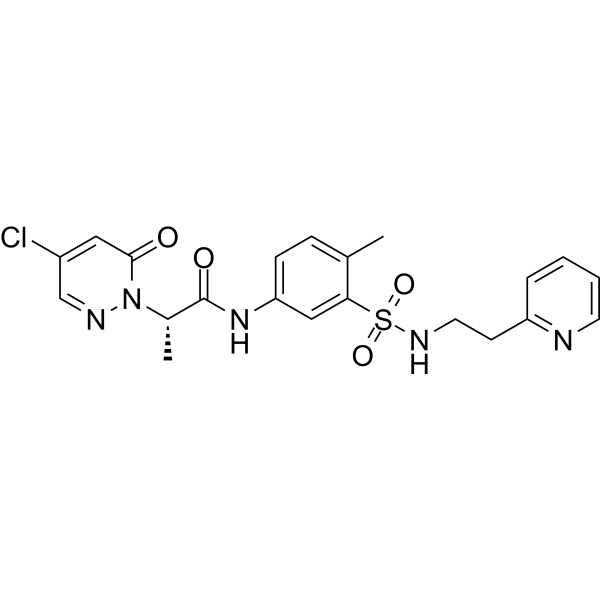
Physicochemical Properties
| Molecular Formula | C21H22CLN5O4S |
| Exact Mass | 475.11 |
| Elemental Analysis | C, 53.00; H, 4.66; Cl, 7.45; N, 14.71; O, 13.45; S, 6.74 |
| CAS # | 2760881-74-9 |
| Related CAS # | 2760881-74-9; 2760909-27-9 (R-isomer); |
| PubChem CID | 156621384 |
| Appearance | Light yellow to brown solid powder |
| LogP | 1.9 |
| Hydrogen Bond Donor Count | 2 |
| Hydrogen Bond Acceptor Count | 7 |
| Rotatable Bond Count | 8 |
| Heavy Atom Count | 32 |
| Complexity | 857 |
| Defined Atom Stereocenter Count | 1 |
| SMILES | CC1=C(C=C(C=C1)NC(=O)[C@H](C)N2C(=O)C=C(C=N2)Cl)S(=O)(=O)NCCC3=CC=CC=N3 |
| InChi Key | BXDCFRRDENJUJM-HNNXBMFYSA-N |
| InChi Code | InChI=1S/C21H22ClN5O4S/c1-14-6-7-18(26-21(29)15(2)27-20(28)11-16(22)13-24-27)12-19(14)32(30,31)25-10-8-17-5-3-4-9-23-17/h3-7,9,11-13,15,25H,8,10H2,1-2H3,(H,26,29)/t15-/m0/s1 |
| Chemical Name | (2S)-2-(4-chloro-6-oxopyridazin-1-yl)-N-[4-methyl-3-(2-pyridin-2-ylethylsulfamoyl)phenyl]propanamide |
| Synonyms | BRD0639; BRD 0639; BRD-0639; |
| HS Tariff Code | 2934.99.9001 |
| Storage |
Powder-20°C 3 years 4°C 2 years In solvent -80°C 6 months -20°C 1 month |
| Shipping Condition | Room temperature (This product is stable at ambient temperature for a few days during ordinary shipping and time spent in Customs) |
Biological Activity
| ln Vitro | Developed to enable the investigation of PBM-dependent PRMT5 activity and the creation of new PRMT5 inhibitors that specifically target these functions, BRD0639 is a first-in-class PBM competitive small molecule. With IC50s of 7.5 uM and 16 uM in permeabilized and viable cells, respectively, BRD0639 effectively competes for binding between full-length PRMT5 and RIOK1 proteins while engaging cellular targets. In the same subset of proteins that are likewise impacted by genetic modification of the PRMT5 binding motif (PBM) binding site, BRD0639 decreases SDMA [1]. |
| References |
[1]. Discovery of a First-in-Class Inhibitor of the PRMT5-Substrate Adaptor Interaction. J Med Chem. 2021;64(15):11148-11168. |
Solubility Data
| Solubility (In Vitro) | DMSO : ~250 mg/mL (~525.27 mM) |
| Solubility (In Vivo) |
Solubility in Formulation 1: ≥ 2.08 mg/mL (4.37 mM) (saturation unknown) in 10% DMSO + 40% PEG300 + 5% Tween80 + 45% Saline (add these co-solvents sequentially from left to right, and one by one), clear solution. For example, if 1 mL of working solution is to be prepared, you can add 100 μL of 20.8 mg/mL clear DMSO stock solution to 400 μL PEG300 and mix evenly; then add 50 μL Tween-80 to the above solution and mix evenly; then add 450 μL normal saline to adjust the volume to 1 mL. Preparation of saline: Dissolve 0.9 g of sodium chloride in 100 mL ddH₂ O to obtain a clear solution. Solubility in Formulation 2: ≥ 2.08 mg/mL (4.37 mM) (saturation unknown) in 10% DMSO + 90% (20% SBE-β-CD in Saline) (add these co-solvents sequentially from left to right, and one by one), clear solution. For example, if 1 mL of working solution is to be prepared, you can add 100 μL of 20.8 mg/mL clear DMSO stock solution to 900 μL of 20% SBE-β-CD physiological saline solution and mix evenly. Preparation of 20% SBE-β-CD in Saline (4°C,1 week): Dissolve 2 g SBE-β-CD in 10 mL saline to obtain a clear solution. Solubility in Formulation 3: ≥ 2.08 mg/mL (4.37 mM) (saturation unknown) in 10% DMSO + 90% Corn Oil (add these co-solvents sequentially from left to right, and one by one), clear solution. For example, if 1 mL of working solution is to be prepared, you can add 100 μL of 20.8 mg/mL clear DMSO stock solution to 900 μL of corn oil and mix evenly. (Please use freshly prepared in vivo formulations for optimal results.) |