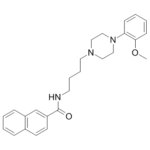
BP 897 is a first potent and selective agonist of dopamine D3 receptor, and a weak antagonist of dopamine D2 receptor with Kis of 0.92 nM and 61 nM for D3 and D2 receptors. It exhibits low affinities, with Ki values of 3 and 0.3 µM at the D1 and D4 receptors, respectively. In vitro, BP 897 functions as a partial agonist and can take on an antagonistic role in vivo. Without any intrinsic, primary rewarding effects, BP 897 inhibits cocaine-seeking behavior that is dependent on the presentation of drug-associated cues. According to the data, substances such as BP 897 may be used to lessen drug cravings and relapse susceptibility that are brought on by environmental cues related to drug use.
Physicochemical Properties
| Molecular Formula | C26H31N3O2 |
| Molecular Weight | 417.54324 |
| Exact Mass | 453.218 |
| Elemental Analysis | C, 74.79; H, 7.48; N, 10.06; O, 7.66 |
| CAS # | 314776-92-6 |
| Related CAS # | BP 897; 192384-87-5 |
| PubChem CID | 3038494 |
| Appearance | Solid powder |
| Boiling Point | 654.5ºC at 760mmHg |
| Flash Point | 349.6ºC |
| LogP | 5.56 |
| Hydrogen Bond Donor Count | 2 |
| Hydrogen Bond Acceptor Count | 4 |
| Rotatable Bond Count | 8 |
| Heavy Atom Count | 32 |
| Complexity | 549 |
| Defined Atom Stereocenter Count | 0 |
| SMILES | COC1=C(N2CCN(CCCCNC(C3=CC4=C(C=CC=C4)C=C3)=O)CC2)C=CC=C1.[H]Cl |
| InChi Key | MNHDKMDLOJSCGN-UHFFFAOYSA-N |
| InChi Code | InChI=1S/C26H31N3O2/c1-31-25-11-5-4-10-24(25)29-18-16-28(17-19-29)15-7-6-14-27-26(30)23-13-12-21-8-2-3-9-22(21)20-23/h2-5,8-13,20H,6-7,14-19H2,1H3,(H,27,30) |
| Chemical Name | N-(4-(4-(2-methoxyphenyl)piperazin-1-yl)butyl)-2-naphthamide |
| Synonyms | BP-897; BP897; BP 897 |
| HS Tariff Code | 2934.99.9001 |
| Storage |
Powder-20°C 3 years 4°C 2 years In solvent -80°C 6 months -20°C 1 month Note: Please store this product in a sealed and protected environment (e.g. under nitrogen), avoid exposure to moisture and light. |
| Shipping Condition | Room temperature (This product is stable at ambient temperature for a few days during ordinary shipping and time spent in Customs) |
Biological Activity
| Targets | D2 Receptor; D3 Receptor |
| ln Vitro | BP 897 hydrochloride adsorbs D1 and D4 (Ki=3 μM and 0.3 μM), α1 and α2 addin energy adsorption (Ki=60 nM and 83 nM) and 5HT1A and 5HT7 adsorption (Ki=84 nM and 345 nM) ) has affinity; it has negligible affinity for muscarinic, histamine and opioid receptors (Ki>1 μM)[1]. BP 897 hydrochloride inhibits forskolin-induced cyclic AMP accumulation in NG 108-15 cells expressing human D3 receptor with EC50=1 nM. BP 897 hydrochloride activates mitogenesis, and this response is preferentially induced by the D3 monoclonal antibody Nafadotride (1 μM) monoclonal antibody. BP 897 hydrochloride is also partially resistant to quinpirole (10 nM)-induced responses [1]. |
| ln Vivo | BP 897 hydrochloride binds to D2 capture in the mouse striatum with an ED50 of 15 mg/kg and a D3 capture occupancy of less than 0.5 mg/kg[1]. Animal model: Male Listar hooded rat [1] Dosage: 0.05, 0.5, 1 mg/kg Administration: intraperitoneal injection; 30 minutes before treatment Results: Dose-dependent reduction in cocaine-seeking behavior prior to first infusion of cocaine, Doses were similar to those at which BP 897 responded to rotation and c-fos expression. |
| Animal Protocol |
Male Listar hooded rats 0.05, 0.5, 1 mg/kg i.p.; 30 min before the session |
| References |
[1]. Selective inhibition of cocaine-seeking behaviour by a partial dopamine D3 receptor agonist [published correction appears in Nature 1999 Sep 23;401(6751):403]. Nature. 1999;400(6742):371-375. |
Solubility Data
| Solubility (In Vitro) | DMSO : ~125 mg/mL (~275.33 mM) |
| Solubility (In Vivo) |
Note: Listed below are some common formulations that may be used to formulate products with low water solubility (e.g. < 1 mg/mL), you may test these formulations using a minute amount of products to avoid loss of samples. Injection Formulations (e.g. IP/IV/IM/SC) Injection Formulation 1: DMSO : Tween 80: Saline = 10 : 5 : 85 (i.e. 100 μL DMSO stock solution → 50 μL Tween 80 → 850 μL Saline) *Preparation of saline: Dissolve 0.9 g of sodium chloride in 100 mL ddH ₂ O to obtain a clear solution. Injection Formulation 2: DMSO : PEG300 :Tween 80 : Saline = 10 : 40 : 5 : 45 (i.e. 100 μL DMSO → 400 μLPEG300 → 50 μL Tween 80 → 450 μL Saline) Injection Formulation 3: DMSO : Corn oil = 10 : 90 (i.e. 100 μL DMSO → 900 μL Corn oil) Example: Take the Injection Formulation 3 (DMSO : Corn oil = 10 : 90) as an example, if 1 mL of 2.5 mg/mL working solution is to be prepared, you can take 100 μL 25 mg/mL DMSO stock solution and add to 900 μL corn oil, mix well to obtain a clear or suspension solution (2.5 mg/mL, ready for use in animals). Injection Formulation 4: DMSO : 20% SBE-β-CD in saline = 10 : 90 [i.e. 100 μL DMSO → 900 μL (20% SBE-β-CD in saline)] *Preparation of 20% SBE-β-CD in Saline (4°C,1 week): Dissolve 2 g SBE-β-CD in 10 mL saline to obtain a clear solution. Injection Formulation 5: 2-Hydroxypropyl-β-cyclodextrin : Saline = 50 : 50 (i.e. 500 μL 2-Hydroxypropyl-β-cyclodextrin → 500 μL Saline) Injection Formulation 6: DMSO : PEG300 : castor oil : Saline = 5 : 10 : 20 : 65 (i.e. 50 μL DMSO → 100 μLPEG300 → 200 μL castor oil → 650 μL Saline) Injection Formulation 7: Ethanol : Cremophor : Saline = 10: 10 : 80 (i.e. 100 μL Ethanol → 100 μL Cremophor → 800 μL Saline) Injection Formulation 8: Dissolve in Cremophor/Ethanol (50 : 50), then diluted by Saline Injection Formulation 9: EtOH : Corn oil = 10 : 90 (i.e. 100 μL EtOH → 900 μL Corn oil) Injection Formulation 10: EtOH : PEG300:Tween 80 : Saline = 10 : 40 : 5 : 45 (i.e. 100 μL EtOH → 400 μLPEG300 → 50 μL Tween 80 → 450 μL Saline) Oral Formulations Oral Formulation 1: Suspend in 0.5% CMC Na (carboxymethylcellulose sodium) Oral Formulation 2: Suspend in 0.5% Carboxymethyl cellulose Example: Take the Oral Formulation 1 (Suspend in 0.5% CMC Na) as an example, if 100 mL of 2.5 mg/mL working solution is to be prepared, you can first prepare 0.5% CMC Na solution by measuring 0.5 g CMC Na and dissolve it in 100 mL ddH2O to obtain a clear solution; then add 250 mg of the product to 100 mL 0.5% CMC Na solution, to make the suspension solution (2.5 mg/mL, ready for use in animals). Oral Formulation 3: Dissolved in PEG400 Oral Formulation 4: Suspend in 0.2% Carboxymethyl cellulose Oral Formulation 5: Dissolve in 0.25% Tween 80 and 0.5% Carboxymethyl cellulose Oral Formulation 6: Mixing with food powders Note: Please be aware that the above formulations are for reference only. InvivoChem strongly recommends customers to read literature methods/protocols carefully before determining which formulation you should use for in vivo studies, as different compounds have different solubility properties and have to be formulated differently. (Please use freshly prepared in vivo formulations for optimal results.) |
| Preparing Stock Solutions | 1 mg | 5 mg | 10 mg | |
| 1 mM | 2.3950 mL | 11.9749 mL | 23.9498 mL | |
| 5 mM | 0.4790 mL | 2.3950 mL | 4.7900 mL | |
| 10 mM | 0.2395 mL | 1.1975 mL | 2.3950 mL |