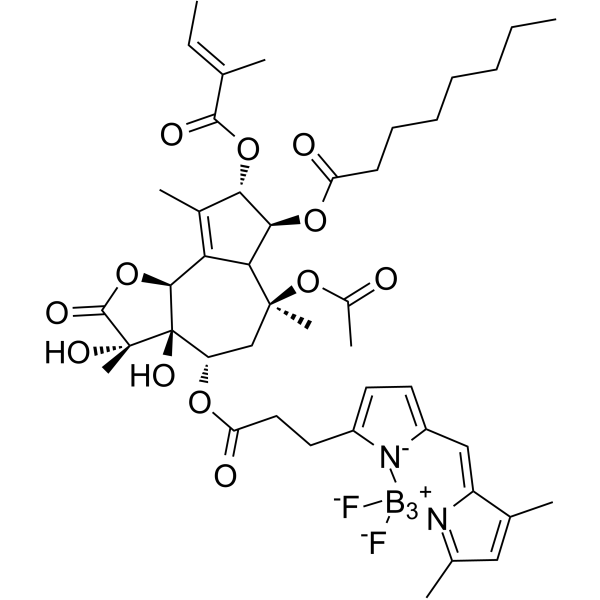
BODIPY FL Thapsigargin is a green fluorescent dye that inhibits intracellular SERCA-type Ca2+ pumps found in the sarcoplasmic/endoplasmic reticulum. BODIPY FL Thapsigargin has been used for study of thapsigargin binding sites in live cells.
Physicochemical Properties
| Molecular Formula | C44H57BN2O12F2 |
| Molecular Weight | 854.737 |
| CAS # | 216571-99-2 |
| Appearance | Typically exists as solid at room temperature |
| HS Tariff Code | 2934.99.9001 |
| Storage |
Powder-20°C 3 years 4°C 2 years In solvent -80°C 6 months -20°C 1 month |
| Shipping Condition | Room temperature (This product is stable at ambient temperature for a few days during ordinary shipping and time spent in Customs) |
Biological Activity
| Targets | Fluorescent dye |
| ln Vitro |
Instruction for use (This is our suggested protocol, which should be adjusted to suit your specific needs). Thapsigargin, BODIPY FL [1]: 1. For one hour at room temperature, fix the purified parasites with 1% formaldehyde in PBS (pH 8) solution and let them stick on glass slides coated with poly-L-lysine. The permeable parasites were inhibited using 0.1% Triton X-100 for five minutes and 3% bovine serum albumin in PBS for an hour after the slides were left on for twenty minutes. 2. For one hour at room temperature, incubate the parasite with a diluted 1:100 polyclonal primary antibody H-300. Next, add a diluted 1:100 goat anti-rabbit IgG secondary antibody conjugated with Texas Red, and incubate for five minutes with 0.25 μM BODIPY FL TG. 3. Use a fluorescent microplate reader, flow cytometer, or fluorescence microscope to analyze samples. |
| ln Vivo | Thapsigargin, a specific inhibitor of most animal intracellular SERCA-type Ca2+ pumps present in the sarcoplasmic/endoplasmic reticulum, was originally isolated from the roots of the Mediterranean plant Thapsia gargancia L. Here, we demonstrate that this root-derived compound is capable of altering root gravitropism in Arabidopsis thaliana. Thapsigargin concentrations as low as 0.1 microM alter root gravitropism whereas under similar conditions cyclopiazonic acid does not. Furthermore, a fluorescently conjugated thapsigargin (BODIPY FL thapsigargin) suggests that target sites for thapsigargin are located in intracellular organelles in the root distal elongation zone and the root cap, regions known to regulate root gravitropism[2]. |
| Cell Assay | In higher eukaryotes, the sarco-endoplasmic reticulum (ER) Ca(2+)-ATPase (SERCA) is characterized for its high sensitivity to low concentrations of thapsigargin (TG), a very specific inhibitor. In contrast, SERCA-like enzymes with different sensitivities to TG have been reported in trypanosomatids. Here, we characterized a SERCA-like enzyme from Trypanosoma evansi and evaluated its interaction with TG. Confocal fluorescence microscopy using BODIPY FL TG and specific anti-SERCA antibodies localized the T. evansi SERCA-like enzyme in the ER and confirmed its direct interaction with TG. Moreover, the use of either 1 μM TG or 25 μM 2',5'-di (tert-butyl)-1,4-benzohydroquinone prevented the reuptake of Ca(2+) and consequently produced a small increase in the parasite cytosolic calcium concentration in a calcium-free medium, which was released from the ER pool. A 3035 bp-sequence coding for a protein with an estimated molecular mass of 110.2 kDa was cloned from T. evansi. The corresponding gene product contained all the invariant residues and conserved motifs found in other P-type ATPases but lacked the calmodulin binding site. Modeling of the three-dimensional structure of the parasite enzyme revealed that the amino acid changes found in the TG-SERCA binding pocket do not compromise the interaction between the enzyme and the inhibitor. Therefore, we concluded that T. evansi possesses a SERCA-like protein that is inhibited by TG[1]. |
| References |
[1]. Presence of a thapsigargin-sensitive calcium pump in Trypanosoma evansi: Immunological, physiological, molecular and structural evidences. Exp Parasitol. 2015 Dec;159:107-17. [2]. The Ca2+ pump inhibitor, thapsigargin, inhibits root gravitropism in Arabidopsis thaliana. Biol Res. 2006;39(2):289-96. |
Solubility Data
| Solubility (In Vitro) | May dissolve in DMSO (in most cases), if not, try other solvents such as H2O, Ethanol, or DMF with a minute amount of products to avoid loss of samples |
| Solubility (In Vivo) |
Note: Listed below are some common formulations that may be used to formulate products with low water solubility (e.g. < 1 mg/mL), you may test these formulations using a minute amount of products to avoid loss of samples. Injection Formulations (e.g. IP/IV/IM/SC) Injection Formulation 1: DMSO : Tween 80: Saline = 10 : 5 : 85 (i.e. 100 μL DMSO stock solution → 50 μL Tween 80 → 850 μL Saline) *Preparation of saline: Dissolve 0.9 g of sodium chloride in 100 mL ddH ₂ O to obtain a clear solution. Injection Formulation 2: DMSO : PEG300 :Tween 80 : Saline = 10 : 40 : 5 : 45 (i.e. 100 μL DMSO → 400 μLPEG300 → 50 μL Tween 80 → 450 μL Saline) Injection Formulation 3: DMSO : Corn oil = 10 : 90 (i.e. 100 μL DMSO → 900 μL Corn oil) Example: Take the Injection Formulation 3 (DMSO : Corn oil = 10 : 90) as an example, if 1 mL of 2.5 mg/mL working solution is to be prepared, you can take 100 μL 25 mg/mL DMSO stock solution and add to 900 μL corn oil, mix well to obtain a clear or suspension solution (2.5 mg/mL, ready for use in animals). Injection Formulation 4: DMSO : 20% SBE-β-CD in saline = 10 : 90 [i.e. 100 μL DMSO → 900 μL (20% SBE-β-CD in saline)] *Preparation of 20% SBE-β-CD in Saline (4°C,1 week): Dissolve 2 g SBE-β-CD in 10 mL saline to obtain a clear solution. Injection Formulation 5: 2-Hydroxypropyl-β-cyclodextrin : Saline = 50 : 50 (i.e. 500 μL 2-Hydroxypropyl-β-cyclodextrin → 500 μL Saline) Injection Formulation 6: DMSO : PEG300 : castor oil : Saline = 5 : 10 : 20 : 65 (i.e. 50 μL DMSO → 100 μLPEG300 → 200 μL castor oil → 650 μL Saline) Injection Formulation 7: Ethanol : Cremophor : Saline = 10: 10 : 80 (i.e. 100 μL Ethanol → 100 μL Cremophor → 800 μL Saline) Injection Formulation 8: Dissolve in Cremophor/Ethanol (50 : 50), then diluted by Saline Injection Formulation 9: EtOH : Corn oil = 10 : 90 (i.e. 100 μL EtOH → 900 μL Corn oil) Injection Formulation 10: EtOH : PEG300:Tween 80 : Saline = 10 : 40 : 5 : 45 (i.e. 100 μL EtOH → 400 μLPEG300 → 50 μL Tween 80 → 450 μL Saline) Oral Formulations Oral Formulation 1: Suspend in 0.5% CMC Na (carboxymethylcellulose sodium) Oral Formulation 2: Suspend in 0.5% Carboxymethyl cellulose Example: Take the Oral Formulation 1 (Suspend in 0.5% CMC Na) as an example, if 100 mL of 2.5 mg/mL working solution is to be prepared, you can first prepare 0.5% CMC Na solution by measuring 0.5 g CMC Na and dissolve it in 100 mL ddH2O to obtain a clear solution; then add 250 mg of the product to 100 mL 0.5% CMC Na solution, to make the suspension solution (2.5 mg/mL, ready for use in animals). Oral Formulation 3: Dissolved in PEG400 Oral Formulation 4: Suspend in 0.2% Carboxymethyl cellulose Oral Formulation 5: Dissolve in 0.25% Tween 80 and 0.5% Carboxymethyl cellulose Oral Formulation 6: Mixing with food powders Note: Please be aware that the above formulations are for reference only. InvivoChem strongly recommends customers to read literature methods/protocols carefully before determining which formulation you should use for in vivo studies, as different compounds have different solubility properties and have to be formulated differently. (Please use freshly prepared in vivo formulations for optimal results.) |
| Preparing Stock Solutions | 1 mg | 5 mg | 10 mg | |
| 1 mM | 1.1699 mL | 5.8497 mL | 11.6995 mL | |
| 5 mM | 0.2340 mL | 1.1699 mL | 2.3399 mL | |
| 10 mM | 0.1170 mL | 0.5850 mL | 1.1699 mL |