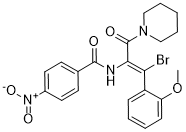
Physicochemical Properties
| Molecular Formula | C22H22BRN3O5 |
| Molecular Weight | 488.3312 |
| Exact Mass | 487.074 |
| CAS # | 211364-06-6 |
| PubChem CID | 3002812 |
| Appearance | White to off-white solid powder |
| LogP | 4 |
| Hydrogen Bond Donor Count | 1 |
| Hydrogen Bond Acceptor Count | 5 |
| Rotatable Bond Count | 5 |
| Heavy Atom Count | 31 |
| Complexity | 694 |
| Defined Atom Stereocenter Count | 0 |
| SMILES | COC1=CC=CC=C1/C(=C(/C(=O)N2CCCCC2)\NC(=O)C3=CC=C(C=C3)[N+](=O)[O-])/Br |
| InChi Key | OQIUTYABZMBBME-FMQUCBEESA-N |
| InChi Code | InChI=1S/C22H22BrN3O5/c1-31-18-8-4-3-7-17(18)19(23)20(22(28)25-13-5-2-6-14-25)24-21(27)15-9-11-16(12-10-15)26(29)30/h3-4,7-12H,2,5-6,13-14H2,1H3,(H,24,27)/b20-19+ |
| Chemical Name | N-[(E)-1-bromo-1-(2-methoxyphenyl)-3-oxo-3-piperidin-1-ylprop-1-en-2-yl]-4-nitrobenzamide |
| Synonyms | AT-130 AT130 AT 130 |
| HS Tariff Code | 2934.99.9001 |
| Storage |
Powder-20°C 3 years 4°C 2 years In solvent -80°C 6 months -20°C 1 month |
| Shipping Condition | Room temperature (This product is stable at ambient temperature for a few days during ordinary shipping and time spent in Customs) |
Biological Activity
| ln Vitro | AT-130 suppresses rtL180M (IC50=9.8 μM), rtM204I (IC50=35.6 μM), and Wt (IC50=2.4 μM) HBV [1]. HepG2 cells transduced with HBV baculovirus showed dose-dependent suppression of wt HBV replication when treated with AT-130 (0.1, 1, 5, 10, 100 μM) for 7 days. When AT-130 is present, encapsidated HBV DNA is reduced by 50% (IC50) at 2.5 μM and by 90% (IC90) at 18.5 μM [1]. At concentrations as high as 250 μM, AT-130 does not cause harm to HepG2 or Huh-7 cells [1]. By directly inhibiting the HBV endogenous DNA polymerase reaction in Huh 7 or HepG2 cells, AT-130 (0.005, 0.05, 0.5, 5, 50 μM) does not inhibit HBV DNA synthesis. While AT-130 has no effect on viral DNA polymerase activity or core protein translation, it suppresses the replication of HBV DNA in liver cancer cells [3]. While it decreases encapsidated RNA, AT-130 (2.5, 18.5 μM) had little effect on total HBV RNA. The activity of protein expression vectors and the synthesis of nucleocapsids or core proteins are unaffected by AT-130 [3]. |
| References |
[1]. Phenylpropenamide derivatives AT-61 and AT-130 inhibit replication of wild-type and lamivudine-resistant strains of hepatitis B virus in vitro. Antimicrob Agents Chemother. 2002 Sep;46(9):3057-60. [2]. Phenylpropenamide derivatives as inhibitors of hepatitis B virus replication. Bioorg Med Chem Lett. 2000 Dec 4;10(23):2687-90. [3]. The phenylpropenamide derivative AT-130 blocks HBV replication at the level of viral RNA packaging. Antiviral Res. 2007 Nov;76(2):168-77. |
Solubility Data
| Solubility (In Vitro) | DMSO : ~25 mg/mL (~51.19 mM) |
| Solubility (In Vivo) |
Solubility in Formulation 1: ≥ 2.5 mg/mL (5.12 mM) (saturation unknown) in 10% DMSO + 90% Corn Oil (add these co-solvents sequentially from left to right, and one by one), clear solution. For example, if 1 mL of working solution is to be prepared, you can add 100 μL of 25.0 mg/mL clear DMSO stock solution to 900 μL of corn oil and mix evenly. (Please use freshly prepared in vivo formulations for optimal results.) |
| Preparing Stock Solutions | 1 mg | 5 mg | 10 mg | |
| 1 mM | 2.0478 mL | 10.2390 mL | 20.4780 mL | |
| 5 mM | 0.4096 mL | 2.0478 mL | 4.0956 mL | |
| 10 mM | 0.2048 mL | 1.0239 mL | 2.0478 mL |