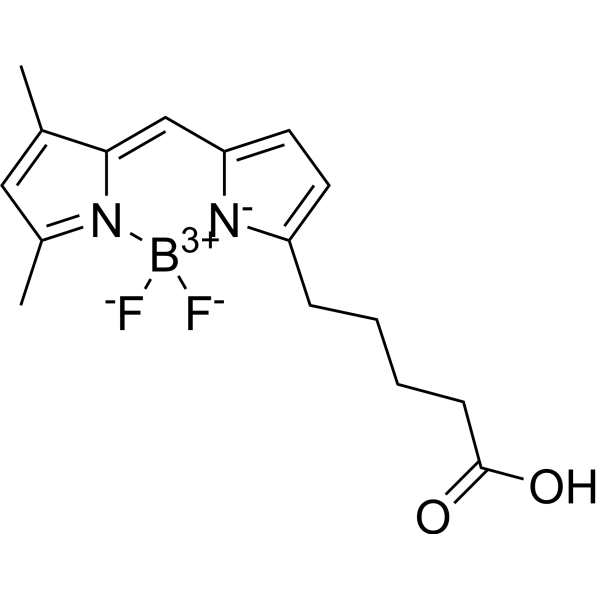
Physicochemical Properties
| Molecular Formula | C16H18BN2O2F2-.H+ |
| Molecular Weight | 320.142 |
| CAS # | 217075-24-6 |
| PubChem CID | 172653034 |
| Appearance | Orange to red solid powder |
| Hydrogen Bond Donor Count | 1 |
| Hydrogen Bond Acceptor Count | 5 |
| Rotatable Bond Count | 5 |
| Heavy Atom Count | 23 |
| Complexity | 615 |
| Defined Atom Stereocenter Count | 0 |
| SMILES | [H+].C(C1=CC=C2C=C3C(C)=CC(C)=N3[B+3]([F-])([F-])[N-]12)CCCC(=O)[O-] |
| HS Tariff Code | 2934.99.9001 |
| Storage |
Powder-20°C 3 years 4°C 2 years In solvent -80°C 6 months -20°C 1 month |
| Shipping Condition | Room temperature (This product is stable at ambient temperature for a few days during ordinary shipping and time spent in Customs) |
Biological Activity
| ln Vitro | Advice (This is our suggested protocol, which should be adjusted to suit your particular circumstances as it simply offers guidance). A. Assaying Enzymes [1]: 1. After placing an aliquot of phospholipids in a 1 × 1-cm fluorescent cuvette, fill the remaining capacity to 1.3 ml with buffer (50 mM Tris, pH 8, 100 mM NaCl, 1 mM CaCl2). After a few minutes of stirring to bring the temperature up to 35°C, record the background emission (background rate is not discernible). Add 1–10 µL of enzyme, then note the emission. 2. A 1 × 1-cm fluorescence cuvette should be filled with an aliquot of phospholipids (78 μL of 0.05 mM substrate/0.5 mM DTPM), and 1.3 mL of buffer (50 mM Tris, pH 8, 100 mM NaCl, 1 mM CaCl2, 30% Glycerol) should be added. After a few minutes of stirring to bring the temperature up to 35°C, record the background emission (background rate is not discernible). Incorporate the enzyme (1–10 μL), further blend the thick solution, and note the release of emissions. 3. To boost the recording emissions, add a measured amount of BODIPYFL-C5 (for PBPEC6DNP and MBPEDNP) or BODIPY-FL-C5-lyso-PAF (for BC11-DNPC8-PC) to the phospholipid substrate solution. Using a factor (picomoles of BODIPY product/unit increase in intensity), the increase in emission per second is subsequently translated to picomoles of product/second in the assay. B. In vitro zebrafish experiment[1]: 1. In 0.15 mL of embryo culture medium (EM) (i.e., 13.7 mM NaCl, 0.537 mM KCl, 0.025 mM Na2HPO4, 0.044 mM KH2PO4, 1.30 mM CaCl2, 1 mM MgSO4, 4.2 mM NaHCO3, pH 7.2) should be added to the embryos. 2. includes 150–200 ng of fluorescent phospholipid substrate that has been sonicated for two to five seconds. 3. Add 0.45 mL of chloroform:methanol (2:1) to stop the reaction after it has been reacting for an hour at 37°C. Mix, then centrifuge (30 seconds, 16,000g). 4. Place an aliquot of the organic fraction onto the TLC plate and discard the aqueous fraction. 5. Using a laser scanner, the plate was produced in a solution of toluene, ether, ethanol, and acetic acid (50:40:2:0.2). |
| References |
[1]. Intramolecularly quenched BODIPY-labeled phospholipid analogs in phospholipase A(2) and platelet-activating factor acetylhydrolase assays and in vivo fluorescence imaging. Anal Biochem. 1999 Dec 1;276(1):27-35. |
Solubility Data
| Solubility (In Vitro) | May dissolve in DMSO (in most cases), if not, try other solvents such as H2O, Ethanol, or DMF with a minute amount of products to avoid loss of samples |
| Solubility (In Vivo) |
Note: Listed below are some common formulations that may be used to formulate products with low water solubility (e.g. < 1 mg/mL), you may test these formulations using a minute amount of products to avoid loss of samples. Injection Formulations (e.g. IP/IV/IM/SC) Injection Formulation 1: DMSO : Tween 80: Saline = 10 : 5 : 85 (i.e. 100 μL DMSO stock solution → 50 μL Tween 80 → 850 μL Saline) *Preparation of saline: Dissolve 0.9 g of sodium chloride in 100 mL ddH ₂ O to obtain a clear solution. Injection Formulation 2: DMSO : PEG300 :Tween 80 : Saline = 10 : 40 : 5 : 45 (i.e. 100 μL DMSO → 400 μLPEG300 → 50 μL Tween 80 → 450 μL Saline) Injection Formulation 3: DMSO : Corn oil = 10 : 90 (i.e. 100 μL DMSO → 900 μL Corn oil) Example: Take the Injection Formulation 3 (DMSO : Corn oil = 10 : 90) as an example, if 1 mL of 2.5 mg/mL working solution is to be prepared, you can take 100 μL 25 mg/mL DMSO stock solution and add to 900 μL corn oil, mix well to obtain a clear or suspension solution (2.5 mg/mL, ready for use in animals). Injection Formulation 4: DMSO : 20% SBE-β-CD in saline = 10 : 90 [i.e. 100 μL DMSO → 900 μL (20% SBE-β-CD in saline)] *Preparation of 20% SBE-β-CD in Saline (4°C,1 week): Dissolve 2 g SBE-β-CD in 10 mL saline to obtain a clear solution. Injection Formulation 5: 2-Hydroxypropyl-β-cyclodextrin : Saline = 50 : 50 (i.e. 500 μL 2-Hydroxypropyl-β-cyclodextrin → 500 μL Saline) Injection Formulation 6: DMSO : PEG300 : castor oil : Saline = 5 : 10 : 20 : 65 (i.e. 50 μL DMSO → 100 μLPEG300 → 200 μL castor oil → 650 μL Saline) Injection Formulation 7: Ethanol : Cremophor : Saline = 10: 10 : 80 (i.e. 100 μL Ethanol → 100 μL Cremophor → 800 μL Saline) Injection Formulation 8: Dissolve in Cremophor/Ethanol (50 : 50), then diluted by Saline Injection Formulation 9: EtOH : Corn oil = 10 : 90 (i.e. 100 μL EtOH → 900 μL Corn oil) Injection Formulation 10: EtOH : PEG300:Tween 80 : Saline = 10 : 40 : 5 : 45 (i.e. 100 μL EtOH → 400 μLPEG300 → 50 μL Tween 80 → 450 μL Saline) Oral Formulations Oral Formulation 1: Suspend in 0.5% CMC Na (carboxymethylcellulose sodium) Oral Formulation 2: Suspend in 0.5% Carboxymethyl cellulose Example: Take the Oral Formulation 1 (Suspend in 0.5% CMC Na) as an example, if 100 mL of 2.5 mg/mL working solution is to be prepared, you can first prepare 0.5% CMC Na solution by measuring 0.5 g CMC Na and dissolve it in 100 mL ddH2O to obtain a clear solution; then add 250 mg of the product to 100 mL 0.5% CMC Na solution, to make the suspension solution (2.5 mg/mL, ready for use in animals). Oral Formulation 3: Dissolved in PEG400 Oral Formulation 4: Suspend in 0.2% Carboxymethyl cellulose Oral Formulation 5: Dissolve in 0.25% Tween 80 and 0.5% Carboxymethyl cellulose Oral Formulation 6: Mixing with food powders Note: Please be aware that the above formulations are for reference only. InvivoChem strongly recommends customers to read literature methods/protocols carefully before determining which formulation you should use for in vivo studies, as different compounds have different solubility properties and have to be formulated differently. (Please use freshly prepared in vivo formulations for optimal results.) |
| Preparing Stock Solutions | 1 mg | 5 mg | 10 mg | |
| 1 mM | 3.1236 mL | 15.6182 mL | 31.2363 mL | |
| 5 mM | 0.6247 mL | 3.1236 mL | 6.2473 mL | |
| 10 mM | 0.3124 mL | 1.5618 mL | 3.1236 mL |