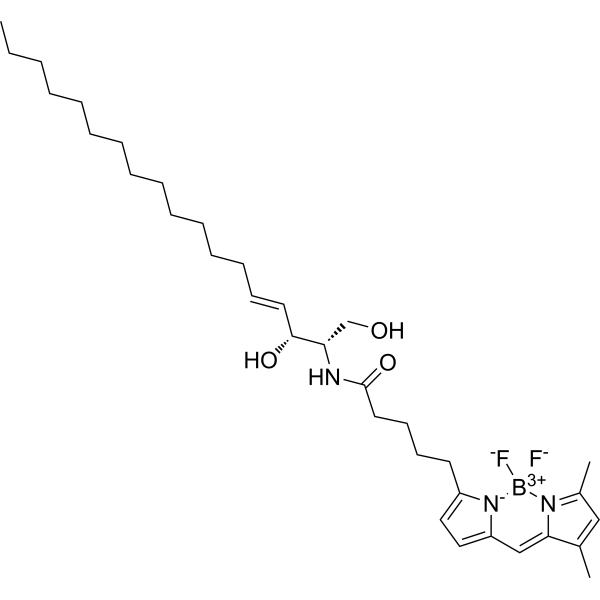
Physicochemical Properties
| Molecular Formula | C34H54BN3O3F2 |
| Molecular Weight | 601.619 |
| CAS # | 133867-53-5 |
| Appearance | Brown to red solid powder |
| SMILES | C(C1=CC=C2C=C3C(C)=CC(C)=N3[B+3]([F-])([F-])[N-]12)CCCC(=O)NC(CO)C(O)C=CCCCCCCCCCCCCC |
| HS Tariff Code | 2934.99.9001 |
| Storage |
Powder-20°C 3 years 4°C 2 years In solvent -80°C 6 months -20°C 1 month Note: This product requires protection from light (avoid light exposure) during transportation and storage. |
| Shipping Condition | Room temperature (This product is stable at ambient temperature for a few days during ordinary shipping and time spent in Customs) |
Biological Activity
| ln Vitro | Guidelines for usage 1. Ingredients for the Golgi working solution 1.1 Make a 5 mM stock solution with DMSO. Note: To prevent recurrent freeze-thaw cycles, it is advised to store the stock solution at -20°C or -80°C in the dark. 1.2 To create a 1–10 μM Golgi working solution, utilize previously produced PBS or culture medium solution. Note: Please prepare Golgi 1-43 working solution for use by adjusting its concentration to suit the current circumstances. 2. Suspension cell staining (2.1): Gather cells at 1,000 g, 4°C, centrifuge for three to five minutes, and remove the supernatant. After adding PBS, wash for five minutes each time. The density of cells is 1×10⁶/mL. 2.2 Add one milliliter of the Golgi working solution (2.3 400 g, 4°C), centrifuge for three to four minutes, and then remove the supernatant. 2.4 Wash the cells twice with PBS, giving them five minutes each time. 2.5 Observe using a flow cytometer or fluorescence microscope after resuspending the cells in 1 mL of serum-free bone marrow or PBS. 3. Adherent cells for staining 3.1 Adherent cells are cultured on sterile coverslips. 3.2 Take off the cell coverslip, aspirate 3.3, add 100 μL of the dye working solution, and shake for 20 to 30 minutes to cover the cells thoroughly. 3.4 Aspirate out the dye working solution, wash twice in culture media for five minutes each time, then use a flow cytometer or fluorescence microscope to monitor. Storage conditions: -20°C for a year, with protection from light. Precautions: 1. The storage solution should be kept out of direct sunlight, at a temperature of -20°C or -80°C, and not frozen and thawed too frequently. 2. Please modify the Golgi 1-43 working solution's concentration and dilution duration to reflect the current circumstances. 3. Alternatively, the diluent Hanks balanced salt solution can be used for washing if the results of utilizing cells are not satisfactory and the cell culture medium is reached. 4. This product should not be used for clinical diagnosis or treatment, nor should it be included into food or medication. It is intended solely for professional use in scientific study. 5. Please wear a lab coat and a snap shot operation for your health and safety. |
| References |
[1]. Development of background-free tame fluorescent probes for intracellular live cell imaging. Nat Commun. 2016 Jun 20;7:11964. [2]. Isolation of single Chlamydia-infected cells using laser microdissection. J Microbiol Methods. 2015 Feb;109:123-8. |
Solubility Data
| Solubility (In Vitro) | DMSO : ~50 mg/mL (~83.11 mM) |
| Solubility (In Vivo) |
Note: Listed below are some common formulations that may be used to formulate products with low water solubility (e.g. < 1 mg/mL), you may test these formulations using a minute amount of products to avoid loss of samples. Injection Formulations (e.g. IP/IV/IM/SC) Injection Formulation 1: DMSO : Tween 80: Saline = 10 : 5 : 85 (i.e. 100 μL DMSO stock solution → 50 μL Tween 80 → 850 μL Saline) *Preparation of saline: Dissolve 0.9 g of sodium chloride in 100 mL ddH ₂ O to obtain a clear solution. Injection Formulation 2: DMSO : PEG300 :Tween 80 : Saline = 10 : 40 : 5 : 45 (i.e. 100 μL DMSO → 400 μLPEG300 → 50 μL Tween 80 → 450 μL Saline) Injection Formulation 3: DMSO : Corn oil = 10 : 90 (i.e. 100 μL DMSO → 900 μL Corn oil) Example: Take the Injection Formulation 3 (DMSO : Corn oil = 10 : 90) as an example, if 1 mL of 2.5 mg/mL working solution is to be prepared, you can take 100 μL 25 mg/mL DMSO stock solution and add to 900 μL corn oil, mix well to obtain a clear or suspension solution (2.5 mg/mL, ready for use in animals). Injection Formulation 4: DMSO : 20% SBE-β-CD in saline = 10 : 90 [i.e. 100 μL DMSO → 900 μL (20% SBE-β-CD in saline)] *Preparation of 20% SBE-β-CD in Saline (4°C,1 week): Dissolve 2 g SBE-β-CD in 10 mL saline to obtain a clear solution. Injection Formulation 5: 2-Hydroxypropyl-β-cyclodextrin : Saline = 50 : 50 (i.e. 500 μL 2-Hydroxypropyl-β-cyclodextrin → 500 μL Saline) Injection Formulation 6: DMSO : PEG300 : castor oil : Saline = 5 : 10 : 20 : 65 (i.e. 50 μL DMSO → 100 μLPEG300 → 200 μL castor oil → 650 μL Saline) Injection Formulation 7: Ethanol : Cremophor : Saline = 10: 10 : 80 (i.e. 100 μL Ethanol → 100 μL Cremophor → 800 μL Saline) Injection Formulation 8: Dissolve in Cremophor/Ethanol (50 : 50), then diluted by Saline Injection Formulation 9: EtOH : Corn oil = 10 : 90 (i.e. 100 μL EtOH → 900 μL Corn oil) Injection Formulation 10: EtOH : PEG300:Tween 80 : Saline = 10 : 40 : 5 : 45 (i.e. 100 μL EtOH → 400 μLPEG300 → 50 μL Tween 80 → 450 μL Saline) Oral Formulations Oral Formulation 1: Suspend in 0.5% CMC Na (carboxymethylcellulose sodium) Oral Formulation 2: Suspend in 0.5% Carboxymethyl cellulose Example: Take the Oral Formulation 1 (Suspend in 0.5% CMC Na) as an example, if 100 mL of 2.5 mg/mL working solution is to be prepared, you can first prepare 0.5% CMC Na solution by measuring 0.5 g CMC Na and dissolve it in 100 mL ddH2O to obtain a clear solution; then add 250 mg of the product to 100 mL 0.5% CMC Na solution, to make the suspension solution (2.5 mg/mL, ready for use in animals). Oral Formulation 3: Dissolved in PEG400 Oral Formulation 4: Suspend in 0.2% Carboxymethyl cellulose Oral Formulation 5: Dissolve in 0.25% Tween 80 and 0.5% Carboxymethyl cellulose Oral Formulation 6: Mixing with food powders Note: Please be aware that the above formulations are for reference only. InvivoChem strongly recommends customers to read literature methods/protocols carefully before determining which formulation you should use for in vivo studies, as different compounds have different solubility properties and have to be formulated differently. (Please use freshly prepared in vivo formulations for optimal results.) |
| Preparing Stock Solutions | 1 mg | 5 mg | 10 mg | |
| 1 mM | 1.6622 mL | 8.3109 mL | 16.6218 mL | |
| 5 mM | 0.3324 mL | 1.6622 mL | 3.3244 mL | |
| 10 mM | 0.1662 mL | 0.8311 mL | 1.6622 mL |