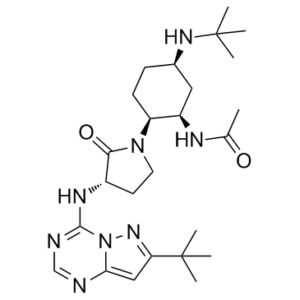
BMS-813160 (BMS813160) is a novel, potent, selective and dual antagonist of CCR2/CCR5 (CC chemokine receptor) with potential immunomodulating and antineoplastic activities. It is the first dual CCR2/CCR5 antagonist to be tested in clinical settings for the management of heart conditions. BMS-813160 selectively binds to CCR2 and CCR5 and inhibits their activation. This suppresses the activation of signal transduction pathways mediated by CCR2/CCR5, which may suppress angiogenesis, inflammation, tumor cell migration, invasion, and proliferation.
Physicochemical Properties
| Molecular Formula | C25H40N8O2 |
| Molecular Weight | 484.637504577637 |
| Exact Mass | 484.33 |
| Elemental Analysis | C, 61.96; H, 8.32; N, 23.12; O, 6.60 |
| CAS # | 1286279-29-5 |
| PubChem CID | 51039119 |
| Appearance | White to off-white solid powder |
| LogP | 2.7 |
| Hydrogen Bond Donor Count | 3 |
| Hydrogen Bond Acceptor Count | 7 |
| Rotatable Bond Count | 7 |
| Heavy Atom Count | 35 |
| Complexity | 778 |
| Defined Atom Stereocenter Count | 4 |
| SMILES | CC(=O)N[C@@H]1C[C@@H](CC[C@@H]1N2CC[C@@H](C2=O)NC3=NC=NC4=CC(=NN43)C(C)(C)C)NC(C)(C)C |
| InChi Key | CMVHFGNTABZQJU-HCXYKTFWSA-N |
| InChi Code | InChI=1S/C25H40N8O2/c1-15(34)28-18-12-16(30-25(5,6)7)8-9-19(18)32-11-10-17(22(32)35)29-23-27-14-26-21-13-20(24(2,3)4)31-33(21)23/h13-14,16-19,30H,8-12H2,1-7H3,(H,28,34)(H,26,27,29)/t16-,17+,18-,19+/m1/s1 |
| Chemical Name | N-[(1R,2S,5R)-5-(tert-butylamino)-2-[(3S)-3-[(7-tert-butylpyrazolo[1,5-a][1,3,5]triazin-4-yl)amino]-2-oxopyrrolidin-1-yl]cyclohexyl]acetamide |
| Synonyms | BMS813160; BMS-813160; BMS 813160 - Bio-X; BMS813160; BMS 813160; 83U7957287; Acetamide, N-((1R,2S,5R)-5-((1,1-dimethylethyl)amino)-2-((3S)-3-((7-(1,1-dimethylethyl)pyrazolo(1,5-a)-1,3,5-triazin-4-yl)amino)-2-oxo-1-pyrrolidinyl)cyclohexyl)-; N-((1R,2S,5R)-5-((1,1-Dimethylethyl)amino)-2-((3S)-3-((7-(1,1-dimethylethyl)pyrazolo(1,5-a)-1,3,5-triazin-4-yl)amino)-2-oxo-1-pyrrolidinyl)cyclohexyl)acetamide; BMS 813160 |
| HS Tariff Code | 2934.99.9001 |
| Storage |
Powder-20°C 3 years 4°C 2 years In solvent -80°C 6 months -20°C 1 month Note: This product requires protection from light (avoid light exposure) during transportation and storage. |
| Shipping Condition | Room temperature (This product is stable at ambient temperature for a few days during ordinary shipping and time spent in Customs) |
Biological Activity
| Targets | CCR5 ( IC50 = 3.6 nM ); CCR2 ( IC50 = 6.2 nM ) |
| ln Vitro |
BMS-813160 binds to CCR2, CCR5, CCR1, CCR4, and CXCR2 with IC50s of 6.2 nM, 3.6 nM, >25 μM, >40 μM and >40 μM, respectively[2]. MS-813160 exhibits activities to CCR2 CTX, CCR2 CD11b, CCR5 CTX, and CCR5 CD11b with IC50s of 0.8, 4.8, 1.1 and 5.7 nM, respectively[2]. |
| ln Vivo | BMS-813160 (10-160 mg/kg; p.o. twice daily for two days) exhibits good oral bioavailability and prevents the migration of inflammatory monocytes and macrophages in a mouse model of thioglycollate-induced peritonitis[2]. |
| Enzyme Assay |
Method for liver microsome t1/2 assay (LM t1/2). [2] Using compound 3 as an example, compound 3 (0.5 M) was incubated with liver microsomes (1 mg/mL final concentration) fortified with NADPH (1 mM) at 37 °C. Metabolic reactions were terminated after 0, 5, 10, 15, 30, and 45 minutes by transferring an aliquot of the reaction mixtures into an acetonitrile quench solution to denature microsomal enzymes. The relative amount of the compound 3 remaining in the reaction mixtures at each time point was quantified using LC-MS/MS analysis. The results for each time point were normalized to the relative amount of compound 3 in the 0-minute sample and expressed as percent remaining. The elimination rate constant (kel) was determined using a linear regression model (natural logarithm of % remaining versus time), and metabolic half-life was calculated (0.693 /kel). |
| Cell Assay |
Human CXCR2 binding assay (CXCR2 Bnd).[2] The human CXCR2 ligand binding assay was established with human overexpressed pEAK cells using human [ 125I]-Interlukin-8 as the tracer ligand. 10 μg of membrane per well was incubated with [125I]-Interleukin-8 (2000 Ci/mmol, 0.162 nM) and 200 nM unlabeled ligand in a total volume of 0.1 mL for 90 min at 25 °C. The mixture was filtered over GF/C (S&S) filters (presoaked in 0.5% PEI) and the filters were washed 5x with 1 mL ice-cold 50 mM HEPES-KOH (pH 7.4), 0.5 M NaCl and 0.1% BSA. After washing, the plate was air-dried for 60 minutes at room temperature. This was followed by adding 25 L of Microscint 20 into each well. The plate was sealed and counted on the S5 Trilux for 1 min. All conditions were tested in duplicate. The IC50 is defined as the concentration of competing cold ligand required to reduce specific binding by 50%. |
| Animal Protocol |
Human-CCR2 knock-in C57BL/6 male mice with thioglycollate injection 10, 50 and 160 mg/kg Oral gavage; 10-160 mg/kg twice a day; for two days Thioglycollate (TG)-induced peritonitis mouse model[2] Six to eight C57BL/6 male mice (Taconic Laboratories), age 9-11 weeks, were treated with compound (vehicle was 0.02 N HCl) by gavage one hour prior to thioglycollate challenge. Thioglycollate (Hardy Diagnostics) was administered IP, 1 mL per mouse. For the 48 hour model, mice were dosed by gavage, BID, for 2 days. On day 3, serum was collected for compound exposure, and the mice were sacrificed by carbon dioxide overdose. The peritoneal cavity was injected with 5 mL phosphate-buffered saline containing 0.01M EDTA and 10% fetal bovine serum. The peritoneal cavity was massaged 15 times, and then the contents collected to retrieve the inflammatory cells. The typical retrieval volume was 4.2-4.5 mL. Total cell counts were determined on a CASY counter, and cytospin slides were made of the lavaged cells. The slides were stained with Diff-Quik, and differential cell counts were performed by manually counting 200 cells per slide. The total cell number of each inflammatory cell type was calculated for each mouse. The average and standard error of the mean (SEM) for recruited monocytes and macrophages for each group was plotted. |
| References |
[1]. A dual CCR2/CCR5 chemokine antagonist, BMS-813160? Evaluation of WO2011046916. Expert Opin Ther Pat. 2011 Dec;21(12):1919-24. [2]. BMS-813160: A Potent CCR2 and CCR5 Dual Antagonist Selected as a Clinical Candidate. ACS Med Chem Lett. 2021 Oct 15;12(11):1753-1758. |
| Additional Infomation |
BMS-813160 is under investigation in clinical trial NCT03496662 (BMS-813160 With Nivolumab and Gemcitabine and Nab-paclitaxel in Borderline Resectable and Locally Advanced Pancreatic Ductal Adenocarcinoma (PDAC)). CCR2/CCR5 Antagonist BMS-813160 is an antagonist of both human C-C chemokine receptor types 2 (CCR2; CD192) and 5 (CCR5; CD195), with potential immunomodulating and antineoplastic activities. Upon administration, CCR2/CCR5 antagonist BMS-813160 specifically binds and prevents the activation of both CCR2 and CCR5. This inhibits the activation of CCR2/CCR5-mediated signal transduction pathways and may inhibit inflammatory processes, angiogenesis, tumor cell migration, tumor cell proliferation and invasion. The G-protein coupled chemokine receptors CCR2 and CCR5 are expressed on the surface of monocytes and macrophages, and stimulate their migration and infiltration; they play key roles in inflammation and autoimmune disease. CCR2 and CCR5 are overexpressed in certain cancer cell types, and are also involved in angiogenesis, and in tumor cell migration, proliferation and metastasis. |
Solubility Data
| Solubility (In Vitro) |
DMSO: 25~97 mg/mL (51.6~200.1 mM) Ethanol: ~97 mg/mL |
| Solubility (In Vivo) |
Solubility in Formulation 1: ≥ 2.08 mg/mL (4.29 mM) (saturation unknown) in 10% DMSO + 40% PEG300 + 5% Tween80 + 45% Saline (add these co-solvents sequentially from left to right, and one by one), clear solution. For example, if 1 mL of working solution is to be prepared, you can add 100 μL of 20.8 mg/mL clear DMSO stock solution to 400 μL PEG300 and mix evenly; then add 50 μL Tween-80 to the above solution and mix evenly; then add 450 μL normal saline to adjust the volume to 1 mL. Preparation of saline: Dissolve 0.9 g of sodium chloride in 100 mL ddH₂ O to obtain a clear solution. Solubility in Formulation 2: ≥ 2.08 mg/mL (4.29 mM) (saturation unknown) in 10% DMSO + 90% (20% SBE-β-CD in Saline) (add these co-solvents sequentially from left to right, and one by one), clear solution. For example, if 1 mL of working solution is to be prepared, you can add 100 μL of 20.8 mg/mL clear DMSO stock solution to 900 μL of 20% SBE-β-CD physiological saline solution and mix evenly. Preparation of 20% SBE-β-CD in Saline (4°C,1 week): Dissolve 2 g SBE-β-CD in 10 mL saline to obtain a clear solution. Solubility in Formulation 3: ≥ 2.08 mg/mL (4.29 mM) (saturation unknown) in 10% DMSO + 90% Corn Oil (add these co-solvents sequentially from left to right, and one by one), clear solution. For example, if 1 mL of working solution is to be prepared, you can add 100 μL of 20.8 mg/mL clear DMSO stock solution to 900 μL of corn oil and mix evenly. (Please use freshly prepared in vivo formulations for optimal results.) |
| Preparing Stock Solutions | 1 mg | 5 mg | 10 mg | |
| 1 mM | 2.0634 mL | 10.3169 mL | 20.6339 mL | |
| 5 mM | 0.4127 mL | 2.0634 mL | 4.1268 mL | |
| 10 mM | 0.2063 mL | 1.0317 mL | 2.0634 mL |