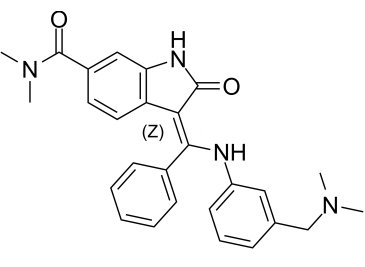
BIX02189 is a novel, potent and selective MEK5 inhibitor with an IC50 of 1.5 nM, also inhibits ERK5 catalytic activity with an IC50 of 59 nM. It was claimed to prevent the purified MEK5 enzyme from performing its catalytic function. In sorbitol-stimulated HeLa cells, BIX02189 prevented ERK5 phosphorylation while having no effect on ERK1/2 phosphorylation. In a cellular trans-reporter assay system, BIX02189 additionally prevented the transcriptional activation of MEF2C, a downstream substrate of the MEK5/ERK5 signaling cascade. To better understand the function of the MEK5/ERK5 pathway in various biological systems, BIX02189 may provide novel pharmacological tools.
Physicochemical Properties
| Molecular Formula | C₂₇H₂₈N₄O₂M |
| Molecular Weight | 440.53682 |
| Exact Mass | 440.221 |
| Elemental Analysis | C, 73.61; H, 6.41; N, 12.72; O, 7.26 |
| CAS # | 1265916-41-3 |
| Related CAS # | (E/Z)-BIX02189;1094614-85-3 |
| PubChem CID | 135659062 |
| Appearance | White to yellow solid powder |
| Density | 1.2±0.1 g/cm3 |
| Boiling Point | 653.4±55.0 °C at 760 mmHg |
| Flash Point | 349.0±31.5 °C |
| Vapour Pressure | 0.0±2.0 mmHg at 25°C |
| Index of Refraction | 1.659 |
| LogP | 2.05 |
| Hydrogen Bond Donor Count | 2 |
| Hydrogen Bond Acceptor Count | 4 |
| Rotatable Bond Count | 6 |
| Heavy Atom Count | 33 |
| Complexity | 688 |
| Defined Atom Stereocenter Count | 0 |
| SMILES | O=C(N(C)C)C1=CC(NC2=O)=C(/C2=C(C3=CC=CC=C3)/NC4=CC=CC(CN(C)C)=C4)C=C1 |
| InChi Key | ZGXOBLVQIVXKEB-UHFFFAOYSA-N |
| InChi Code | InChI=1S/C27H28N4O2/c1-30(2)17-18-9-8-12-21(15-18)28-25(19-10-6-5-7-11-19)24-22-14-13-20(27(33)31(3)4)16-23(22)29-26(24)32/h5-16,29,32H,17H2,1-4H3 |
| Chemical Name | 3-[N-[3-[(dimethylamino)methyl]phenyl]-C-phenylcarbonimidoyl]-2-hydroxy-N,N-dimethyl-1H-indole-6-carboxamide |
| Synonyms | BIX02189; BIX 02189; BIX-02189 |
| HS Tariff Code | 2934.99.9001 |
| Storage |
Powder-20°C 3 years 4°C 2 years In solvent -80°C 6 months -20°C 1 month |
| Shipping Condition | Room temperature (This product is stable at ambient temperature for a few days during ordinary shipping and time spent in Customs) |
Biological Activity
| Targets | MEK5 (IC50 = 1.5 nM); ERK5 (IC50 = 59 nM); CSF1R (FMS) (IC50 = 46 nM); LCK (IC50 = 250 nM); JAK3 (IC50 = 440 nM); TGFβR1 (IC50 = 580 nM); RPS6KA6 (RSK4) (IC50 = 990 nM); RPS6KA3 (RSK2) (IC50 = 2.1 μM); FGFR1 (IC50 = 1 μM); KIT (IC50 = 1.1 μM); ABL1 (IC50 = 2.4 μM); MAPK14 (p38 alpha) (IC50 = 3.7 μM); SRC (IC50 = 7.6 μM) |
| ln Vitro | BIX02189 blocks phosphorylation of ERK5, without affecting phosphorylation of ERK1/2 in sorbitol-stimulated HeLa cells. A dose-dependent mechanism underlies BIX02189's inhibition of ERK5 phosphorylation[1]. Vascular smooth muscle cells' (VSMCs') proliferation is inhibited by fluvastatin in response to advanced glycation endproducts (AGE). VSMCs are given AGE treatment with or without Fluvastatin to see if this effect is present, and after that, the cells are subjected to an MTT assay. Fluvastatin significantly inhibits the dose-dependent induction of cell proliferation by AGEs that is observed. The same outcomes are obtained with cell counting in addition to the MTT assay. When VSMCs receive BIX02189 as a pretreatment, the suppressive effect of Fluvastatin is avoided. Using Ad-CA-MEK5α, which encodes a mutant form of MEK5 (an upstream kinase of ERK5) that is constitutively active, it is also investigated whether activating ERK5 can inhibit proliferation. In the presence of Ad-CA-MEK5, AGE-induced proliferation as measured by the MTT assay and cell counting is significantly reduced, and Nrf2 depletion using siRNA restored AGE-induced proliferation[2]. |
| ln Vivo | Mice are administered 10 mg/kg of BIX02189 (in 25% DMSO) intraperitoneally, or a vehicle control (the same volume of 25% DMSO). In mice treated with BIX02189, the nuclear localization of Nrf2 is inhibited in the aortic endothelial cells[3]. |
| Enzyme Assay | MEK5 protein isolated from the baculovirus expression system is used to measure kinase activity utilizing PKLight ATP Detection Reagent. The assay is conducted with 15 nM GST-MEK5 and 0.75 μM ATP in the presence of various concentrations of BIX02189 in assay buffer made up of 25 mM Hepes, pH 7.5, 10 mM MgCl2, 50 mM KCl, 0.2% BSA, 0.01% CHAPS, 100 μM Na3VO4, 0.5 mM DTT, and 1% DMSO. Following a 90-minute incubation period at room temperature, 10 μL of an ATP detection reagent is added to the kinase reaction mixture, which is then incubated for an additional 15 minutes. The relative light unit (RLU) signal is measured, and the RLU signals are converted to percent of control (POC) values to determine the IC50 value. |
| Cell Assay | The MTT assay is used to measure the proliferation caused by AGE. VSMCs are cultured on 24-well plates, and when they are about 80% confluent, serum-free DMEM is added to the medium. Fluvastatin (5 mM) is then used to stimulate the cells after BIX02189 (2 mM) pretreatment. MTT reagents are added, incubated for 4 hours at 37°C, removed, washed in PBS, and eluted in DMSO. Using a microplate reader at 570 nm, proliferation is measured[2]. |
| Animal Protocol | Mice: The mice used are C57BL/6-specific pathogen-free mice. Six-week-old male C57BL/6 mice are intraperitoneally treated with BIX02189 (10 mg/kg of body weight in 25% DMSO) or vehicle control to determine the role of ERK5 on laminar flow-dependent Nrf2 nuclear translocation in vivo. Following euthanasia, vascular perfusion with saline is carried out for 5 min, and then the animal is fixed for 5 min in 4% paraformaldehyde. Fat is removed after a 0.1% PBS with Tween incubation on an isolated aorta. Antibody diluents and blocking solutions are made with 5% goat serum. Anti-vascular endothelial-cadherin antibody and Topro3 are used to stain aortic endothelial cells for the endothelial cell junction and the nuclear, respectively. Immunofluorescence staining with anti-Nrf2 antibody and a Confocal microscope are used to identify Nrf2's cellular localization[3]. |
| References |
[1]. Identification of pharmacological inhibitors of the MEK5/ERK5 pathway. Biochem Biophys Res Commun. 2008 Dec 5;377(1):120-5. [2]. Fluvastatin inhibits AGE-induced cell proliferation and migration via an ERK5-dependent Nrf2 pathway in vascular smooth muscle cells. PLoS One. 2017 May 22;12(5):e0178278. [3]. Laminar flow activation of ERK5 protein in vascular endothelium leads to atheroprotective effect via NF-E2-related factor 2 (Nrf2) activation. J Biol Chem. 2012 Nov 23;287(48):40722-31. |
| Additional Infomation | 3-[[3-[(dimethylamino)methyl]anilino]-phenylmethylidene]-N,N-dimethyl-2-oxo-1H-indole-6-carboxamide is an indolecarboxamide. |
Solubility Data
| Solubility (In Vitro) |
DMSO: ~88 mg/mL (~199.8 mM) Ethanol: ~88 mg/mL (~199.8 mM) |
| Solubility (In Vivo) |
Solubility in Formulation 1: ≥ 2.5 mg/mL (5.67 mM) (saturation unknown) in 10% DMSO + 40% PEG300 + 5% Tween80 + 45% Saline (add these co-solvents sequentially from left to right, and one by one), clear solution. For example, if 1 mL of working solution is to be prepared, you can add 100 μL of 25.0 mg/mL clear DMSO stock solution to 400 μL PEG300 and mix evenly; then add 50 μL Tween-80 to the above solution and mix evenly; then add 450 μL normal saline to adjust the volume to 1 mL. Preparation of saline: Dissolve 0.9 g of sodium chloride in 100 mL ddH₂ O to obtain a clear solution. Solubility in Formulation 2: ≥ 2.5 mg/mL (5.67 mM) (saturation unknown) in 10% DMSO + 90% (20% SBE-β-CD in Saline) (add these co-solvents sequentially from left to right, and one by one), clear solution. For example, if 1 mL of working solution is to be prepared, you can add 100 μL of 25.0 mg/mL clear DMSO stock solution to 900 μL of 20% SBE-β-CD physiological saline solution and mix evenly. Preparation of 20% SBE-β-CD in Saline (4°C,1 week): Dissolve 2 g SBE-β-CD in 10 mL saline to obtain a clear solution. Solubility in Formulation 3: ≥ 2.5 mg/mL (5.67 mM) (saturation unknown) in 10% DMSO + 90% Corn Oil (add these co-solvents sequentially from left to right, and one by one), clear solution. For example, if 1 mL of working solution is to be prepared, you can add 100 μL of 25.0 mg/mL clear DMSO stock solution to 900 μL of corn oil and mix evenly. Solubility in Formulation 4: 2% DMSO+30% PEG 300+5% Tween 80+ddH2O: 10mg/mL (Please use freshly prepared in vivo formulations for optimal results.) |
| Preparing Stock Solutions | 1 mg | 5 mg | 10 mg | |
| 1 mM | 2.2699 mL | 11.3497 mL | 22.6994 mL | |
| 5 mM | 0.4540 mL | 2.2699 mL | 4.5399 mL | |
| 10 mM | 0.2270 mL | 1.1350 mL | 2.2699 mL |