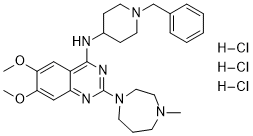
BIX01294 triHCl (the tri-hydrochloride salt of BIX01294) is a novel and potent inhibitor of G9a histone methyltransferase with IC50 of 2.7 μM in a cell-free assay. BIX-01294 was discovered by screening a library of 125,000 synthetic and preselected compounds against G9a. BIX-01294 is selective for G9a and GLP (G9a-like protein) over several H3K9 PKMTs including SUV39H1 and ESET, other KMTs such as SET7/9, and the arginine methyltransferase PRTM1. The X-ray crystal structure of GLP and BIX-01294 confirmed that BIX-01294 bound to the histone peptide binding pocket but failed to interact with the lysine binding channel.
Physicochemical Properties
| Molecular Formula | C28H41CL3N6O2 |
| Molecular Weight | 600.0231 |
| Exact Mass | 598.235 |
| CAS # | 1392399-03-9 |
| Related CAS # | BIX-01294;935693-62-2 |
| PubChem CID | 46945860 |
| Appearance | Typically exists as solid at room temperature |
| LogP | 5.634 |
| Hydrogen Bond Donor Count | 4 |
| Hydrogen Bond Acceptor Count | 8 |
| Rotatable Bond Count | 7 |
| Heavy Atom Count | 39 |
| Complexity | 656 |
| Defined Atom Stereocenter Count | 0 |
| SMILES | Cl[H].Cl[H].Cl[H].O(C([H])([H])[H])C1=C(C([H])=C2C(=C1[H])C(=NC(=N2)N1C([H])([H])C([H])([H])N(C([H])([H])[H])C([H])([H])C([H])([H])C1([H])[H])N([H])C1([H])C([H])([H])C([H])([H])N(C([H])([H])C2C([H])=C([H])C([H])=C([H])C=2[H])C([H])([H])C1([H])[H])OC([H])([H])[H] |
| InChi Key | FMURUEPQXKJIPS-UHFFFAOYSA-N |
| InChi Code | InChI=1S/C28H38N6O2.3ClH/c1-32-12-7-13-34(17-16-32)28-30-24-19-26(36-3)25(35-2)18-23(24)27(31-28)29-22-10-14-33(15-11-22)20-21-8-5-4-6-9-21;;;/h4-6,8-9,18-19,22H,7,10-17,20H2,1-3H3,(H,29,30,31);3*1H |
| Chemical Name | N-(1-benzylpiperidin-4-yl)-6,7-dimethoxy-2-(4-methyl-1,4-diazepan-1-yl)quinazolin-4-amine;trihydrochloride |
| Synonyms | BIX01294; BIX-01294; BIX 01294;N-(1-benzylpiperidin-4-yl)-6,7-dimethoxy-2-(4-methyl-1,4-diazepan-1-yl)quinazolin-4-aminetrihydrochloride |
| HS Tariff Code | 2934.99.9001 |
| Storage |
Powder-20°C 3 years 4°C 2 years In solvent -80°C 6 months -20°C 1 month |
| Shipping Condition | Room temperature (This product is stable at ambient temperature for a few days during ordinary shipping and time spent in Customs) |
Biological Activity
| ln Vitro | Recurrent tumor cell proliferation is selectively inhibited by BIX-01294 (2 μM; 48 h) trihydrochloride[1]. The phosphorylation of MLKL's S345 is markedly increased by BIX-01294 trihydrochloride (1 μM)[1]. In recurrent tumor cell lines, BIX-01294 (1 μM) trihydrochloride strongly upregulates the classical p53 targets Cdkn1a (p21) and Gadd45a[1]. Primary and recurrent tumor cells exhibit a decrease in H3K9me2 levels upon exposure to BIX-01294 (1 μM; 6 days) trihydrochloride[1]. In recurring tumor cells, BIX-01294 trihydrochloride causes necroptotic cell death. A partial reversal of cell death caused by BIX-01294 (750 nM; 24 h) trihydrochloride is achieved using necrostatin-1 (30 μM). In mouse ES cells, BIX-01294 (4.1 μM) trihydrochloride results in approximately a 20% drop and a similar increase in the unmodified H3K9 fragment in H3K9me2. In wild-type ES cells, BIX-01294 trihydrochloride significantly lowers H3K9me2, but H3K9me3 and H3K9me1 only slightly decrease[2]. Even at 45 μM doses, BIX-01294 trihydrochloride does not block any other histone methyltransferases. SUV39H1 (H320R) and PRMT1 are unaffected by BIX-01294 trihydrochloride in the investigated concentration range (up to 10 μM)[2]. In an uncompetitive way, BIX-01294 trihydrochloride inhibits G9a in conjunction with S-adenosyl-methionine (SAM)[2]. In fetal PASMCs, BIX-01294 (1 µg/mL) reduces the amount of BrdU incorporated. Treatment with BIX-01294 reduces the migration of PASMCs brought on by PDGF[3]. |
| ln Vivo | In recurrent tumor cells, BIX-01294 trihydrochloride (10 mg/kg; IP; three times a week for two weeks) dramatically lowers tumor development and tumor burden. Growth of primary tumors is not inhibited[1]. |
| Cell Assay |
Cell Viability Assay[1] Cell Types: Primary or recurrent tumor cells Tested Concentrations: 2 μM Incubation Duration: 48 h Experimental Results: Selectively inhibited recurrent tumor cell growth. |
| Animal Protocol |
Animal/Disease Models: Female MMTV-rtTA; TetO-Her2/neu (MTB;TAN) and TetO-Her2/neu (TAN) mice with recurrent or primary tumor cells[1] Doses: 10 mg/kg Route of Administration: IP; three times a week for 2 weeks Experimental Results: Dramatically decreased tumor growth and tumor burden in recurrent tumor cells. Primary tumor growth was not inhibited. Slowed the growth of orthotopic recurrent tumors in athymic nude recipients. |
| References |
[1]. G9a Promotes Breast Cancer Recurrence through Repression of a Pro-inflammatory Program. Cell Rep. 2020 Nov 3;33(5):108341. [2]. Reversal of H3K9me2 by a small-molecule inhibitor for the G9a histone methyltransferase. Mol Cell. 2007 Feb 9;25(3):473-81. [3]. BIX-01294 treatment blocks cell proliferation, migration and contractility in ovine foetal pulmonary arterial smooth muscle cells. Cell Prolif. 2012 Aug;45(4):335-44. [4]. BIX01294, an inhibitor of histone methyltransferase, induces autophagy-dependent differentiation of glioma stem-like cells. Sci Rep. [5]. Structural basis for G9a-like protein lysine methyltransferase inhibition by BIX-01294. Nat Struct Mol Biol. 2009 Mar;16(3):312-7. |
Solubility Data
| Solubility (In Vitro) |
|
|||
| Solubility (In Vivo) |
Note: Listed below are some common formulations that may be used to formulate products with low water solubility (e.g. < 1 mg/mL), you may test these formulations using a minute amount of products to avoid loss of samples. Injection Formulations (e.g. IP/IV/IM/SC) Injection Formulation 1: DMSO : Tween 80: Saline = 10 : 5 : 85 (i.e. 100 μL DMSO stock solution → 50 μL Tween 80 → 850 μL Saline) *Preparation of saline: Dissolve 0.9 g of sodium chloride in 100 mL ddH ₂ O to obtain a clear solution. Injection Formulation 2: DMSO : PEG300 :Tween 80 : Saline = 10 : 40 : 5 : 45 (i.e. 100 μL DMSO → 400 μLPEG300 → 50 μL Tween 80 → 450 μL Saline) Injection Formulation 3: DMSO : Corn oil = 10 : 90 (i.e. 100 μL DMSO → 900 μL Corn oil) Example: Take the Injection Formulation 3 (DMSO : Corn oil = 10 : 90) as an example, if 1 mL of 2.5 mg/mL working solution is to be prepared, you can take 100 μL 25 mg/mL DMSO stock solution and add to 900 μL corn oil, mix well to obtain a clear or suspension solution (2.5 mg/mL, ready for use in animals). Injection Formulation 4: DMSO : 20% SBE-β-CD in saline = 10 : 90 [i.e. 100 μL DMSO → 900 μL (20% SBE-β-CD in saline)] *Preparation of 20% SBE-β-CD in Saline (4°C,1 week): Dissolve 2 g SBE-β-CD in 10 mL saline to obtain a clear solution. Injection Formulation 5: 2-Hydroxypropyl-β-cyclodextrin : Saline = 50 : 50 (i.e. 500 μL 2-Hydroxypropyl-β-cyclodextrin → 500 μL Saline) Injection Formulation 6: DMSO : PEG300 : castor oil : Saline = 5 : 10 : 20 : 65 (i.e. 50 μL DMSO → 100 μLPEG300 → 200 μL castor oil → 650 μL Saline) Injection Formulation 7: Ethanol : Cremophor : Saline = 10: 10 : 80 (i.e. 100 μL Ethanol → 100 μL Cremophor → 800 μL Saline) Injection Formulation 8: Dissolve in Cremophor/Ethanol (50 : 50), then diluted by Saline Injection Formulation 9: EtOH : Corn oil = 10 : 90 (i.e. 100 μL EtOH → 900 μL Corn oil) Injection Formulation 10: EtOH : PEG300:Tween 80 : Saline = 10 : 40 : 5 : 45 (i.e. 100 μL EtOH → 400 μLPEG300 → 50 μL Tween 80 → 450 μL Saline) Oral Formulations Oral Formulation 1: Suspend in 0.5% CMC Na (carboxymethylcellulose sodium) Oral Formulation 2: Suspend in 0.5% Carboxymethyl cellulose Example: Take the Oral Formulation 1 (Suspend in 0.5% CMC Na) as an example, if 100 mL of 2.5 mg/mL working solution is to be prepared, you can first prepare 0.5% CMC Na solution by measuring 0.5 g CMC Na and dissolve it in 100 mL ddH2O to obtain a clear solution; then add 250 mg of the product to 100 mL 0.5% CMC Na solution, to make the suspension solution (2.5 mg/mL, ready for use in animals). Oral Formulation 3: Dissolved in PEG400 Oral Formulation 4: Suspend in 0.2% Carboxymethyl cellulose Oral Formulation 5: Dissolve in 0.25% Tween 80 and 0.5% Carboxymethyl cellulose Oral Formulation 6: Mixing with food powders Note: Please be aware that the above formulations are for reference only. InvivoChem strongly recommends customers to read literature methods/protocols carefully before determining which formulation you should use for in vivo studies, as different compounds have different solubility properties and have to be formulated differently. (Please use freshly prepared in vivo formulations for optimal results.) |
| Preparing Stock Solutions | 1 mg | 5 mg | 10 mg | |
| 1 mM | 1.6666 mL | 8.3331 mL | 16.6661 mL | |
| 5 mM | 0.3333 mL | 1.6666 mL | 3.3332 mL | |
| 10 mM | 0.1667 mL | 0.8333 mL | 1.6666 mL |