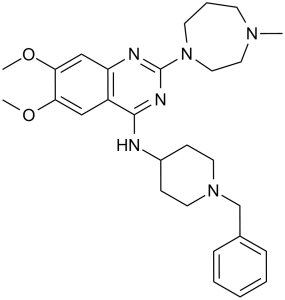
BIX01294 is a novel and potent inhibitor of G9a histone methyltransferase with anticancer activity. It inhibits G9a with an IC50 of 2.7 μM in a cell-free assay. BIX-01294 was discovered by screening a library of 125,000 synthetic and preselected compounds against G9a. It demostrates excellent antiproliferative activity and high in vivo antitumor efficacy. BIX-01294 is selective for G9a and GLP (G9a-like protein) over several H3K9 PKMTs including SUV39H1 and ESET, other KMTs such as SET7/9, and the arginine methyltransferase PRTM1. The X-ray crystal structure of GLP and BIX-01294 confirmed that BIX-01294 bound to the histone peptide binding pocket but failed to interact with the lysine binding channel.
Physicochemical Properties
| Molecular Formula | C28H38N6O2 |
| Molecular Weight | 490.640326023102 |
| Exact Mass | 490.305 |
| CAS # | 935693-62-2 |
| Related CAS # | BIX-01294 trihydrochloride;1392399-03-9 |
| PubChem CID | 25150857 |
| Appearance | White to off-white solid powder |
| Melting Point | 178.44° C |
| LogP | 6.22 |
| Hydrogen Bond Donor Count | 1 |
| Hydrogen Bond Acceptor Count | 8 |
| Rotatable Bond Count | 7 |
| Heavy Atom Count | 36 |
| Complexity | 656 |
| Defined Atom Stereocenter Count | 0 |
| InChi Key | OSXFATOLZGZLSK-UHFFFAOYSA-N |
| InChi Code | InChI=1S/C28H38N6O2/c1-32-12-7-13-34(17-16-32)28-30-24-19-26(36-3)25(35-2)18-23(24)27(31-28)29-22-10-14-33(15-11-22)20-21-8-5-4-6-9-21/h4-6,8-9,18-19,22H,7,10-17,20H2,1-3H3,(H,29,30,31) |
| Chemical Name | N-(1-benzylpiperidin-4-yl)-6,7-dimethoxy-2-(4-methyl-1,4-diazepan-1-yl)quinazolin-4-amine |
| Synonyms | BIX01294 HCl;BIX01294; BIX-01294; BIX 01294;N-(1-benzylpiperidin-4-yl)-6,7-dimethoxy-2-(4-methyl-1,4-diazepan-1-yl)quinazolin-4-amine |
| HS Tariff Code | 2934.99.9001 |
| Storage |
Powder-20°C 3 years 4°C 2 years In solvent -80°C 6 months -20°C 1 month |
| Shipping Condition | Room temperature (This product is stable at ambient temperature for a few days during ordinary shipping and time spent in Customs) |
Biological Activity
| ln Vitro | Recurrent tumor cell proliferation is selectively inhibited by BIX-01294 (2 μM; 48 hours) [1]. Significant increase in MLKL S345 phosphorylation is caused by BIX-01294 (1 μM)[1]. In recurrent tumor cell lines, BIX-01294 (1 μM) strongly upregulates the traditional p53 targets Gadd45a and Cdkn1a (p21)[1]. Both primary and recurrent tumor cells exhibit decreased H3K9me2 levels in response to BIX-01294 (1 μM; 6 days) [1]. Necroptotic cell death in recurring tumor cells is induced by BIX-01294. Necrostatin-1 (30 μM) partially counteracts the 24-hour, 750 nM-induced cell death caused by BIX-01294[1]. In mouse ES cells, BIX-01294 (4.1 μM) resulted in a 20% decrease in unmodified H3K9 fragments in H3K9me2, which was significantly accompanied by an increase. In wild-type ES cells, BIX-01294 significantly lowers H3K9me2, but only slightly lowering H3K9me3 and H3K9me1 [2]. Even at 45 μM, BIX-01294 did not inhibit other histone methyltransferases. SUV39H1 (H320R) and PRMT1[2] are unaffected by BIX-01294 in the measured concentration range (up to 10 μM). G9a and S-adenosylmethionine (SAM) are inhibited by BIX-01294 in a non-competitive way[2]. Reduced BrdU binding is caused by BIX-01294 (1 μg/mL) in fetal PASMC. PASMC migration caused by PDGF[3] was inhibited by BIX-01294 therapy. |
| ln Vivo | In recurring tumor cells, BIX-01294 (10 mg/kg; i.p.; three times weekly for two weeks) dramatically lowered tumor development and tumor burden. Growth of primary tumors is not inhibited [1]. |
| Cell Assay |
Cell Viability Assay[1] Cell Types: Primary or recurrent tumor cells Tested Concentrations: 2 μM Incubation Duration: 48 hrs (hours) Experimental Results: Selectively inhibited recurrent tumor cell growth. |
| Animal Protocol |
Animal/Disease Models: Female MMTV-rtTA;TetO-Her2/neu (MTB;TAN) and TetO-Her2/neu (TAN) mice with recurrent or primary tumor cells[1] Doses: 10 mg/kg Route of Administration: IP; three times a week for 2 weeks Experimental Results: Dramatically decreased tumor growth and tumor burden in recurrent tumor cells. Primary tumor growth was not inhibited. Slowed the growth of orthotopic recurrent tumors in athymic nude recipients. |
| References |
[1]. G9a Promotes Breast Cancer Recurrence through Repression of a Pro-inflammatory Program. Cell Rep. 2020 Nov 3;33(5):108341. [2]. Reversal of H3K9me2 by a small-molecule inhibitor for the G9a histone methyltransferase. Mol Cell. 2007 Feb 9;25(3):473-81. [3]. BIX-01294 treatment blocks cell proliferation, migration and contractility in ovine foetal pulmonary arterial smooth muscle cells. Cell Prolif. 2012 Aug;45(4):335-44. [4]. BIX01294, an inhibitor of histone methyltransferase, induces autophagy-dependent differentiation of glioma stem-like cells. Sci Rep. [5]. Structural basis for G9a-like protein lysine methyltransferase inhibition by BIX-01294. Nat Struct Mol Biol. 2009 Mar;16(3):312-7. |
| Additional Infomation | 6,7-dimethoxy-2-(4-methyl-1,4-diazepan-1-yl)-N-[1-(phenylmethyl)-4-piperidinyl]-4-quinazolinamine is a member of piperidines. |
Solubility Data
| Solubility (In Vitro) |
|
|||
| Solubility (In Vivo) |
Solubility in Formulation 1: ≥ 2.75 mg/mL (5.60 mM) (saturation unknown) in 10% DMSO + 40% PEG300 + 5% Tween80 + 45% Saline (add these co-solvents sequentially from left to right, and one by one), clear solution. For example, if 1 mL of working solution is to be prepared, you can add 100 μL of 27.5 mg/mL clear DMSO stock solution to 400 μL PEG300 and mix evenly; then add 50 μL Tween-80 to the above solution and mix evenly; then add 450 μL normal saline to adjust the volume to 1 mL. Preparation of saline: Dissolve 0.9 g of sodium chloride in 100 mL ddH₂ O to obtain a clear solution. Solubility in Formulation 2: ≥ 2.75 mg/mL (5.60 mM) (saturation unknown) in 10% DMSO + 90% (20% SBE-β-CD in Saline) (add these co-solvents sequentially from left to right, and one by one), clear solution. For example, if 1 mL of working solution is to be prepared, you can add 100 μL of 27.5 mg/mL clear DMSO stock solution to 900 μL of 20% SBE-β-CD physiological saline solution and mix evenly. Preparation of 20% SBE-β-CD in Saline (4°C,1 week): Dissolve 2 g SBE-β-CD in 10 mL saline to obtain a clear solution. Solubility in Formulation 3: ≥ 2.75 mg/mL (5.60 mM) (saturation unknown) in 10% DMSO + 90% Corn Oil (add these co-solvents sequentially from left to right, and one by one), clear solution. For example, if 1 mL of working solution is to be prepared, you can add 100 μL of 27.5 mg/mL clear DMSO stock solution to 900 μL of corn oil and mix evenly. (Please use freshly prepared in vivo formulations for optimal results.) |
| Preparing Stock Solutions | 1 mg | 5 mg | 10 mg | |
| 1 mM | 2.0382 mL | 10.1908 mL | 20.3815 mL | |
| 5 mM | 0.4076 mL | 2.0382 mL | 4.0763 mL | |
| 10 mM | 0.2038 mL | 1.0191 mL | 2.0382 mL |