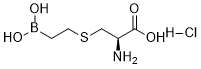
Physicochemical Properties
| Molecular Formula | C5H13BCLNO4S |
| Molecular Weight | 229.482 |
| Exact Mass | 229.035 |
| CAS # | 222638-67-7 |
| Related CAS # | 222638-67-7 (HCl);63107-40-4; |
| PubChem CID | 91826515 |
| Appearance | White to yellow solid powder |
| LogP | 0.106 |
| Hydrogen Bond Donor Count | 5 |
| Hydrogen Bond Acceptor Count | 6 |
| Rotatable Bond Count | 6 |
| Heavy Atom Count | 13 |
| Complexity | 145 |
| Defined Atom Stereocenter Count | 1 |
| SMILES | B(CCSC[C@@H](C(=O)O)N)(O)O.Cl |
| InChi Key | GHPYJLCQYMAXGG-WCCKRBBISA-N |
| InChi Code | InChI=1S/C5H12BNO4S.ClH/c7-4(5(8)9)3-12-2-1-6(10)11;/h4,10-11H,1-3,7H2,(H,8,9);1H/t4-;/m0./s1 |
| Chemical Name | (2R)-2-amino-3-(2-boronoethylsulfanyl)propanoic acid;hydrochloride |
| Synonyms | S-(2-boronoethyl)-L-cysteine BEC HCl |
| HS Tariff Code | 2934.99.9001 |
| Storage |
Powder-20°C 3 years 4°C 2 years In solvent -80°C 6 months -20°C 1 month Note: Please store this product in a sealed and protected environment (e.g. under nitrogen), avoid exposure to moisture. |
| Shipping Condition | Room temperature (This product is stable at ambient temperature for a few days during ordinary shipping and time spent in Customs) |
Biological Activity
| ln Vitro | Using hemihedral completely twinned crystals, the X-ray crystal structure of the arginase-BEC complex has been established at a resolution of 2.3 Å. The complex's structure demonstrates that a metal-bridging hydroxide ion nucleophilically attacks the boronic acid moiety, resulting in the formation of a tetrahedral borate anion that bridges the dinuclear manganese cluster. This mimics the tetrahedral intermediate and its flanking ions in the transition state of the arginine hydrolysis reaction [2]. |
| ln Vivo | Increased S-nitrosylated and nitrated proteins are seen in the lungs of inflamed mice after the arginase inhibitor BEC is administered. This decreases arginase activity and alters NO homeostasis. BECs promote mucus metaplasia, NF-κB DNA binding, mRNA production of the NF-κB-driven chemokine genes CCL20 and KC, and perivascular and peribronchiolar lung inflammation. They also cause further increases in airway hyperresponsiveness [3]. |
| Animal Protocol |
Animal/Disease Models: C57BL/6J wild-type mice, arginase 2-deficient mice (Arg2-/-), arginase 1 and arginase 2-deficient mice (Arg1-/-Arg2-/ -), NOX2-deficient mice (NOX2-/- Doses: 20 mg/kg. Route of Administration: 1 hour before LPS injection, intravenous (iv) (iv)injection of 0.9% saline. Experimental Results: BEC Dramatically diminished glial cells (72% reduction) and VEGF expression in macrophages/microglia (87% reduction). |
| References |
[1]. Classical and slow-binding inhibitors of human type II arginase. Biochemistry. 2001 Aug 7;40(31):9356-62. [2]. Probing erectile function: S-(2-boronoethyl)-L-cysteine binds to arginase as a transition state analogue and enhances smooth muscle relaxation in human penile corpus cavernosum. Biochemistry. 2001 Mar 6;40(9):2678-88. [3]. Inhibition of arginase activity enhances inflammation in mice with allergic airway disease, in association with increases in protein S-nitrosylation and tyrosine nitration. J Immunol. 2008 Sep 15;181(6):4255-64. |
Solubility Data
| Solubility (In Vitro) |
H2O : ~50 mg/mL (~217.87 mM) DMSO : ~50 mg/mL (~217.87 mM) |
| Solubility (In Vivo) |
Solubility in Formulation 1: ≥ 2.5 mg/mL (10.89 mM) (saturation unknown) in 10% DMSO + 40% PEG300 + 5% Tween80 + 45% Saline (add these co-solvents sequentially from left to right, and one by one), clear solution. For example, if 1 mL of working solution is to be prepared, you can add 100 μL of 25.0 mg/mL clear DMSO stock solution to 400 μL PEG300 and mix evenly; then add 50 μL Tween-80 to the above solution and mix evenly; then add 450 μL normal saline to adjust the volume to 1 mL. Preparation of saline: Dissolve 0.9 g of sodium chloride in 100 mL ddH₂ O to obtain a clear solution. Solubility in Formulation 2: ≥ 2.5 mg/mL (10.89 mM) (saturation unknown) in 10% DMSO + 90% (20% SBE-β-CD in Saline) (add these co-solvents sequentially from left to right, and one by one), clear solution. For example, if 1 mL of working solution is to be prepared, you can add 100 μL of 25.0 mg/mL clear DMSO stock solution to 900 μL of 20% SBE-β-CD physiological saline solution and mix evenly. Preparation of 20% SBE-β-CD in Saline (4°C,1 week): Dissolve 2 g SBE-β-CD in 10 mL saline to obtain a clear solution. Solubility in Formulation 3: ≥ 2.5 mg/mL (10.89 mM) (saturation unknown) in 10% DMSO + 90% Corn Oil (add these co-solvents sequentially from left to right, and one by one), clear solution. For example, if 1 mL of working solution is to be prepared, you can add 100 μL of 25.0 mg/mL clear DMSO stock solution to 900 μL of corn oil and mix evenly. Solubility in Formulation 4: 140 mg/mL (610.05 mM) in PBS (add these co-solvents sequentially from left to right, and one by one), clear solution; with ultrasonication. (Please use freshly prepared in vivo formulations for optimal results.) |
| Preparing Stock Solutions | 1 mg | 5 mg | 10 mg | |
| 1 mM | 4.3577 mL | 21.7884 mL | 43.5768 mL | |
| 5 mM | 0.8715 mL | 4.3577 mL | 8.7154 mL | |
| 10 mM | 0.4358 mL | 2.1788 mL | 4.3577 mL |