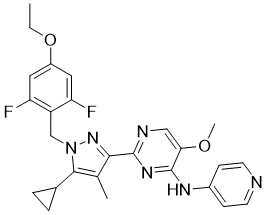
BAY-320 is a novel and potent Bub1 inhibitor with an IC50 of 680 nM for human Bub1 in the presence of 2 mM ATP. It demonstrated potent Bub1 kinase inhibition both in vitro and in intact cells. The kinase Bub1 functions in the spindle assembly checkpoint (SAC) and in chromosome congression, but the role of its catalytic activity remains controversial. Bub1 inhibition affected chromosome association of Shugoshin and the chromosomal passenger complex (CPC), without abolishing global Aurora B function. Consequently, inhibition of Bub1 kinase impaired chromosome arm resolution but exerted only minor effects on mitotic progression or SAC function. Importantly, BAY-320 and BAY-524 treatment sensitized cells to low doses of Paclitaxel, impairing both chromosome segregation and cell proliferation. These findings are relevant to our understanding of Bub1 kinase function and the prospects of targeting Bub1 for therapeutic applications.
Physicochemical Properties
| Molecular Formula | C26H26F2N6O2 |
| Molecular Weight | 492.520452022552 |
| Exact Mass | 492.208 |
| CAS # | 1445830-50-1 |
| PubChem CID | 71611462 |
| Appearance | White to off-white solid powder |
| LogP | 4.1 |
| Hydrogen Bond Donor Count | 1 |
| Hydrogen Bond Acceptor Count | 9 |
| Rotatable Bond Count | 9 |
| Heavy Atom Count | 36 |
| Complexity | 687 |
| Defined Atom Stereocenter Count | 0 |
| InChi Key | WAELFQHBZPHEMW-UHFFFAOYSA-N |
| InChi Code | InChI=1S/C26H26F2N6O2/c1-4-36-18-11-20(27)19(21(28)12-18)14-34-24(16-5-6-16)15(2)23(33-34)26-30-13-22(35-3)25(32-26)31-17-7-9-29-10-8-17/h7-13,16H,4-6,14H2,1-3H3,(H,29,30,31,32) |
| Chemical Name | 2-[5-cyclopropyl-1-[(4-ethoxy-2,6-difluorophenyl)methyl]-4-methylpyrazol-3-yl]-5-methoxy-N-pyridin-4-ylpyrimidin-4-amine |
| Synonyms | BAY-320; BAY 320; BAY320 |
| HS Tariff Code | 2934.99.9001 |
| Storage |
Powder-20°C 3 years 4°C 2 years In solvent -80°C 6 months -20°C 1 month |
| Shipping Condition | Room temperature (This product is stable at ambient temperature for a few days during ordinary shipping and time spent in Customs) |
Biological Activity
| ln Vitro | To address the role of Bub1 kinase activity in mammalian mitosis, we have made use of two novel small molecule inhibitors, BAY-320 and BAY-524. Using biochemical and cellular assays, we show that these ATP-competitive inhibitors potently and specifically block human Bub1 both in vitro and in living cells. By comparing phenotypes provoked by Bub1 kinase inhibition and Bub1 protein depletion, we are able to differentiate between catalytic and non-catalytic functions of Bub1. Our data indicate that Bub1 catalytic activity is largely dispensable for chromosome alignment and SAC function, arguing that Bub1 largely operates as a scaffolding protein. However, even though Bub1 inhibition per se exerts only minor effects on mitotic fidelity, BAY-320 and BAY-524 treatment sensitizes cells to clinically relevant low doses of Paclitaxel, resulting in remarkable impairment of chromosome segregation and cell proliferation. |
| Cell Assay | IC50 isobolograms BAY-320 plus Paclitaxel combination studies were conducted with HeLa and NCI-H1299 cells. Cells were plated into 384-well plates at 600 (HeLa) or 700 (NCI-H1299) cells per well. After 24 hr, cells were treated with BAY-320 (concentration range, 1E-07 M to 1E-05 M) and Paclitaxel (concentration range, 1E-09 M to 1E-07 M) for single compound treatments, and in nine different fixed-ratio combinations of BAY-320 (D1) and Paclitaxel (D2) (0.9xD1+0.1xD2, 0.8xD1+0.2xD2, 0.7xD1+0.3xD2, 0.6xD1+0.4xD2, 0.5xD1+0.5xD2, 0.4xD1+0.6xD2, 0.3xD1+0.7xD2, 0.2xD1+0.8xD2, 0.1xD1+0.9xD2). Cell viability was assessed after 96 hr exposure, using the Cell Titre-Glo Luminescent Cell Viability Assay (Promega). |
| References | Elife. 2016 Feb 17;5. pii: e12187. |
Solubility Data
| Solubility (In Vitro) | DMSO : ~83.33 mg/mL (~169.19 mM) |
| Solubility (In Vivo) |
Solubility in Formulation 1: ≥ 2.08 mg/mL (4.22 mM) (saturation unknown) in 10% DMSO + 40% PEG300 + 5% Tween80 + 45% Saline (add these co-solvents sequentially from left to right, and one by one), clear solution. For example, if 1 mL of working solution is to be prepared, you can add 100 μL of 20.8 mg/mL clear DMSO stock solution to 400 μL PEG300 and mix evenly; then add 50 μL Tween-80 to the above solution and mix evenly; then add 450 μL normal saline to adjust the volume to 1 mL. Preparation of saline: Dissolve 0.9 g of sodium chloride in 100 mL ddH₂ O to obtain a clear solution. Solubility in Formulation 2: ≥ 2.08 mg/mL (4.22 mM) (saturation unknown) in 10% DMSO + 90% Corn Oil (add these co-solvents sequentially from left to right, and one by one), clear solution. For example, if 1 mL of working solution is to be prepared, you can add 100 μL of 20.8 mg/mL clear DMSO stock solution to 900 μL of corn oil and mix evenly. (Please use freshly prepared in vivo formulations for optimal results.) |
| Preparing Stock Solutions | 1 mg | 5 mg | 10 mg | |
| 1 mM | 2.0304 mL | 10.1519 mL | 20.3037 mL | |
| 5 mM | 0.4061 mL | 2.0304 mL | 4.0607 mL | |
| 10 mM | 0.2030 mL | 1.0152 mL | 2.0304 mL |