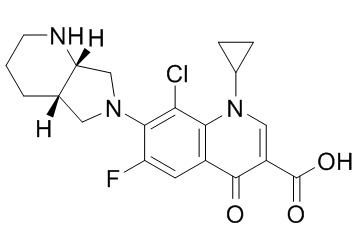
BAY-Y 3118 is novel and potent chlorofluoroquinolone derivative with antimicrobial activity against Haemophilhs influenzae, Moraxela catarrhalis, Acinetobacter baumannii, Xanthomonas maltophiia, gram-positive cocci, and anaerobes; MICs for 50%o of the strains (MIC50s) and MIC90s are ≤0.015 and ≤0.015, ≤0.015 and ≤0.015, 0.03 and 2, 0.25 and 0.5, 0.06 and 1, and 0.12 and 0.25 μg/mL, respectively. The cellular concentration-to-extracellular concentration ratio of BAY-Y 3118 is higher than 6.3 at extracellular concentrations ranging from 2 to 100 mg/L. The uptake of BAY-Y 3118 is rapid, reversible and nonsaturable. The intracellular penetration of BAY-Y 3118 is significantly affected by environmental temperature and cell viability. BAY-Y 3118 reaches high intracellular concentrations within human polymorphonuclear leukocytes (PMNs) and remains active intracellularly. All strains of L. monocytogenes and other Listeria spp. are highly susceptible; the MICs for these organisms ranges from 0.062 to 0.25 μg/mL. BAY-Y 3118 is rapidly bactericidal in vitro, with a postantibiotic effect occurring for 3 h after removal of the antibiotic. L. monocytogenes is eliminated from infected L929 cells treated with BAY-Y 3118, suggesting a bactericidal effect on the listeriae in these cells.
Physicochemical Properties
| Molecular Formula | C20H21CLFN3O3 |
| Molecular Weight | 405.850447416306 |
| Exact Mass | 405.125 |
| CAS # | 151213-16-0 |
| Related CAS # | (R,R)-BAY-Y 3118;151213-22-8 |
| PubChem CID | 119375 |
| Appearance | Typically exists as solid at room temperature |
| Density | 1.5±0.1 g/cm3 |
| Boiling Point | 627.2±55.0 °C at 760 mmHg |
| Flash Point | 333.1±31.5 °C |
| Vapour Pressure | 0.0±1.9 mmHg at 25°C |
| Index of Refraction | 1.654 |
| LogP | 2.05 |
| Hydrogen Bond Donor Count | 2 |
| Hydrogen Bond Acceptor Count | 7 |
| Rotatable Bond Count | 3 |
| Heavy Atom Count | 28 |
| Complexity | 715 |
| Defined Atom Stereocenter Count | 2 |
| SMILES | O=C(C1=CN(C2CC2)C3=C(C=C(F)C(N(C4)C[C@]5([H])[C@@]4([H])CCCN5)=C3Cl)C1=O)O |
| InChi Key | VRXORHRXNRJZCQ-ZUZCIYMTSA-N |
| InChi Code | InChI=1S/C20H21ClFN3O3/c21-16-17-12(19(26)13(20(27)28)8-25(17)11-3-4-11)6-14(22)18(16)24-7-10-2-1-5-23-15(10)9-24/h6,8,10-11,15,23H,1-5,7,9H2,(H,27,28)/t10-,15+/m0/s1 |
| Chemical Name | 7-[(4aS,7aS)-1,2,3,4,4a,5,7,7a-octahydropyrrolo[3,4-b]pyridin-6-yl]-8-chloro-1-cyclopropyl-6-fluoro-4-oxoquinoline-3-carboxylic acid |
| Synonyms | BAY-Y 3118; BAY-Y-3118; BAY Y 3118; |
| HS Tariff Code | 2934.99.9001 |
| Storage |
Powder-20°C 3 years 4°C 2 years In solvent -80°C 6 months -20°C 1 month |
| Shipping Condition | Room temperature (This product is stable at ambient temperature for a few days during ordinary shipping and time spent in Customs) |
Biological Activity
| ln Vitro | Acinetobacter baumannii, Xanthomonas maltomonas, Haemophilus influenzae, Moraxella catarrhalis, Gram-positive cocci, and anaerobic bacteria are among the strains against which BAY-Y 3118 is effective; its MIC (MIC50) and MIC90, which represent 50% of the strains, are ≤0.015 and ≤0.015, ≤0.015 and ≤0.015, 0.03 and 2, 0.25 and 0.5, 0.06 and 1, 0.12 and 0.25 μg/mL[1]. At extracellular concentrations ranging from 2 to 100 mg/L, BAY-Y 3118's cellular to extracellular concentration ratio was more than 6.3. BAY-Y 3118 is absorbed quickly, reversibly, and unsaturatedly. Cell viability and ambient temperature have a major impact on BAY-Y 3118's capacity to penetrate cells inside of them. Human polymorphonuclear leukocytes (PMN) contain substantial intracellular quantities of BAY-Y 3118, which is still active within the cells [2]. All strains of Listeria spp., including Listeria monocytogenes. Extremely sensitive; these organisms have a MIC range of 0.062 to 0.25 μg/mL. In vitro, BAY-Y 3118 exhibits a fast bactericidal action, exhibiting post-antibiotic effects within 3 hours of antibiotic withdrawal. Infected L929 cells treated with BAY-Y 3118 showed the elimination of Listeria monocytogenes, suggesting that the compound had a bactericidal effect on Listeria in these cells [3]. |
| ln Vivo | Treating immunocompetent mice with 4 mg every 12 hours resulted in a quick recovery. Simultaneously, the mouse serum's levels of gamma interferon and interleukin-6 dropped quickly. Compared to treating immunocompetent mice with 2 mg of ampicillin every 12 hours, treating them with 2 mg of BAY-Y 3118 every 12 hours produced a larger initial reduction in organ Listeria counts. Listeria monocytogenes in the liver and spleen of chronically infected nude mice are totally eradicated by BAY-Y 3118 [3]. |
| References |
[1]. Fass RJ, et al. In vitro activity of Bay y 3118, a new quinolone. Antimicrob Agents Chemother. 1993 Nov;37(11):2348-57. [2]. García I, et al. Intracellular penetration and activity of BAY Y 3118 in human polymorphonuclear leukocytes. Antimicrob Agents Chemother. 1994 Oct;38(10):2426-9. [3]. Nichterlein T, et al. Bay Y 3118, a new quinolone derivative, rapidly eradicates Listeria monocytogenes from infected mice and L929 cells. Antimicrob Agents Chemother. 1994 Jul;38(7):1501-6 |
Solubility Data
| Solubility (In Vitro) | DMSO : ~33.33 mg/mL (~82.12 mM) |
| Solubility (In Vivo) |
Solubility in Formulation 1: ≥ 2.5 mg/mL (6.16 mM) (saturation unknown) in 10% DMSO + 40% PEG300 + 5% Tween80 + 45% Saline (add these co-solvents sequentially from left to right, and one by one), clear solution. For example, if 1 mL of working solution is to be prepared, you can add 100 μL of 25.0 mg/mL clear DMSO stock solution to 400 μL PEG300 and mix evenly; then add 50 μL Tween-80 to the above solution and mix evenly; then add 450 μL normal saline to adjust the volume to 1 mL. Preparation of saline: Dissolve 0.9 g of sodium chloride in 100 mL ddH₂ O to obtain a clear solution. Solubility in Formulation 2: ≥ 2.5 mg/mL (6.16 mM) (saturation unknown) in 10% DMSO + 90% (20% SBE-β-CD in Saline) (add these co-solvents sequentially from left to right, and one by one), clear solution. For example, if 1 mL of working solution is to be prepared, you can add 100 μL of 25.0 mg/mL clear DMSO stock solution to 900 μL of 20% SBE-β-CD physiological saline solution and mix evenly. Preparation of 20% SBE-β-CD in Saline (4°C,1 week): Dissolve 2 g SBE-β-CD in 10 mL saline to obtain a clear solution. (Please use freshly prepared in vivo formulations for optimal results.) |
| Preparing Stock Solutions | 1 mg | 5 mg | 10 mg | |
| 1 mM | 2.4640 mL | 12.3198 mL | 24.6396 mL | |
| 5 mM | 0.4928 mL | 2.4640 mL | 4.9279 mL | |
| 10 mM | 0.2464 mL | 1.2320 mL | 2.4640 mL |