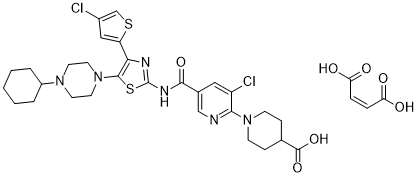
Avatrombopag maleate (formerly AKR501, YM477, AS1670542; E5501;AKR-501, YM-477, AS-1670542; E-5501;Doptelet), the maleate salt ofAvatrombopag, is an orally bioactive thrombopoietin (TPO) receptor agonist approved in 2008 to treat patients with chronic idiopathic thrombocytopenic purpura.
Physicochemical Properties
| Molecular Formula | C29H34CL2N6O3S2 |
| Molecular Weight | 649.65 |
| Exact Mass | 764.162 |
| CAS # | 677007-74-8 |
| Related CAS # | Avatrombopag;570406-98-3;Avatrombopag hydrochloride;570403-17-7 |
| PubChem CID | 9918581 |
| Appearance | White to off-white solid powder |
| LogP | 6.745 |
| Hydrogen Bond Donor Count | 4 |
| Hydrogen Bond Acceptor Count | 14 |
| Rotatable Bond Count | 9 |
| Heavy Atom Count | 50 |
| Complexity | 1050 |
| Defined Atom Stereocenter Count | 0 |
| SMILES | ClC1=CC(=CN=C1N1CCC(C(=O)O)CC1)C(NC1=NC(C2=CC(=CS2)Cl)=C(N2CCN(CC2)C2CCCCC2)S1)=O.OC(/C=C\C(=O)O)=O |
| Synonyms | YM477; YM-477; YM 477; AKR501; AKR 501; AKR-501; E5501; E 5501; E-5501; AS 1670542; AS1670542; AS-1670542 |
| HS Tariff Code | 2934.99.9001 |
| Storage |
Powder-20°C 3 years 4°C 2 years In solvent -80°C 6 months -20°C 1 month |
| Shipping Condition | Room temperature (This product is stable at ambient temperature for a few days during ordinary shipping and time spent in Customs) |
Biological Activity
| ln Vivo |
50% effective concentration values for cell proliferation with AS1670542 or eltrombopag were 1.9 and 13nM, respectively, while those for megakaryocyte colony formation from human cord blood CD34(+) cells with AS1670542 or eltrombopag were 260 and 950nM, respectively. On Day 14 after the start of administration, AS1670542 significantly increased the number of human platelets in non-obese diabetic/severe combined immunodeficiency (NOD/SCID) mice with transplanted human hematopoietic stem cells at 0.3 (P<0.05); in contrast, while administration of eltrombopag also increased the numbers of these platelets at 30mg/kg/day (P=0.058), no statistical significance was noted in the increase. Here, we identified AS1670542, a novel orally-active TPO receptor agonist which mimics the biological activity of TPO and may demonstrate greater in vitro and in vivo pharmacologically efficacy than eltrombopag.[1] we examined the in vivo platelet-increasing effect of AKR-501 in human platelet producing non-obese diabetic/severe combined immunodeficiency (NOD/SCID) mice transplanted with human fetal liver CD34(+) cells. Daily oral administration of AKR-501 dose-dependently increased the number of human platelets in these mice, with significance achieved at doses of 1 mg/kg and above. The peak unbound plasma concentrations of AKR-501 after administration at 1 mg/kg in NOD/SCID mice were similar to those observed following administration of an active oral dose in human subjects. These results suggest that AKR-501 is an orally-active TPO receptor agonist that may be useful in the treatment of patients with thrombocytopenia.[2] |
| References |
:Eur J Pharmacol.2011 Jan10;650(1):58-63;Eur J Haematol.2009 Apr;82(4):247-54. |
| Additional Infomation |
Avatrombopag Maleate is the maleate salt form of avatrombopag, an orally available platelet thrombopoietin receptor (TPOR; MPL) agonist, with potential megakaryopoiesis stimulating activity. Upon administration, avatrombopag binds to and stimulates TPOR, which may lead to the proliferation and differentiation of megakaryocytes from bone marrow progenitor cells. This increases the production of platelets and may prevent chemotherapy-induced thrombocytopenia (CIT). TPOR is a cytokine receptor and member of the hematopoietin receptor superfamily. See also: Avatrombopag (has active moiety). Drug Indication Doptelet is indicated for the treatment of severe thrombocytopenia in adult patients with chronic liver disease who are scheduled to undergo an invasive procedure. Doptelet is indicated for the treatment of primary chronic immune thrombocytopenia (ITP) in adult patients who are refractory to other treatments (e. g. corticosteroids, immunoglobulins). Treatment of Idiopathic Thrombocytopenia Purpura (ITP), Treatment of Thrombocytopenic Purpura Secondary to Liver Disease |
Solubility Data
| Solubility (In Vitro) | DMSO:≥ 30 mg/mL Water:< 1 mg/mL Ethanol:< 1 mg/mL |
| Solubility (In Vivo) |
Note: Listed below are some common formulations that may be used to formulate products with low water solubility (e.g. < 1 mg/mL), you may test these formulations using a minute amount of products to avoid loss of samples. Injection Formulations (e.g. IP/IV/IM/SC) Injection Formulation 1: DMSO : Tween 80: Saline = 10 : 5 : 85 (i.e. 100 μL DMSO stock solution → 50 μL Tween 80 → 850 μL Saline) *Preparation of saline: Dissolve 0.9 g of sodium chloride in 100 mL ddH ₂ O to obtain a clear solution. Injection Formulation 2: DMSO : PEG300 :Tween 80 : Saline = 10 : 40 : 5 : 45 (i.e. 100 μL DMSO → 400 μLPEG300 → 50 μL Tween 80 → 450 μL Saline) Injection Formulation 3: DMSO : Corn oil = 10 : 90 (i.e. 100 μL DMSO → 900 μL Corn oil) Example: Take the Injection Formulation 3 (DMSO : Corn oil = 10 : 90) as an example, if 1 mL of 2.5 mg/mL working solution is to be prepared, you can take 100 μL 25 mg/mL DMSO stock solution and add to 900 μL corn oil, mix well to obtain a clear or suspension solution (2.5 mg/mL, ready for use in animals). Injection Formulation 4: DMSO : 20% SBE-β-CD in saline = 10 : 90 [i.e. 100 μL DMSO → 900 μL (20% SBE-β-CD in saline)] *Preparation of 20% SBE-β-CD in Saline (4°C,1 week): Dissolve 2 g SBE-β-CD in 10 mL saline to obtain a clear solution. Injection Formulation 5: 2-Hydroxypropyl-β-cyclodextrin : Saline = 50 : 50 (i.e. 500 μL 2-Hydroxypropyl-β-cyclodextrin → 500 μL Saline) Injection Formulation 6: DMSO : PEG300 : castor oil : Saline = 5 : 10 : 20 : 65 (i.e. 50 μL DMSO → 100 μLPEG300 → 200 μL castor oil → 650 μL Saline) Injection Formulation 7: Ethanol : Cremophor : Saline = 10: 10 : 80 (i.e. 100 μL Ethanol → 100 μL Cremophor → 800 μL Saline) Injection Formulation 8: Dissolve in Cremophor/Ethanol (50 : 50), then diluted by Saline Injection Formulation 9: EtOH : Corn oil = 10 : 90 (i.e. 100 μL EtOH → 900 μL Corn oil) Injection Formulation 10: EtOH : PEG300:Tween 80 : Saline = 10 : 40 : 5 : 45 (i.e. 100 μL EtOH → 400 μLPEG300 → 50 μL Tween 80 → 450 μL Saline) Oral Formulations Oral Formulation 1: Suspend in 0.5% CMC Na (carboxymethylcellulose sodium) Oral Formulation 2: Suspend in 0.5% Carboxymethyl cellulose Example: Take the Oral Formulation 1 (Suspend in 0.5% CMC Na) as an example, if 100 mL of 2.5 mg/mL working solution is to be prepared, you can first prepare 0.5% CMC Na solution by measuring 0.5 g CMC Na and dissolve it in 100 mL ddH2O to obtain a clear solution; then add 250 mg of the product to 100 mL 0.5% CMC Na solution, to make the suspension solution (2.5 mg/mL, ready for use in animals). Oral Formulation 3: Dissolved in PEG400 Oral Formulation 4: Suspend in 0.2% Carboxymethyl cellulose Oral Formulation 5: Dissolve in 0.25% Tween 80 and 0.5% Carboxymethyl cellulose Oral Formulation 6: Mixing with food powders Note: Please be aware that the above formulations are for reference only. InvivoChem strongly recommends customers to read literature methods/protocols carefully before determining which formulation you should use for in vivo studies, as different compounds have different solubility properties and have to be formulated differently. (Please use freshly prepared in vivo formulations for optimal results.) |
| Preparing Stock Solutions | 1 mg | 5 mg | 10 mg | |
| 1 mM | 1.5393 mL | 7.6965 mL | 15.3929 mL | |
| 5 mM | 0.3079 mL | 1.5393 mL | 3.0786 mL | |
| 10 mM | 0.1539 mL | 0.7696 mL | 1.5393 mL |