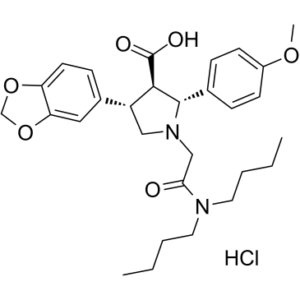
Atrasentan HCl, the hydrochloride salt of Atrasentan (NSC-720763; ABT-627; A-147627; trade name: Xinlay), is a novel and selective endothelin receptor antagonist (IC50 = 0.0551 nM for ETA) with anticancer activity. Atrasentan may be used to treat metastatic hormone-refractory prostate cancer since it is made to inhibit the effects of endothelin-1.
Physicochemical Properties
| Molecular Formula | C29H39CLN2O6 |
| Molecular Weight | 547.08276 |
| Exact Mass | 546.25 |
| Elemental Analysis | C, 63.67; H, 7.19; Cl, 6.48; N, 5.12; O, 17.55 |
| CAS # | 195733-43-8 |
| Related CAS # | Atrasentan; 173937-91-2 |
| PubChem CID | 159595 |
| Appearance | Off-white to gray solid powder |
| Density | 1.238g/cm3 |
| Boiling Point | 659.4ºC at 760mmHg |
| Flash Point | 352.6ºC |
| LogP | 5.433 |
| Hydrogen Bond Donor Count | 2 |
| Hydrogen Bond Acceptor Count | 7 |
| Rotatable Bond Count | 12 |
| Heavy Atom Count | 38 |
| Complexity | 734 |
| Defined Atom Stereocenter Count | 3 |
| SMILES | O=C([C@H]1[C@H](C2=CC=C(OC)C=C2)N(CC(N(CCCC)CCCC)=O)C[C@@H]1C3=CC=C(OCO4)C4=C3)O.Cl |
| InChi Key | IJFUJIFSUKPWCZ-SQMFDTLJSA-N |
| InChi Code | InChI=1S/C29H38N2O6.ClH/c1-4-6-14-30(15-7-5-2)26(32)18-31-17-23(21-10-13-24-25(16-21)37-19-36-24)27(29(33)34)28(31)20-8-11-22(35-3)12-9-20;/h8-13,16,23,27-28H,4-7,14-15,17-19H2,1-3H3,(H,33,34);1H/t23-,27-,28+;/m1./s1 |
| Chemical Name | (2R,3R,4S)-4-(1,3-benzodioxol-5-yl)-1-[2-(dibutylamino)-2-oxoethyl]-2-(4-methoxyphenyl)pyrrolidine-3-carboxylic acid;hydrochloride |
| Synonyms | ABT 627; Abbott 147627; (+)A 127722; A147627; A 127722; ABT627; ABT-627; NSC720763; US trade name: Xinlay |
| HS Tariff Code | 2934.99.9001 |
| Storage |
Powder-20°C 3 years 4°C 2 years In solvent -80°C 6 months -20°C 1 month Note: Please store this product in a sealed and protected environment, avoid exposure to moisture. |
| Shipping Condition | Room temperature (This product is stable at ambient temperature for a few days during ordinary shipping and time spent in Customs) |
Biological Activity
| Targets | ETA ( IC50 = 0.055 nM ) | |
| ln Vitro |
|
|
| ln Vivo |
|
|
| Cell Assay |
|
|
| Animal Protocol |
|
|
| References |
[1]. Superiority of YM598 over atrasentan as a selective endothelin ETA receptor antagonist. Eur J Pharmacol. 2004 Sep 13;498(1-3):171-7. [2]. In vitro and in vivo molecular evidence for better therapeutic efficacy of ABT-627 combination in prostate cancer. Cancer Res. 2007 Apr 15;67(8):3818-26. [3]. Interaction potential of the endothelin-A receptor antagonist atrasentan with drug transporters and drug-metabolising enzymes assessed in vitro. Cancer Chemother Pharmacol. 2011 Oct;68(4):1093-8. |
|
| Additional Infomation |
Atrasentan Hydrochloride is the orally available hydrochloride salt of pyrrolidine-3-carboxylic acid with potential antineoplastic activity. As a selective antagonist of the endothelin-A (ETA) receptor, atrasentan binds selectively to the ETA receptor, which may result in inhibition of endothelin-induced angiogenesis and tumor cell proliferation. A pyrrolidine and benzodioxole derivative that acts a RECEPTOR, ENDOTHELIN A antagonist. It has therapeutic potential as an antineoplastic agent and for the treatment of DIABETIC NEPHROPATHIES. Drug Indication Treatment of nephropathy |
Solubility Data
| Solubility (In Vitro) |
DMSO: ~28.57 mg/mL (~52.2 mM) H2O: ~0.5 mg/mL (~0.9 mM) 0.1 M HCL: < 1 mg/mL |
| Solubility (In Vivo) |
Solubility in Formulation 1: ≥ 2.5 mg/mL (4.57 mM) (saturation unknown) in 10% DMSO + 40% PEG300 + 5% Tween80 + 45% Saline (add these co-solvents sequentially from left to right, and one by one), clear solution. For example, if 1 mL of working solution is to be prepared, you can add 100 μL of 25.0 mg/mL clear DMSO stock solution to 400 μL PEG300 and mix evenly; then add 50 μL Tween-80 to the above solution and mix evenly; then add 450 μL normal saline to adjust the volume to 1 mL. Preparation of saline: Dissolve 0.9 g of sodium chloride in 100 mL ddH₂ O to obtain a clear solution. Solubility in Formulation 2: ≥ 2.5 mg/mL (4.57 mM) (saturation unknown) in 10% DMSO + 90% (20% SBE-β-CD in Saline) (add these co-solvents sequentially from left to right, and one by one), clear solution. For example, if 1 mL of working solution is to be prepared, you can add 100 μL of 25.0 mg/mL clear DMSO stock solution to 900 μL of 20% SBE-β-CD physiological saline solution and mix evenly. Preparation of 20% SBE-β-CD in Saline (4°C,1 week): Dissolve 2 g SBE-β-CD in 10 mL saline to obtain a clear solution. Solubility in Formulation 3: ≥ 2.5 mg/mL (4.57 mM) (saturation unknown) in 10% DMSO + 90% Corn Oil (add these co-solvents sequentially from left to right, and one by one), clear solution. For example, if 1 mL of working solution is to be prepared, you can add 100 μL of 25.0 mg/mL clear DMSO stock solution to 900 μL of corn oil and mix evenly. Solubility in Formulation 4: 0.75 mg/mL (1.37 mM) in 0.5% CMC-Na/saline water (add these co-solvents sequentially from left to right, and one by one), clear solution; with heating and sonication. Preparation of saline: Dissolve 0.9 g of sodium chloride in 100 mL ddH₂ O to obtain a clear solution. (Please use freshly prepared in vivo formulations for optimal results.) |
| Preparing Stock Solutions | 1 mg | 5 mg | 10 mg | |
| 1 mM | 1.8279 mL | 9.1394 mL | 18.2789 mL | |
| 5 mM | 0.3656 mL | 1.8279 mL | 3.6558 mL | |
| 10 mM | 0.1828 mL | 0.9139 mL | 1.8279 mL |