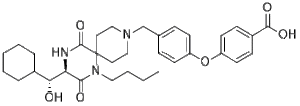
Aplaviroc (formerly known as AK-602; GW-873140; ONO-4128; GW873140A; GSK-873140), a SDP (spirodiketopiperazine) derivative, is a CCR5 entry inhibitor with the potential treatment of HIV infection. With respective IC50s of 0.1–0.4 nM, it inhibits HIV-1Ba-L, HIV-1JRFL, and HIV-1MOKW. Concerns about liver toxicity led to the termination of aplaviroc's development in October 2005. With a subnanomolar range of potent anti-human immunodeficiency virus activity, apivirocin binds specifically to the human cellular CC chemokine receptor 5 (CCR5) in vitro. Apaviroc specifically prevents the binding of a specific monoclonal antibody, 45531, to CCR5, according to in vitro research. A broad range of laboratory and primary R5 HIV-1 isolates, including multidrug-resistant HIV-1 (HIV-1(MDR)), were effectively inhibited by plaviroc. Plaviroc specifically blocked the binding of macrophage inflammatory protein 1alpha (MIP-1alpha) to CCR5 with a high affinity (K(d) of approximately 3 nM), potently blocked human immunodeficiency virus type 1 (HIV-1) gp120/CCR5 binding, and demonstrated potent activity against these strains of HIV-1. Two monoclonal antibodies, 45523, which targets multidomain epitopes of CCR5, and 45531, which targets the C-terminal half of the second extracellular loop (ECL2B) of CCR5, were competitively blocked from binding to CCR5, which was expressed on Chinese hamster ovary cells, by AK602. AK602 maintained MIP-1beta binding to CCR5(+) cells and its functions, such as CC-chemokine-induced chemotaxis and CCR5 internalization, while TAK-779 and SCH-C completely blocked the CC-chemokine/CCR5 interactions. This was in spite of AK602 having much greater anti-HIV-1 activity than other previously published CCR5 inhibitors, such as TAK-779 and SCH-C. Rodents with favorable oral bioavailability were found through pharmacokinetic studies. These findings support the need to investigate AK602 further as a possible HIV-1 infection treatment.
Physicochemical Properties
| Molecular Formula | C33H43N3O6 |
| Molecular Weight | 577.71102 |
| Exact Mass | 577.315 |
| Elemental Analysis | C, 68.61; H, 7.50; N, 7.27; O, 16.62 |
| CAS # | 461443-59-4 |
| Related CAS # | Aplaviroc hydrochloride; 461023-63-2 |
| PubChem CID | 3001322 |
| Appearance | Solid powder |
| Density | 1.3±0.1 g/cm3 |
| Boiling Point | 800.6±65.0 °C at 760 mmHg |
| Flash Point | 438.0±34.3 °C |
| Vapour Pressure | 0.0±3.0 mmHg at 25°C |
| Index of Refraction | 1.630 |
| LogP | 4.31 |
| Hydrogen Bond Donor Count | 3 |
| Hydrogen Bond Acceptor Count | 7 |
| Rotatable Bond Count | 10 |
| Heavy Atom Count | 42 |
| Complexity | 915 |
| Defined Atom Stereocenter Count | 2 |
| SMILES | O=C(O)C1=CC=C(OC2=CC=C(CN(CC3)CCC3(N(CCCC)C([C@@H]([C@@H](C4CCCCC4)O)N5)=O)C5=O)C=C2)C=C1 |
| InChi Key | GWNOTCOIYUNTQP-FQLXRVMXSA-N |
| InChi Code | InChI=1S/C33H43N3O6/c1-2-3-19-36-30(38)28(29(37)24-7-5-4-6-8-24)34-32(41)33(36)17-20-35(21-18-33)22-23-9-13-26(14-10-23)42-27-15-11-25(12-16-27)31(39)40/h9-16,24,28-29,37H,2-8,17-22H2,1H3,(H,34,41)(H,39,40)/t28-,29-/m1/s1 |
| Chemical Name | 4-[4-[[(3R)-1-butyl-3-[(R)-cyclohexyl(hydroxy)methyl]-2,5-dioxo-1,4,9-triazaspiro[5.5]undecan-9-yl]methyl]phenoxy]benzoic acid |
| Synonyms | GSK-873140; AK 602; GW873140A; ONO-4128; GSK 873140; AGW 873140; ONO 4128; K602; GW-873140; GSK873140; AK 602; AK-602; GW873140; ONO4128; Aplaviroc hydrochloride |
| HS Tariff Code | 2934.99.03.00 |
| Storage |
Powder-20°C 3 years 4°C 2 years In solvent -80°C 6 months -20°C 1 month |
| Shipping Condition | Room temperature (This product is stable at ambient temperature for a few days during ordinary shipping and time spent in Customs) |
Biological Activity
| Targets | HIV-1Ba-L ( IC50 = 0.4 nM ); HIV-1JRFL ( IC50 = 0.1 nM ); HIV-1MOKW ( IC50 = 0.2 nM ); CCR5 |
| ln Vitro | Aplaviroc exhibits strong efficacy against three wild-type R5 HIV-1 strains: HIV-1Ba-L, HIV-1JRFL, and HIV-1MOKW, With IC50 values ranging from 0.1 to 0.4 nM. Two previously reported CCR5 inhibitors, E921/TAK-779 and AK671/SCH-C, are significantly less potent than apiverroc. In two HIV-1MDR variants, HIV-1MM and HIV-1JSL, apivirofoc inhibits replication and infectivity at incredibly low concentrations (IC50 values of 0.4 to 0.6 nM). High affinity binding of plaviroc occurs with CCR5. Kd values for Aplaviroc, E913, E921/TAK-779, and AK671/SCH-C are 2.9±1.0, 111.7±3.5, 32.2±9.6, and 16.0±1.5 nM, respectively, based on the results calculated. At a 2.7 nM IC50, apivermico effectively inhibits the binding of rgp120/sCD4 to CCR5. These findings imply that the strong action of Aplaviroc against R5 HIV-1 originates from its highly selective binding to ECL2B and/or its surrounding regions, which inhibits gp120/CD4 binding to CCR5[1]. |
| ln Vivo |
Aplaviroc (AK602, 60 mg/kg, bid, daily) suppresses R5 HIV-1 viremia in hu-PBMC-NOG mice[2]. Immediately following intraperitoneal administration, the concentration of Aplaviroc (AK602) reached its maximum concentration and rapidly declined[2]. |
| Animal Protocol |
hu-PBMC-NOG mice 60 mg/kg Single intraperitoneal administration, bid, daily |
| References |
[1]. Spirodiketopiperazine-based CCR5 inhibitor which preserves CC-chemokine/CCR5 interactions and exerts potent activity against R5 human immunodeficiency virus type 1 in vitro. J Virol. 2004 Aug;78(16):8654-62. [2]. Potent anti-R5 human immunodeficiency virus type 1 effects of a CCR5 antagonist, AK602/ONO4128/GW873140, in a novel human peripheral blood mononuclear cell nonobese diabetic-SCID, interleukin-2 receptor gamma-chain-knocked-out AIDS mouse model. Virol. 2005 Feb;79(4):2087-96. |
| Additional Infomation |
A spiro-diketo-piperazine; a potent noncompetitive allosteric antagonist of the CCR5 receptor with concomitantly potent antiviral effects for HIV-1. Aplaviroc is a C-C Chemokine Receptor Type 5 (CCR5) antagonist with activity against HIV-1. Aplaviroc inhibits HIV-1 entry via CCR5 coreceptor interaction. Drug Indication Investigated for use/treatment in HIV infection. Mechanism of Action GW873140 is a novel CCR5 receptor antagonist that binds specifically to human CCR5. It binds to human CCR5 with a unique profile as evidenced by the selective inhibition of monoclonal antibody binding. One of the many ways in which CCR5 inhibitors differ from the currently available classes of HIV drugs is that they bind to the host (CCR5 receptor), the cell, target rather than to the viral enzymes in cells like the CD4 cell. |
Solubility Data
| Solubility (In Vitro) | May dissolve in DMSO (in most cases), if not, try other solvents such as H2O, Ethanol, or DMF with a minute amount of products to avoid loss of samples |
| Solubility (In Vivo) |
Note: Listed below are some common formulations that may be used to formulate products with low water solubility (e.g. < 1 mg/mL), you may test these formulations using a minute amount of products to avoid loss of samples. Injection Formulations (e.g. IP/IV/IM/SC) Injection Formulation 1: DMSO : Tween 80: Saline = 10 : 5 : 85 (i.e. 100 μL DMSO stock solution → 50 μL Tween 80 → 850 μL Saline) *Preparation of saline: Dissolve 0.9 g of sodium chloride in 100 mL ddH ₂ O to obtain a clear solution. Injection Formulation 2: DMSO : PEG300 :Tween 80 : Saline = 10 : 40 : 5 : 45 (i.e. 100 μL DMSO → 400 μLPEG300 → 50 μL Tween 80 → 450 μL Saline) Injection Formulation 3: DMSO : Corn oil = 10 : 90 (i.e. 100 μL DMSO → 900 μL Corn oil) Example: Take the Injection Formulation 3 (DMSO : Corn oil = 10 : 90) as an example, if 1 mL of 2.5 mg/mL working solution is to be prepared, you can take 100 μL 25 mg/mL DMSO stock solution and add to 900 μL corn oil, mix well to obtain a clear or suspension solution (2.5 mg/mL, ready for use in animals). Injection Formulation 4: DMSO : 20% SBE-β-CD in saline = 10 : 90 [i.e. 100 μL DMSO → 900 μL (20% SBE-β-CD in saline)] *Preparation of 20% SBE-β-CD in Saline (4°C,1 week): Dissolve 2 g SBE-β-CD in 10 mL saline to obtain a clear solution. Injection Formulation 5: 2-Hydroxypropyl-β-cyclodextrin : Saline = 50 : 50 (i.e. 500 μL 2-Hydroxypropyl-β-cyclodextrin → 500 μL Saline) Injection Formulation 6: DMSO : PEG300 : castor oil : Saline = 5 : 10 : 20 : 65 (i.e. 50 μL DMSO → 100 μLPEG300 → 200 μL castor oil → 650 μL Saline) Injection Formulation 7: Ethanol : Cremophor : Saline = 10: 10 : 80 (i.e. 100 μL Ethanol → 100 μL Cremophor → 800 μL Saline) Injection Formulation 8: Dissolve in Cremophor/Ethanol (50 : 50), then diluted by Saline Injection Formulation 9: EtOH : Corn oil = 10 : 90 (i.e. 100 μL EtOH → 900 μL Corn oil) Injection Formulation 10: EtOH : PEG300:Tween 80 : Saline = 10 : 40 : 5 : 45 (i.e. 100 μL EtOH → 400 μLPEG300 → 50 μL Tween 80 → 450 μL Saline) Oral Formulations Oral Formulation 1: Suspend in 0.5% CMC Na (carboxymethylcellulose sodium) Oral Formulation 2: Suspend in 0.5% Carboxymethyl cellulose Example: Take the Oral Formulation 1 (Suspend in 0.5% CMC Na) as an example, if 100 mL of 2.5 mg/mL working solution is to be prepared, you can first prepare 0.5% CMC Na solution by measuring 0.5 g CMC Na and dissolve it in 100 mL ddH2O to obtain a clear solution; then add 250 mg of the product to 100 mL 0.5% CMC Na solution, to make the suspension solution (2.5 mg/mL, ready for use in animals). Oral Formulation 3: Dissolved in PEG400 Oral Formulation 4: Suspend in 0.2% Carboxymethyl cellulose Oral Formulation 5: Dissolve in 0.25% Tween 80 and 0.5% Carboxymethyl cellulose Oral Formulation 6: Mixing with food powders Note: Please be aware that the above formulations are for reference only. InvivoChem strongly recommends customers to read literature methods/protocols carefully before determining which formulation you should use for in vivo studies, as different compounds have different solubility properties and have to be formulated differently. (Please use freshly prepared in vivo formulations for optimal results.) |
| Preparing Stock Solutions | 1 mg | 5 mg | 10 mg | |
| 1 mM | 1.7310 mL | 8.6549 mL | 17.3097 mL | |
| 5 mM | 0.3462 mL | 1.7310 mL | 3.4619 mL | |
| 10 mM | 0.1731 mL | 0.8655 mL | 1.7310 mL |