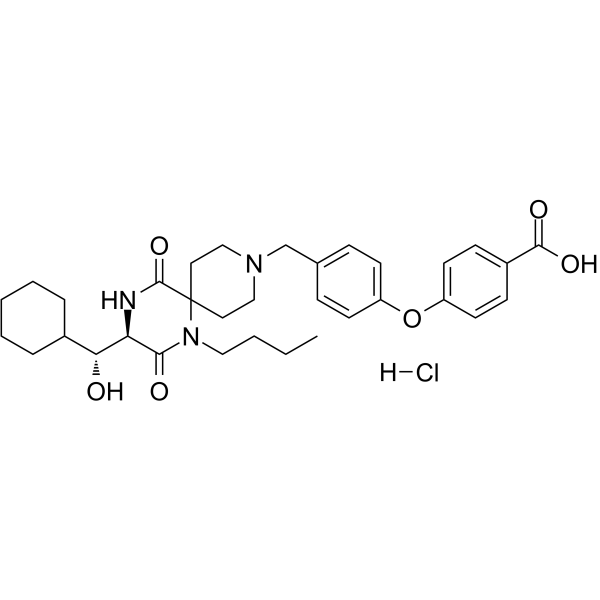
Aplaviroc HCl (GW873140A; ONO-4128; AK-602; GSK 873140) is the hydrochloride salt of Aplaviroc which is a SDP (spirodiketopiperazine) derivative, and a CCR5 entry inhibitor with anti-HIV activity. It inhibits HIV-1Ba-L, HIV-1JRFL, and HIV-1MOKW with IC50s ranging from 0.1 to 0.4 nM.
Physicochemical Properties
| Molecular Formula | C33H44CLN3O6 |
| Molecular Weight | 614.171968460083 |
| Exact Mass | 613.292 |
| Elemental Analysis | C, 64.54; H, 7.22; Cl, 5.77; N, 6.84; O, 15.63 |
| CAS # | 461023-63-2 |
| Related CAS # | Aplaviroc; 461443-59-4 |
| PubChem CID | 6918686 |
| Appearance | White to off-white solid powder |
| LogP | 5.533 |
| Hydrogen Bond Donor Count | 4 |
| Hydrogen Bond Acceptor Count | 7 |
| Rotatable Bond Count | 10 |
| Heavy Atom Count | 43 |
| Complexity | 915 |
| Defined Atom Stereocenter Count | 2 |
| SMILES | CCCCN1C(=O)C(NC(=O)C12CCN(CC2)CC3=CC=C(C=C3)OC4=CC=C(C=C4)C(=O)O)C(C5CCCCC5)O.Cl |
| InChi Key | QNNBMSGFNQRUEH-PQQSRXGVSA-N |
| InChi Code | InChI=1S/C33H43N3O6.ClH/c1-2-3-19-36-30(38)28(29(37)24-7-5-4-6-8-24)34-32(41)33(36)17-20-35(21-18-33)22-23-9-13-26(14-10-23)42-27-15-11-25(12-16-27)31(39)40;/h9-16,24,28-29,37H,2-8,17-22H2,1H3,(H,34,41)(H,39,40);1H/t28-,29-;/m1./s1 |
| Chemical Name | 4-[4-[[(3R)-1-butyl-3-[(R)-cyclohexyl(hydroxy)methyl]-2,5-dioxo-1,4,9-triazaspiro[5.5]undecan-9-yl]methyl]phenoxy]benzoic acid;hydrochloride |
| Synonyms | GW873140A; GW 873140; GW-873140; GW873140; ONO-4128; AK-602; AK602; AK 602; ONO 4128; ONO4128; Aplaviroc hydrochloride |
| HS Tariff Code | 2934.99.9001 |
| Storage |
Powder-20°C 3 years 4°C 2 years In solvent -80°C 6 months -20°C 1 month Note: Please store this product in a sealed and protected environment, avoid exposure to moisture. |
| Shipping Condition | Room temperature (This product is stable at ambient temperature for a few days during ordinary shipping and time spent in Customs) |
Biological Activity
| Targets | HIV-1Ba-L ( IC50 = 0.4 nM ); HIV-1JRFL ( IC50 = 0.1 nM ); HIV-1MOKW ( IC50 = 0.2 nM ); CCR5 |
| ln Vitro | Aplaviroc exhibits strong efficacy against three wild-type R5 HIV-1 strains: HIV-1Ba-L, HIV-1JRFL, and HIV-1MOKW, With IC50 values ranging from 0.1 to 0.4 nM. Two previously reported CCR5 inhibitors, E921/TAK-779 and AK671/SCH-C, are significantly less potent than apiverroc. In two HIV-1MDR variants, HIV-1MM and HIV-1JSL, apivirofoc inhibits replication and infectivity at incredibly low concentrations (IC50 values of 0.4 to 0.6 nM). High affinity binding of plaviroc occurs with CCR5. Kd values for Aplaviroc, E913, E921/TAK-779, and AK671/SCH-C are 2.9±1.0, 111.7±3.5, 32.2±9.6, and 16.0±1.5 nM, respectively, based on the results calculated. At a 2.7 nM IC50, apivermico effectively inhibits the binding of rgp120/sCD4 to CCR5. These findings imply that the strong action of Aplaviroc against R5 HIV-1 originates from its highly selective binding to ECL2B and/or its surrounding regions, which inhibits gp120/CD4 binding to CCR5[1]. |
| ln Vivo |
Aplaviroc (AK602, 60 mg/kg, bid, daily) suppresses R5 HIV-1 viremia in hu-PBMC-NOG mice[2]. Immediately following intraperitoneal administration, the concentration of Aplaviroc (AK602) reached its maximum concentration and rapidly declined[2]. |
| Animal Protocol |
hu-PBMC-NOG mice 60 mg/kg Single intraperitoneal administration, bid, daily |
| References |
[1]. Spirodiketopiperazine-based CCR5 inhibitor which preserves CC-chemokine/CCR5 interactions and exerts potent activity against R5 human immunodeficiency virus type 1 in vitro. J Virol. 2004 Aug;78(16):8654-62. [2]. Potent anti-R5 human immunodeficiency virus type 1 effects of a CCR5 antagonist, AK602/ONO4128/GW873140, in a novel human peripheral blood mononuclear cell nonobese diabetic-SCID, interleukin-2 receptor gamma-chain-knocked-out AIDS mouse model. Virol. 2005 Feb;79(4):2087-96. |
| Additional Infomation |
Aplaviroc Hydrochloride is a hydrochloride salt form of Aplaviroc, a C-C Chemokine Receptor Type 5 (CCR5) antagonist with activity against HIV-1. Aplaviroc inhibits HIV-1 entry via CCR5 coreceptor interaction. See also: Aplaviroc (annotation moved to). |
Solubility Data
| Solubility (In Vitro) |
DMSO: ~200 mg/mL (~325.6 mM) H2O: < 0.1 mg/mL |
| Solubility (In Vivo) |
Solubility in Formulation 1: ≥ 12.5 mg/mL (20.35 mM) (saturation unknown) in 10% DMSO + 40% PEG300 + 5% Tween80 + 45% Saline (add these co-solvents sequentially from left to right, and one by one), clear solution. For example, if 1 mL of working solution is to be prepared, you can add 100 μL of 125.0 mg/mL clear DMSO stock solution to 400 μL of PEG300 and mix evenly; then add 50 μL of Tween-80 to the above solution and mix evenly; then add 450 μL of normal saline to adjust the volume to 1 mL. Preparation of saline: Dissolve 0.9 g of sodium chloride in 100 mL ddH₂ O to obtain a clear solution. Solubility in Formulation 2: ≥ 12.5 mg/mL (20.35 mM) (saturation unknown) in 10% DMSO + 90% (20% SBE-β-CD in Saline) (add these co-solvents sequentially from left to right, and one by one), clear solution. For example, if 1 mL of working solution is to be prepared, you can add 100 μL of 125.0 mg/mL clear DMSO stock solution to 900 μL of 20% SBE-β-CD physiological saline solution and mix evenly. Preparation of 20% SBE-β-CD in Saline (4°C,1 week): Dissolve 2 g SBE-β-CD in 10 mL saline to obtain a clear solution. Solubility in Formulation 3: ≥ 12.5 mg/mL (20.35 mM) (saturation unknown) in 10% DMSO + 90% Corn Oil (add these co-solvents sequentially from left to right, and one by one), clear solution. For example, if 1 mL of working solution is to be prepared, you can add 100 μL of 125.0 mg/mL clear DMSO stock solution to 900 μL of corn oil and mix evenly. (Please use freshly prepared in vivo formulations for optimal results.) |
| Preparing Stock Solutions | 1 mg | 5 mg | 10 mg | |
| 1 mM | 1.6282 mL | 8.1411 mL | 16.2821 mL | |
| 5 mM | 0.3256 mL | 1.6282 mL | 3.2564 mL | |
| 10 mM | 0.1628 mL | 0.8141 mL | 1.6282 mL |