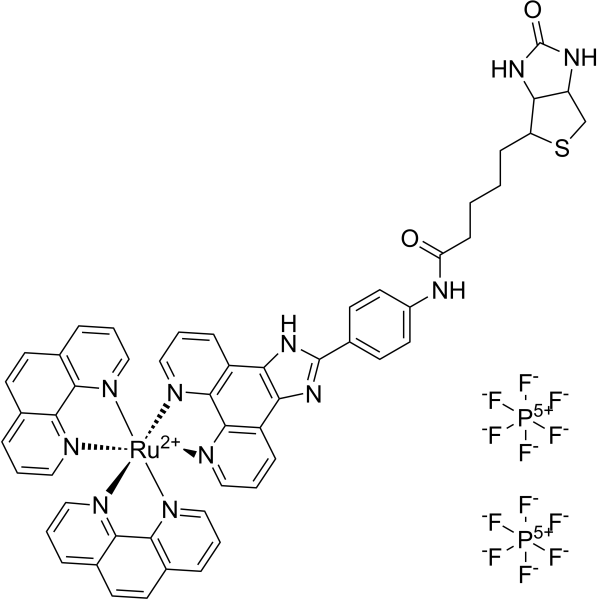
Physicochemical Properties
| Molecular Formula | C53H43F12N11O2P2RUS |
| Molecular Weight | 1289.04 |
| Appearance | Typically exists as solid at room temperature |
| HS Tariff Code | 2934.99.9001 |
| Storage |
Powder-20°C 3 years 4°C 2 years In solvent -80°C 6 months -20°C 1 month |
| Shipping Condition | Room temperature (This product is stable at ambient temperature for a few days during ordinary shipping and time spent in Customs) |
Biological Activity
| Targets | Nicotinamide adenine dinucleotide (NADH)[1] |
| ln Vitro | The fluorescence signal of biotin receptor-positive A549 cells may be greatly increased (32.08 times) by antitumor photosensitizer-5 (10 μM, 4 h), however the fluorescence signal of biotin receptor-negative BHK cells can only be slightly increased (7.35 times). [1]. In BHK and A549 cells, antitumor photosensitizer-5 (0.391-100 μM, 24 h) shows phototoxicity with very little cytotoxicity at 100 μM in the absence of light, and more than 75% of the cells survive. [1]. The antitumor photosensitizer-5 (10 μM, 4 h) and the mitochondrial probe Mito-Tracker Green have a Pearson colocalization coefficient of 0.87.[1]. Antitumor photosensitizer-5 (0.15-0.6 μM, 24 hours) Following 15 minutes of 460 nm light irradiation, the fluorescence intensity ratio of the mitochondrial membrane potential probe decreased concentration-dependently, suggesting mitochondrial damage; conversely, the fluorescence intensity of the ROS probe increased concentration-dependently, suggesting effective ROS generation [1]. In A549 cells, antitumor photosensitizer-5 (0.15-0.6 μM, 24 h) can induce apoptosis following illumination. In a dark environment, apoptosis remains essentially constant. There is an increase in DNA migration damage and activated caspase-3 under light settings. Lower the amount of NADH in cells [1]. Following 460 nm light, A549 cell migration is inhibited by antitumor photosensitizer-5 (0.15-0.6 μM, 24 h/48 h) [1]. |
| ln Vivo | After 460 nm light irradiation, antitumor photosensitizer-5 (10 mg/kg, i.tu. once, 24 days) considerably reduces tumor growth without having a major negative effect on normal organs [1]. |
| Cell Assay |
Cell Viability Assay[1] Cell Types: BHK, A549 Tested Concentrations: 0.195, 0.391, 0.781, 1.563, 3.125, 6.250, 12.5, 25, 50, 100 μM Incubation Duration: 4 h in dark + 15 min in light or dark + 20 h in dark Experimental Results: demonstrated phototoxicity in both BHK cells and A549 cells, but was more phototoxic in A549 cells(A549 cell viability < 40% under 0.391 μM while BHK cell viability < 40% under 6.25 μM), revealed minimal cytotoxicity in the absence of light with over 75 % cell viability under 100 μM. Apoptosis Analysis[1] Cell Types: A549 Tested Concentrations: 0.15, 0.3, 0.6 μM Incubation Duration: 4 h in dark + 15 min in light or dark + 20 h in dark Experimental Results: Increased the percentage of early and late apoptotic cells in A549 in a concentration-dependent manner under the 460 nm light condition. Conversely, under dark conditions, the percentage of early and late apoptotic cells in treated A549 cells remained virtually unchanged. Cell Migration Assay [1] Cell Types: A549 Tested Concentrations: 0.15, 0.3, 0.6 μM Incubation Duration: 4 h in dark + 15 min in light or dark + 20 h/44 h in dark Experimental Results: Displayed a significant concentration-dependent inhibition of wound healing in A549 cells under 460 nm light compared to cells kept in the dark. |
| Animal Protocol |
Animal/Disease Models: BALB/c nude female mice (6–8 weeks old) , Human lung adenocarcinoma epithelial A549 cells[1] Doses: 10 mg/kg Route of Administration: intratumoral injection (i.tu.) for once Experimental Results: Suppressed the tumor growth remarkably in the light group while tumors in the dark or control groups grow rapidly during the same period. Caused severe apoptosis and disruption of the tumor structure in the tumor of light group while the tumors in the other group demonstrated no obvious tissue damage, normal organs Such as the heart, liver, spleen, lung, and kidney did not exhibit significant pathological abnormalities or inflammatory lesions. |
| References |
[1]. Biotin-conjugated Ru(II) complexes with AIE characteristics as mitochondria-targeted photosensitizers for enhancing photodynamic therapy by disrupting cellular redox balance. European Journal of Medicinal Chemistry. 2023,Volume 264,115985. |
Solubility Data
| Solubility (In Vitro) | May dissolve in DMSO (in most cases), if not, try other solvents such as H2O, Ethanol, or DMF with a minute amount of products to avoid loss of samples |
| Solubility (In Vivo) |
Note: Listed below are some common formulations that may be used to formulate products with low water solubility (e.g. < 1 mg/mL), you may test these formulations using a minute amount of products to avoid loss of samples. Injection Formulations (e.g. IP/IV/IM/SC) Injection Formulation 1: DMSO : Tween 80: Saline = 10 : 5 : 85 (i.e. 100 μL DMSO stock solution → 50 μL Tween 80 → 850 μL Saline) *Preparation of saline: Dissolve 0.9 g of sodium chloride in 100 mL ddH ₂ O to obtain a clear solution. Injection Formulation 2: DMSO : PEG300 :Tween 80 : Saline = 10 : 40 : 5 : 45 (i.e. 100 μL DMSO → 400 μLPEG300 → 50 μL Tween 80 → 450 μL Saline) Injection Formulation 3: DMSO : Corn oil = 10 : 90 (i.e. 100 μL DMSO → 900 μL Corn oil) Example: Take the Injection Formulation 3 (DMSO : Corn oil = 10 : 90) as an example, if 1 mL of 2.5 mg/mL working solution is to be prepared, you can take 100 μL 25 mg/mL DMSO stock solution and add to 900 μL corn oil, mix well to obtain a clear or suspension solution (2.5 mg/mL, ready for use in animals). Injection Formulation 4: DMSO : 20% SBE-β-CD in saline = 10 : 90 [i.e. 100 μL DMSO → 900 μL (20% SBE-β-CD in saline)] *Preparation of 20% SBE-β-CD in Saline (4°C,1 week): Dissolve 2 g SBE-β-CD in 10 mL saline to obtain a clear solution. Injection Formulation 5: 2-Hydroxypropyl-β-cyclodextrin : Saline = 50 : 50 (i.e. 500 μL 2-Hydroxypropyl-β-cyclodextrin → 500 μL Saline) Injection Formulation 6: DMSO : PEG300 : castor oil : Saline = 5 : 10 : 20 : 65 (i.e. 50 μL DMSO → 100 μLPEG300 → 200 μL castor oil → 650 μL Saline) Injection Formulation 7: Ethanol : Cremophor : Saline = 10: 10 : 80 (i.e. 100 μL Ethanol → 100 μL Cremophor → 800 μL Saline) Injection Formulation 8: Dissolve in Cremophor/Ethanol (50 : 50), then diluted by Saline Injection Formulation 9: EtOH : Corn oil = 10 : 90 (i.e. 100 μL EtOH → 900 μL Corn oil) Injection Formulation 10: EtOH : PEG300:Tween 80 : Saline = 10 : 40 : 5 : 45 (i.e. 100 μL EtOH → 400 μLPEG300 → 50 μL Tween 80 → 450 μL Saline) Oral Formulations Oral Formulation 1: Suspend in 0.5% CMC Na (carboxymethylcellulose sodium) Oral Formulation 2: Suspend in 0.5% Carboxymethyl cellulose Example: Take the Oral Formulation 1 (Suspend in 0.5% CMC Na) as an example, if 100 mL of 2.5 mg/mL working solution is to be prepared, you can first prepare 0.5% CMC Na solution by measuring 0.5 g CMC Na and dissolve it in 100 mL ddH2O to obtain a clear solution; then add 250 mg of the product to 100 mL 0.5% CMC Na solution, to make the suspension solution (2.5 mg/mL, ready for use in animals). Oral Formulation 3: Dissolved in PEG400 Oral Formulation 4: Suspend in 0.2% Carboxymethyl cellulose Oral Formulation 5: Dissolve in 0.25% Tween 80 and 0.5% Carboxymethyl cellulose Oral Formulation 6: Mixing with food powders Note: Please be aware that the above formulations are for reference only. InvivoChem strongly recommends customers to read literature methods/protocols carefully before determining which formulation you should use for in vivo studies, as different compounds have different solubility properties and have to be formulated differently. (Please use freshly prepared in vivo formulations for optimal results.) |
| Preparing Stock Solutions | 1 mg | 5 mg | 10 mg | |
| 1 mM | 0.7758 mL | 3.8789 mL | 7.7577 mL | |
| 5 mM | 0.1552 mL | 0.7758 mL | 1.5515 mL | |
| 10 mM | 0.0776 mL | 0.3879 mL | 0.7758 mL |