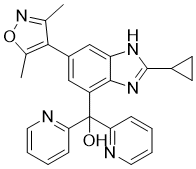
Alobresib (GS-5829) is a novel and potent BET bromodomain inhibitor with anticancer activity. IIt may be used to treat USCs that are recurrent or chemotherapy-resistant and overexpress c-Myc.
Physicochemical Properties
| Molecular Formula | C26H23N5O2 |
| Molecular Weight | 437.4931 |
| Exact Mass | 437.185 |
| Elemental Analysis | C, 71.38; H, 5.30; N, 16.01; O, 7.31 |
| CAS # | 1637771-14-2 |
| Related CAS # | 1637771-14-2 |
| PubChem CID | 86281210 |
| Appearance | Off-white to light yellow solid powder |
| LogP | 3.2 |
| Hydrogen Bond Donor Count | 2 |
| Hydrogen Bond Acceptor Count | 6 |
| Rotatable Bond Count | 5 |
| Heavy Atom Count | 33 |
| Complexity | 672 |
| Defined Atom Stereocenter Count | 0 |
| InChi Key | CMSUJGUHYXQSOK-UHFFFAOYSA-N |
| InChi Code | InChI=1S/C26H23N5O2/c1-15-23(16(2)33-31-15)18-13-19(24-20(14-18)29-25(30-24)17-9-10-17)26(32,21-7-3-5-11-27-21)22-8-4-6-12-28-22/h3-8,11-14,17,32H,9-10H2,1-2H3,(H,29,30) |
| Chemical Name | [2-cyclopropyl-6-(3,5-dimethyl-1,2-oxazol-4-yl)-1H-benzimidazol-4-yl]-dipyridin-2-ylmethanol |
| Synonyms | Alobresib; GS 5829; GS5829; GS-5829 |
| HS Tariff Code | 2934.99.9001 |
| Storage |
Powder-20°C 3 years 4°C 2 years In solvent -80°C 6 months -20°C 1 month |
| Shipping Condition | Room temperature (This product is stable at ambient temperature for a few days during ordinary shipping and time spent in Customs) |
Biological Activity
| Targets | BET; BLK; Akt; ERK1/2; MYC |
| ln Vitro | In-vitro research shows that USC cell lines are highly sensitive to the drug GS-5829, which results in a dose-dependent reduction in the level of phosphorylated c-Myc and an increase in caspase activation (apoptosis).[1] Through the deregulation of important signaling pathways like BLK, AKT, ERK1/2, and MYC, GS-5829 reduces CLL cell proliferation and triggers leukemia cell apoptosis. According to IκBα modulation, GS-5829 also suppresses NF-κB signaling. An imbalance between the positive (BIM) and negative (BCL-XL) regulators of the intrinsic apoptosis pathway causes GS-5829-induced apoptosis.[2] |
| ln Vivo | GS-5829 has impressive activity against USC primary tumors as well as USC xenografts. In tumors exposed to GS-5829, analysis of the expression of c-Myc shows that both the total and phosphorylated forms of the protein are downregulated. When compared to JQ1 at the doses used in in vivo experiments against USC xenografts, GS-5829 significantly outperforms it in terms of bioavailability after oral administration. There is a need for clinical studies with the drug GS-5829 in USC patients who have disease that is resistant to conventional salvage chemotherapy. [1] |
| Cell Assay | Following the manufacturer's instructions, MEC-1 cells treated for 72 hours with GS-5829 or the BCR signaling inhibitors are subjected to the TACS XTT cell proliferation/viability assay (Trevigen). Using technical triplicate measurements, half-maximal inhibitory concentrations (IC50) are computed. |
| Animal Protocol |
female CB17/lcrHsd-Prkd/scid mice bearing USC-ARK1 or USC-ARK2 xenograft 20 mg/kg, 10 mg/kg Oral gavage |
| References |
[1]. Clin Cancer Res . 2018 Oct 1;24(19):4845-4853. [2]. Leukemia . 2020 Jun;34(6):1588-1598. |
| Additional Infomation |
Alobresib is under investigation in clinical trial NCT02607228 (Safety, Tolerability, Pharmacokinetics, and Pharmacodynamics of GS-5829 as a Single Agent and In Combination With Enzalutamide in Participants With Metastatic Castrate-Resistant Prostate Cancer). Alobresib is an orally bioavailable inhibitor of the Bromodomain and Extra-Terminal (BET) family of proteins, with potential antineoplastic activity. Upon oral administration, alobresib binds to the acetylated lysine recognition motifs in the bromodomains of BET proteins, thereby preventing the interaction between the BET proteins and acetylated histones. This disrupts chromatin remodeling and gene expression. Prevention of the expression of certain growth-promoting genes may lead to an inhibition of proliferation in BET-overexpressing tumor cells. BET proteins, comprised of BRD2, BRD3, BRD4 and BRDT, are transcriptional regulators that play an important role during development and cellular growth. |
Solubility Data
| Solubility (In Vitro) |
DMSO: 83.3~87 mg/mL (~198.9 mM) Water: ˂1 mg/mL Ethanol: ~11 mg/mL (~25.1 mM) |
| Solubility (In Vivo) |
Solubility in Formulation 1: ≥ 2.08 mg/mL (4.75 mM) (saturation unknown) in 10% DMSO + 40% PEG300 + 5% Tween80 + 45% Saline (add these co-solvents sequentially from left to right, and one by one), clear solution. For example, if 1 mL of working solution is to be prepared, you can add 100 μL of 20.8 mg/mL clear DMSO stock solution to 400 μL PEG300 and mix evenly; then add 50 μL Tween-80 to the above solution and mix evenly; then add 450 μL normal saline to adjust the volume to 1 mL. Preparation of saline: Dissolve 0.9 g of sodium chloride in 100 mL ddH₂ O to obtain a clear solution. Solubility in Formulation 2: ≥ 2.08 mg/mL (4.75 mM) (saturation unknown) in 10% DMSO + 90% (20% SBE-β-CD in Saline) (add these co-solvents sequentially from left to right, and one by one), clear solution. For example, if 1 mL of working solution is to be prepared, you can add 100 μL of 20.8 mg/mL clear DMSO stock solution to 900 μL of 20% SBE-β-CD physiological saline solution and mix evenly. Preparation of 20% SBE-β-CD in Saline (4°C,1 week): Dissolve 2 g SBE-β-CD in 10 mL saline to obtain a clear solution. Solubility in Formulation 3: ≥ 2.08 mg/mL (4.75 mM) (saturation unknown) in 10% DMSO + 90% Corn Oil (add these co-solvents sequentially from left to right, and one by one), clear solution. For example, if 1 mL of working solution is to be prepared, you can add 100 μL of 20.8 mg/mL clear DMSO stock solution to 900 μL of corn oil and mix evenly. (Please use freshly prepared in vivo formulations for optimal results.) |
| Preparing Stock Solutions | 1 mg | 5 mg | 10 mg | |
| 1 mM | 2.2858 mL | 11.4288 mL | 22.8577 mL | |
| 5 mM | 0.4572 mL | 2.2858 mL | 4.5715 mL | |
| 10 mM | 0.2286 mL | 1.1429 mL | 2.2858 mL |