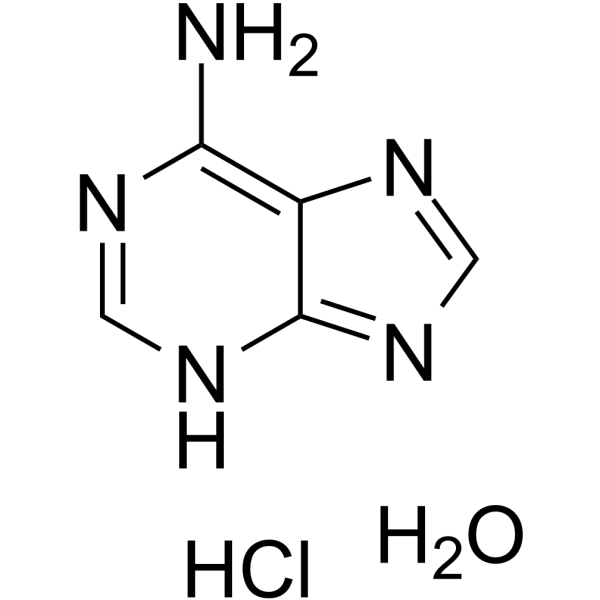
Physicochemical Properties
| Molecular Formula | C5H8CLN5O |
| Molecular Weight | 189.60 |
| Exact Mass | 189.041 |
| CAS # | 6055-72-7 |
| Related CAS # | Adenine monohydrochloride hemihydrate-15N5 |
| PubChem CID | 24211900 |
| Appearance | White to off-white solid powder |
| Boiling Point | 613.5ºC at 760 mmHg |
| Melting Point | 289-291ºC (dec.) |
| Flash Point | 324.9ºC |
| LogP | 1.254 |
| Hydrogen Bond Donor Count | 4 |
| Hydrogen Bond Acceptor Count | 5 |
| Rotatable Bond Count | 0 |
| Heavy Atom Count | 12 |
| Complexity | 127 |
| Defined Atom Stereocenter Count | 0 |
| SMILES | C1=NC2=NC=NC(=C2N1)N.O.Cl |
| InChi Key | MYRDTAUFFBYTHA-UHFFFAOYSA-N |
| InChi Code | InChI=1S/C5H5N5.ClH.H2O/c6-4-3-5(9-1-7-3)10-2-8-4;;/h1-2H,(H3,6,7,8,9,10);1H;1H2 |
| Chemical Name | 7H-purin-6-amine;hydrate;hydrochloride |
| Synonyms | 6055-72-7; Adenine hydrochloride hydrate; 7H-Purin-6-amine hydrochloride hydrate; Adenine hydrochloride hemihydrate; 916986-40-8; 7H-purin-6-amine;hydrate;hydrochloride; 1H-Purin-6-amine, monohydrochloride, hydrate (2:1); C5H8ClN5O; |
| HS Tariff Code | 2934.99.9001 |
| Storage |
Powder-20°C 3 years 4°C 2 years In solvent -80°C 6 months -20°C 1 month Note: (1). This product requires protection from light (avoid light exposure) during transportation and storage.(2). Please store this product in a sealed and protected environment (e.g. under nitrogen), avoid exposure to moisture. |
| Shipping Condition | Room temperature (This product is stable at ambient temperature for a few days during ordinary shipping and time spent in Customs) |
Biological Activity
| Targets | Endogenous metabolite |
| ln Vivo |
- Induced chronic kidney disease in mice. Male C57BL/6 mice were fed a diet containing 0.2% adenine for 4 weeks, resulting in significant increases in serum creatinine, blood urea nitrogen, and phosphorus levels, as well as a decrease in hemoglobin levels. It also caused dento - alveolar bone loss, increased osteoclast number and activity, and reduced osteoblast activity, with down - regulated expression of osteoblast - related genes (Runx2, Osterix, and Col1a1) and up - regulated expression of osteoclast - related genes (Acp5, Ctsk, and Trap) [5] - Induced chronic kidney disease in rats, leading to hypertension. Male Sprague - Dawley rats were fed a diet containing 0.75% adenine for 4 weeks to establish a chronic kidney disease model. After that, the rats showed increased blood pressure, and treatment with sodium thiosulfate could improve hypertension in these rats [6] |
| Animal Protocol |
- For the mouse model of chronic kidney disease, male C57BL/6 mice were used, and they were fed a diet containing 0.2% adenine for 4 weeks [5] - For the rat model of chronic kidney disease, male Sprague - Dawley rats were used, and they were fed a diet containing 0.75% adenine for 4 weeks [6] |
| Toxicity/Toxicokinetics |
- Can cause kidney damage. In mouse and rat models, feeding a diet containing adenine led to an increase in serum creatinine and blood urea nitrogen levels, indicating kidney function impairment [5] - Can cause blood system changes. In the mouse model, feeding a diet containing adenine led to a decrease in hemoglobin levels, suggesting an impact on the blood system [5] Toxicity Summary Adenine forms adenosine, a nucleoside, when attached to ribose, and deoxyadenosine when attached to deoxyribose, and it forms adenosine triphosphate (ATP), a nucleotide, when three phosphate groups are added to adenosine. Adenosine triphosphate is used in cellular metabolism as one of the basic methods of transferring chemical energy between reactions. In older literature, adenine was sometimes called Vitamin B4Not Available |
| References |
[1]. Synthesis of purines under possible primitive earth conditions. I. Adenine from hydrogen cyanide. Arch Biochem Biophys. 1961 Aug;94:217-27. [2]. An Introduction to Genetic Analysis. 7th edition. New York: W. H. Freeman; 2000. Structure of DNA. [3]. Reader V. The assay of vitamin B(4). Biochem J. 1930;24(6):1827-31. [4]. Pharmacokinetics of Adenosine and Cordycepin, a Bioactive Constituent of Cordyceps sinensis in Rat. J Agric Food Chem 2010 Apr 28;58(8):4638-43. [5]. Dentoalveolar Alterations in an Adenine‐Induced Chronic Kidney Disease Mouse Model. J Bone Miner Res. 2023 Aug;38(8):1192-1207. [6]. Sodium Thiosulfate Improves Hypertension in Rats with Adenine-Induced Chronic Kidney Disease. Antioxidants (Basel). 2022 Jan 11;11(1):147. |
Solubility Data
| Solubility (In Vitro) | DMSO: 8.33 mg/mL (43.93 mM) |
| Solubility (In Vivo) |
Note: Listed below are some common formulations that may be used to formulate products with low water solubility (e.g. < 1 mg/mL), you may test these formulations using a minute amount of products to avoid loss of samples. Injection Formulations (e.g. IP/IV/IM/SC) Injection Formulation 1: DMSO : Tween 80: Saline = 10 : 5 : 85 (i.e. 100 μL DMSO stock solution → 50 μL Tween 80 → 850 μL Saline) *Preparation of saline: Dissolve 0.9 g of sodium chloride in 100 mL ddH ₂ O to obtain a clear solution. Injection Formulation 2: DMSO : PEG300 :Tween 80 : Saline = 10 : 40 : 5 : 45 (i.e. 100 μL DMSO → 400 μLPEG300 → 50 μL Tween 80 → 450 μL Saline) Injection Formulation 3: DMSO : Corn oil = 10 : 90 (i.e. 100 μL DMSO → 900 μL Corn oil) Example: Take the Injection Formulation 3 (DMSO : Corn oil = 10 : 90) as an example, if 1 mL of 2.5 mg/mL working solution is to be prepared, you can take 100 μL 25 mg/mL DMSO stock solution and add to 900 μL corn oil, mix well to obtain a clear or suspension solution (2.5 mg/mL, ready for use in animals). Injection Formulation 4: DMSO : 20% SBE-β-CD in saline = 10 : 90 [i.e. 100 μL DMSO → 900 μL (20% SBE-β-CD in saline)] *Preparation of 20% SBE-β-CD in Saline (4°C,1 week): Dissolve 2 g SBE-β-CD in 10 mL saline to obtain a clear solution. Injection Formulation 5: 2-Hydroxypropyl-β-cyclodextrin : Saline = 50 : 50 (i.e. 500 μL 2-Hydroxypropyl-β-cyclodextrin → 500 μL Saline) Injection Formulation 6: DMSO : PEG300 : castor oil : Saline = 5 : 10 : 20 : 65 (i.e. 50 μL DMSO → 100 μLPEG300 → 200 μL castor oil → 650 μL Saline) Injection Formulation 7: Ethanol : Cremophor : Saline = 10: 10 : 80 (i.e. 100 μL Ethanol → 100 μL Cremophor → 800 μL Saline) Injection Formulation 8: Dissolve in Cremophor/Ethanol (50 : 50), then diluted by Saline Injection Formulation 9: EtOH : Corn oil = 10 : 90 (i.e. 100 μL EtOH → 900 μL Corn oil) Injection Formulation 10: EtOH : PEG300:Tween 80 : Saline = 10 : 40 : 5 : 45 (i.e. 100 μL EtOH → 400 μLPEG300 → 50 μL Tween 80 → 450 μL Saline) Oral Formulations Oral Formulation 1: Suspend in 0.5% CMC Na (carboxymethylcellulose sodium) Oral Formulation 2: Suspend in 0.5% Carboxymethyl cellulose Example: Take the Oral Formulation 1 (Suspend in 0.5% CMC Na) as an example, if 100 mL of 2.5 mg/mL working solution is to be prepared, you can first prepare 0.5% CMC Na solution by measuring 0.5 g CMC Na and dissolve it in 100 mL ddH2O to obtain a clear solution; then add 250 mg of the product to 100 mL 0.5% CMC Na solution, to make the suspension solution (2.5 mg/mL, ready for use in animals). Oral Formulation 3: Dissolved in PEG400 Oral Formulation 4: Suspend in 0.2% Carboxymethyl cellulose Oral Formulation 5: Dissolve in 0.25% Tween 80 and 0.5% Carboxymethyl cellulose Oral Formulation 6: Mixing with food powders Note: Please be aware that the above formulations are for reference only. InvivoChem strongly recommends customers to read literature methods/protocols carefully before determining which formulation you should use for in vivo studies, as different compounds have different solubility properties and have to be formulated differently. (Please use freshly prepared in vivo formulations for optimal results.) |
| Preparing Stock Solutions | 1 mg | 5 mg | 10 mg | |
| 1 mM | 5.2743 mL | 26.3713 mL | 52.7426 mL | |
| 5 mM | 1.0549 mL | 5.2743 mL | 10.5485 mL | |
| 10 mM | 0.5274 mL | 2.6371 mL | 5.2743 mL |