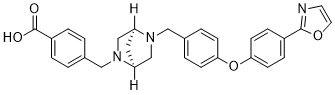
Acebilustat, also known as ZK322, is a novel, oral, potent and selective leukotriene A4 hydrolase inhibitor that is a promising new once-daily oral antiinflammatory drug in development for treatment of cystic fibrosis (CF) and other diseases. In a Phase I study, seventeen patients with mild to moderate cystic fibrosis were enrolled and randomized into groups receiving placebo or doses of 50 mg or 100 mg acebilustat administered orally, once daily for 15 days. Sputum neutrophil counts were reduced by 65% over baseline values in patients treated with 100 mg acebilustat. A modestly significant 58% reduction vs. placebo in sputum elastase was observed with acebilustat treatment. Favorable trends were observed for reduction of serum C-reactive protein and sputum neutrophil DNA in acebilustat-treated patients. No changes in pulmonary function were observed. Acebilustat was safe and well tolerated. The results of this study support further clinical development of acebilustat for treatment of cystic fibrosis.
Physicochemical Properties
| Molecular Formula | C₂₉H₂₇N₃O₄ | |
| Molecular Weight | 481.54 | |
| Exact Mass | 481.2 | |
| Elemental Analysis | C, 72.33; H, 5.65; N, 8.73; O, 13.29 | |
| CAS # | 943764-99-6 | |
| Related CAS # |
|
|
| PubChem CID | 68488178 | |
| Appearance | White to off-white solid powder | |
| Density | 1.3±0.1 g/cm3 | |
| Boiling Point | 649.1±65.0 °C at 760 mmHg | |
| Flash Point | 346.3±34.3 °C | |
| Vapour Pressure | 0.0±2.0 mmHg at 25°C | |
| Index of Refraction | 1.654 | |
| LogP | 4.37 | |
| Hydrogen Bond Donor Count | 1 | |
| Hydrogen Bond Acceptor Count | 7 | |
| Rotatable Bond Count | 8 | |
| Heavy Atom Count | 36 | |
| Complexity | 728 | |
| Defined Atom Stereocenter Count | 2 | |
| SMILES | C(C1C=CC(OC2C=CC(C3OC=CN=3)=CC=2)=CC=1)N1C[C@H]2N(C[C@@H]1C2)CC1C=CC(C(=O)O)=CC=1 |
|
| InChi Key | GERJIEKMNDGSCS-DQEYMECFSA-N | |
| InChi Code | InChI=1S/C29H27N3O4/c33-29(34)23-5-1-20(2-6-23)16-31-18-25-15-24(31)19-32(25)17-21-3-9-26(10-4-21)36-27-11-7-22(8-12-27)28-30-13-14-35-28/h1-14,24-25H,15-19H2,(H,33,34)/t24-,25-/m0/s1 | |
| Chemical Name | 4-[[(1S,4S)-5-[[4-[4-(1,3-oxazol-2-yl)phenoxy]phenyl]methyl]-2,5-diazabicyclo[2.2.1]heptan-2-yl]methyl]benzoic acid | |
| Synonyms |
|
|
| HS Tariff Code | 2934.99.9001 | |
| Storage |
Powder-20°C 3 years 4°C 2 years In solvent -80°C 6 months -20°C 1 month |
|
| Shipping Condition | Room temperature (This product is stable at ambient temperature for a few days during ordinary shipping and time spent in Customs) |
Biological Activity
| ln Vitro | Leukotriene A4 hydrolase inhibitor acebilustat (CTX-4430) has been shown in phase 1 trials to be safe and well tolerated[1]. An anti-inflammatory medication called acebilustat is being developed to treat CF and other conditions. It is a potent inhibitor of the enzyme leukotriene A4 hydrolase (LTA4H), which catalyzes the rate-limiting step in the formation of leukotriene B4 (LTB4), a potent chemoattractant and activator of inflammatory immune cells including neutrophils[2]. | ||
| ln Vivo |
|
||
| Animal Protocol |
|
||
| References |
[1]. Phase 1 Studies of Acebilustat: Biomarker Response and Safety in Patients with Cystic Fibrosis. Clin Transl Sci. 2016 Nov 2. [2]. Phase I Studies of Acebilustat: Pharmacokinetics, Pharmacodynamics, Food Effect, and CYP3A Induction. Clin Transl Sci. 2016 Oct 28. |
||
| Additional Infomation |
Acebilustat is under investigation in clinical trial NCT01748838 (Phase 1 Study Assessing the Safety and Tolerability of CTX-4430). Acebilustat is an orally bioavailable, small molecule inhibitor of the enzyme leukotriene A4 hydrolase (LTA4H), with potential anti-inflammatory activity. Upon oral administration, acebilustat targets and inhibits the activity of LTA4H, thereby inhibiting the synthesis of the pro-inflammatory mediator leukotriene B4 (LTB4). This may reduce inflammation in various inflammatory disorders including cystic fibrosis and serious pulmonary inflammatory diseases. LTA4H catalyzes a major and rate-limiting step in LTB4 production, and LTB4 plays an important role in pulmonary and systemic inflammation. |
Solubility Data
| Solubility (In Vitro) |
|
|||
| Solubility (In Vivo) |
Solubility in Formulation 1: ≥ 1.67 mg/mL (3.47 mM) (saturation unknown) in 10% DMSO + 40% PEG300 + 5% Tween80 + 45% Saline (add these co-solvents sequentially from left to right, and one by one), clear solution. For example, if 1 mL of working solution is to be prepared, you can add 100 μL of 16.7 mg/mL clear DMSO stock solution to 400 μL PEG300 and mix evenly; then add 50 μL Tween-80 to the above solution and mix evenly; then add 450 μL normal saline to adjust the volume to 1 mL. Preparation of saline: Dissolve 0.9 g of sodium chloride in 100 mL ddH₂ O to obtain a clear solution. Solubility in Formulation 2: ≥ 1.67 mg/mL (3.47 mM) (saturation unknown) in 10% DMSO + 90% (20% SBE-β-CD in Saline) (add these co-solvents sequentially from left to right, and one by one), clear solution. For example, if 1 mL of working solution is to be prepared, you can add 100 μL of 16.7 mg/mL clear DMSO stock solution to 900 μL of 20% SBE-β-CD physiological saline solution and mix evenly. Preparation of 20% SBE-β-CD in Saline (4°C,1 week): Dissolve 2 g SBE-β-CD in 10 mL saline to obtain a clear solution. Solubility in Formulation 3: ≥ 1.67 mg/mL (3.47 mM) (saturation unknown) in 10% DMSO + 90% Corn Oil (add these co-solvents sequentially from left to right, and one by one), clear solution. For example, if 1 mL of working solution is to be prepared, you can add 100 μL of 16.7 mg/mL clear DMSO stock solution to 900 μL of corn oil and mix evenly. (Please use freshly prepared in vivo formulations for optimal results.) |
| Preparing Stock Solutions | 1 mg | 5 mg | 10 mg | |
| 1 mM | 2.0767 mL | 10.3834 mL | 20.7667 mL | |
| 5 mM | 0.4153 mL | 2.0767 mL | 4.1533 mL | |
| 10 mM | 0.2077 mL | 1.0383 mL | 2.0767 mL |