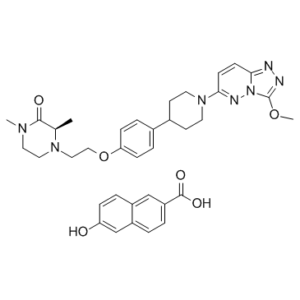
AZD-5153 HNT salt, the 6-Hydroxy-2-naphthoic acid salt form of AZD5153, is a potent, selective, and orally available BET/BRD4 (bromodomain and extraterminal) bromodomain inhibitor with pKi of 8.3 for BRD4. It has anticancer activity and possesses a bivalent binding mode. Unlike previously described monovalent inhibitors, AZD5153 ligates two bromodomains in BRD4 simultaneously. AZD5153 treatment markedly affects transcriptional programs of MYC, E2F, and mTOR. Of note, mTOR pathway modulation is associated with cell line sensitivity to AZD5153. AZD5153 potently disrupts BRD4 foci in U2OS cells with an IC50 value of 1.7 nmol/L. AZD5153 efficiently downregulates MYC protein levels across the cell line panel irrespective of their sensitivity to AZD5153. AML, MM, and DLBCL cell lines are highly sensitive to AZD5153. This study establishes AZD5153 as a highly potent, orally available BET/BRD4 inhibitor and provides a rationale for clinical development in hematologic malignancies.
Physicochemical Properties
| Molecular Formula | C36H41N7O6 | |
| Molecular Weight | 667.7540 | |
| Exact Mass | 667.311 | |
| Elemental Analysis | C, 64.75; H, 6.19; N, 14.68; O, 14.38 | |
| CAS # | 1869912-40-2 | |
| Related CAS # | AZD5153;1869912-39-9 | |
| PubChem CID | 118693658 | |
| Appearance | White to off-white solid powder | |
| Hydrogen Bond Donor Count | 2 | |
| Hydrogen Bond Acceptor Count | 11 | |
| Rotatable Bond Count | 8 | |
| Heavy Atom Count | 49 | |
| Complexity | 925 | |
| Defined Atom Stereocenter Count | 1 | |
| SMILES | C[C@@H]1C(=O)N(CCN1CCOC2=CC=C(C=C2)C3CCN(CC3)C4=NN5C(=NN=C5OC)C=C4)C.C1=CC2=C(C=CC(=C2)O)C=C1C(=O)O |
|
| InChi Key | UNZQBHXKCHECEC-GMUIIQOCSA-N | |
| InChi Code | InChI=1S/C25H33N7O3.C11H8O3/c1-18-24(33)29(2)14-15-30(18)16-17-35-21-6-4-19(5-7-21)20-10-12-31(13-11-20)23-9-8-22-26-27-25(34-3)32(22)28-23;12-10-4-3-7-5-9(11(13)14)2-1-8(7)6-10/h4-9,18,20H,10-17H2,1-3H3;1-6,12H,(H,13,14)/t18-;/m1./s1 | |
| Chemical Name | 6-hydroxynaphthalene-2-carboxylic acid;(3R)-4-[2-[4-[1-(3-methoxy-[1,2,4]triazolo[4,3-b]pyridazin-6-yl)piperidin-4-yl]phenoxy]ethyl]-1,3-dimethylpiperazin-2-one | |
| Synonyms |
|
|
| HS Tariff Code | 2934.99.9001 | |
| Storage |
Powder-20°C 3 years 4°C 2 years In solvent -80°C 6 months -20°C 1 month Note: Please store this product in a sealed and protected environment, avoid exposure to moisture. |
|
| Shipping Condition | Room temperature (This product is stable at ambient temperature for a few days during ordinary shipping and time spent in Customs) |
Biological Activity
| ln Vitro | Compared to BD1, AZD5153 exhibits a significant increase in potency when it comes to dislodging full-length BRD4, with IC50 values of 5.0 nM and 1.6 μM, respectively. With an IC50 value of 1.7 nM, AZD5153 potently disrupts BRD4 foci in U2OS cells. AZD5153 effectively reduces the levels of MYC protein in a panel of cell lines, regardless of the lines' susceptibility to AZD5153[1]. | ||
| ln Vivo | In multiple xenograft models of acute myeloid leukemia, multiple myeloma, and diffuse large B-cell lymphoma, administration of AZD5153 results in tumor stasis or regression. Treatment with AZD5153 significantly affects the transcriptional programs of mTOR, E2F, and MYC[1]. | ||
| Animal Protocol |
|
||
| References |
[1]. AZD5153: A Novel Bivalent BET Bromodomain Inhibitor Highly Active against Hematologic Malignancies. Mol Cancer Ther. 2016 Nov;15(11):2563-2574. |
Solubility Data
| Solubility (In Vitro) |
|
|||
| Solubility (In Vivo) |
Solubility in Formulation 1: ≥ 2.5 mg/mL (3.74 mM) (saturation unknown) in 10% DMSO + 40% PEG300 + 5% Tween80 + 45% Saline (add these co-solvents sequentially from left to right, and one by one), clear solution. For example, if 1 mL of working solution is to be prepared, you can add 100 μL of 25.0 mg/mL clear DMSO stock solution to 400 μL PEG300 and mix evenly; then add 50 μL Tween-80 to the above solution and mix evenly; then add 450 μL normal saline to adjust the volume to 1 mL. Preparation of saline: Dissolve 0.9 g of sodium chloride in 100 mL ddH₂ O to obtain a clear solution. Solubility in Formulation 2: ≥ 2.5 mg/mL (3.74 mM) (saturation unknown) in 10% DMSO + 90% (20% SBE-β-CD in Saline) (add these co-solvents sequentially from left to right, and one by one), clear solution. For example, if 1 mL of working solution is to be prepared, you can add 100 μL of 25.0 mg/mL clear DMSO stock solution to 900 μL of 20% SBE-β-CD physiological saline solution and mix evenly. Preparation of 20% SBE-β-CD in Saline (4°C,1 week): Dissolve 2 g SBE-β-CD in 10 mL saline to obtain a clear solution. Solubility in Formulation 3: ≥ 2.5 mg/mL (3.74 mM) (saturation unknown) in 10% DMSO + 90% Corn Oil (add these co-solvents sequentially from left to right, and one by one), clear solution. For example, if 1 mL of working solution is to be prepared, you can add 100 μL of 25.0 mg/mL clear DMSO stock solution to 900 μL of corn oil and mix evenly. (Please use freshly prepared in vivo formulations for optimal results.) |
| Preparing Stock Solutions | 1 mg | 5 mg | 10 mg | |
| 1 mM | 1.4976 mL | 7.4878 mL | 14.9757 mL | |
| 5 mM | 0.2995 mL | 1.4976 mL | 2.9951 mL | |
| 10 mM | 0.1498 mL | 0.7488 mL | 1.4976 mL |