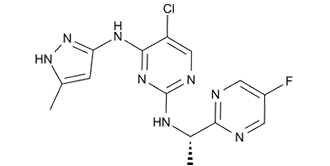
AZD1480 (AZD-1480) is a selective, orally bioavailable and ATP-competitive inhibitor of JAK2 (Janus-associated kinase) with potential antitumor activity. It inhibits JAK2 with an IC50 of 0.26 nM in a cell-free assay. It shows potent in vitro antiproliferative activity and high in vivo antitumor efficacy, because JAK2 is upregulated/mutated in a variety of cancer cells, mediating STAT3 activation and playing a key role in tumor cell proliferation and survival.
Physicochemical Properties
| Molecular Formula | C14H14CLFN8 |
| Molecular Weight | 348.7660 |
| Exact Mass | 348.101 |
| CAS # | 935666-88-9 |
| PubChem CID | 16659841 |
| Appearance | White to yellow solid powder |
| Density | 1.5±0.1 g/cm3 |
| Boiling Point | 575.2±60.0 °C at 760 mmHg |
| Flash Point | 301.7±32.9 °C |
| Vapour Pressure | 0.0±1.6 mmHg at 25°C |
| Index of Refraction | 1.702 |
| LogP | 1.6 |
| Hydrogen Bond Donor Count | 3 |
| Hydrogen Bond Acceptor Count | 8 |
| Rotatable Bond Count | 5 |
| Heavy Atom Count | 24 |
| Complexity | 397 |
| Defined Atom Stereocenter Count | 1 |
| SMILES | CC1=CC(=NN1)NC2=NC(=NC=C2Cl)N[C@@H](C)C3=NC=C(C=N3)F |
| InChi Key | PDOQBOJDRPLBQU-QMMMGPOBSA-N |
| InChi Code | InChI=1S/C14H14ClFN8/c1-7-3-11(24-23-7)21-13-10(15)6-19-14(22-13)20-8(2)12-17-4-9(16)5-18-12/h3-6,8H,1-2H3,(H3,19,20,21,22,23,24)/t8-/m0/s1 |
| Chemical Name | (S)-5-chloro-N2-(1-(5-fluoropyrimidin-2-yl)ethyl)-N4-(5-methyl-1H-pyrazol-3-yl)pyrimidine-2,4-diamine |
| Synonyms | AZD-1480; AZD1480; AZD 1480 |
| HS Tariff Code | 2934.99.9001 |
| Storage |
Powder-20°C 3 years 4°C 2 years In solvent -80°C 6 months -20°C 1 month |
| Shipping Condition | Room temperature (This product is stable at ambient temperature for a few days during ordinary shipping and time spent in Customs) |
Biological Activity
| ln Vitro | By blocking Aurora kinase, AZD-1480 (5 μM) causes G2/M arrest and cell death [1]. Strongly inhibiting proliferation, survival, FGFR3 and STAT3 signaling, as well as downstream targets such cyclin D2, in human multiple myeloma cells is AZD-1480. In myeloma cell lines, AZD-1480 causes apoptosis and inhibits cell proliferation at low micromolar doses [2]. In human and mouse glioma cells, AZD-1480 can efficiently inhibit constitutive and stimulus-induced phosphorylation of JAK1, JAK2, and STAT-3, which reduces cell proliferation and induces apoptosis [3]. As a strong competitive small molecule inhibitor of JAK1/2 kinase, AZD-1480 reduces tumor development and STAT3 phosphorylation in a manner that is dependent on STAT3. By altering the tumor microenvironment, AZD-1480 partially prevents tumor angiogenesis and metastasis [4]. |
| ln Vivo | In multiple myeloma xenograft models and human solid tumors, AZD-1480 suppresses STAT3 phosphorylation [1]. AZD-1480 prolongs mouse life in vivo by preventing subcutaneous tumors from growing. By suppressing STAT-3 activity, it prevents intracranial glioblastoma (GBM) tumors, indicating AZD-1480's impact on the JAK/STAT-3 pathway. In research involving patients with GBM tumors, pharmacological inhibition must to be taken into account [3]. AZD-1480 prevents myeloid cell infiltration into the lungs and the development of lung metastases in models of spontaneous metastasis and syngeneic experimental mice. In addition, AZD-1480 decreases metastasis and angiogenesis in tumor models derived from human xenografts [4]. Human solid tumor xenografts with prolonged Stat3 activation are not able to grow when exposed to AZD-1480 [5]. |
| Animal Protocol | SCID/Beige mice injected with TC32 or Rh18 cells; |
| References |
[1]. The JAK inhibitor AZD1480 regulates proliferation and immunity in Hodgkin lymphoma. Blood Cancer J. 2011 Dec;1(12):e46. [2]. The novel JAK inhibitor AZD1480 blocks STAT3 and FGFR3 signaling, resulting in suppression of human myeloma cell growth and survival. Leukemia. 2011 Mar;25(3):538-50. [3]. Therapeutic potential of AZD1480 for the treatment of human glioblastoma. Mol Cancer Ther. 2011 Dec;10(12):2384-93. [4]. Antiangiogenic and antimetastatic activity of JAK inhibitor AZD1480. Cancer Res. 2011 Nov 1;71(21):6601-10. [5]. The JAK2 inhibitor AZD1480 potently blocks Stat3 signaling and oncogenesis in solid tumors. Cancer Cell. 2009 Dec 8;16(6):487-9. [6]. Tyrosine receptor kinase B is a drug target in astrocytomas. Neuro Oncol. 2017 Jan;19(1):22-30. |
| Additional Infomation |
AZD1480 has been used in trials studying the treatment of Solid Malignancies, Post-Polycythaemia Vera, Primary Myelofibrosis (PMF), and Essential Thrombocythaemia Myelofibrosis. JAK2 Inhibitor AZD1480 is an orally bioavailable inhibitor of Janus-associated kinase 2 (JAK2) with potential antineoplastic activity. JAK2 inhibitor AZD1480 inhibits JAK2 activation, leading to the inhibition of the JAK/STAT (signal transducer and activator of transcription) signaling including activation of STAT3. This may lead to induction of tumor cell apoptosis and a decrease in cellular proliferation. JAK2, often upregulated or mutated in a variety of cancer cells, mediates STAT3 activation and plays a key role in tumor cell proliferation and survival. |
Solubility Data
| Solubility (In Vitro) | DMSO : ~50 mg/mL (~143.36 mM) |
| Solubility (In Vivo) |
Solubility in Formulation 1: ≥ 2.5 mg/mL (7.17 mM) (saturation unknown) in 10% DMSO + 40% PEG300 + 5% Tween80 + 45% Saline (add these co-solvents sequentially from left to right, and one by one), clear solution. For example, if 1 mL of working solution is to be prepared, you can add 100 μL of 25.0 mg/mL clear DMSO stock solution to 400 μL PEG300 and mix evenly; then add 50 μL Tween-80 to the above solution and mix evenly; then add 450 μL normal saline to adjust the volume to 1 mL. Preparation of saline: Dissolve 0.9 g of sodium chloride in 100 mL ddH₂ O to obtain a clear solution. Solubility in Formulation 2: ≥ 2.5 mg/mL (7.17 mM) (saturation unknown) in 10% DMSO + 90% (20% SBE-β-CD in Saline) (add these co-solvents sequentially from left to right, and one by one), clear solution. For example, if 1 mL of working solution is to be prepared, you can add 100 μL of 25.0 mg/mL clear DMSO stock solution to 900 μL of 20% SBE-β-CD physiological saline solution and mix evenly. Preparation of 20% SBE-β-CD in Saline (4°C,1 week): Dissolve 2 g SBE-β-CD in 10 mL saline to obtain a clear solution. Solubility in Formulation 3: ≥ 2.5 mg/mL (7.17 mM) (saturation unknown) in 10% DMSO + 90% Corn Oil (add these co-solvents sequentially from left to right, and one by one), clear solution. For example, if 1 mL of working solution is to be prepared, you can add 100 μL of 25.0 mg/mL clear DMSO stock solution to 900 μL of corn oil and mix evenly. (Please use freshly prepared in vivo formulations for optimal results.) |
| Preparing Stock Solutions | 1 mg | 5 mg | 10 mg | |
| 1 mM | 2.8672 mL | 14.3361 mL | 28.6722 mL | |
| 5 mM | 0.5734 mL | 2.8672 mL | 5.7344 mL | |
| 10 mM | 0.2867 mL | 1.4336 mL | 2.8672 mL |