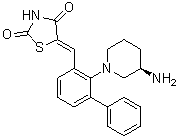
AZD1208 is a novel, highly selective, ATP-competitive and orally bioavailable small molecule pan-inhibitor of Pim kinase with potential antitumor activity. It inhibits Pim1, Pim2, and Pim3 with IC50s of 0.4 nM, 5 nM, and 1.9 nM in cell-free assays, respectively. As a Pan-PIM kinase inhibitor, AZD1208 demonstrated a broad spectrum of antineoplastic activity against various cancers such as breast, prostate, AML, and non-Hodgkin lymphomas. The mechanism of action of AZD1208 is to inhibit the activities of PIM1/2/3 serine/threonine kinases, which may result in the interruption of the G1/S phase of cell cycle transition, therefore causing cell cycle arrest and inducing apoptosis in cells that overexpress PIMs.
Physicochemical Properties
| Molecular Formula | C21H21N3O2S | |
| Molecular Weight | 379.48 | |
| Exact Mass | 379.135 | |
| Elemental Analysis | C, 66.47; H, 5.58; N, 11.07; O, 8.43; S, 8.45 | |
| CAS # | 1204144-28-4 | |
| Related CAS # | AZD1208 hydrochloride;1621866-96-3 | |
| PubChem CID | 58423153 | |
| Appearance | Light yellow to yellow solid powder | |
| Density | 1.3±0.1 g/cm3 | |
| Index of Refraction | 1.677 | |
| LogP | 2.38 | |
| Hydrogen Bond Donor Count | 2 | |
| Hydrogen Bond Acceptor Count | 5 | |
| Rotatable Bond Count | 3 | |
| Heavy Atom Count | 27 | |
| Complexity | 602 | |
| Defined Atom Stereocenter Count | 1 | |
| SMILES | C1C[C@H](CN(C1)C2=C(C=CC=C2C3=CC=CC=C3)/C=C\4/C(=O)NC(=O)S4)N |
|
| InChi Key | MCUJKPPARUPFJM-UWCCDQBKSA-N | |
| InChi Code | InChI=1S/C21H21N3O2S/c22-16-9-5-11-24(13-16)19-15(12-18-20(25)23-21(26)27-18)8-4-10-17(19)14-6-2-1-3-7-14/h1-4,6-8,10,12,16H,5,9,11,13,22H2,(H,23,25,26)/b18-12-/t16-/m1/s1 | |
| Chemical Name | (5Z)-5-[[2-[(3R)-3-aminopiperidin-1-yl]-3-phenylphenyl]methylidene]-1,3-thiazolidine-2,4-dione | |
| Synonyms |
|
|
| HS Tariff Code | 2934.99.9001 | |
| Storage |
Powder-20°C 3 years 4°C 2 years In solvent -80°C 6 months -20°C 1 month |
|
| Shipping Condition | Room temperature (This product is stable at ambient temperature for a few days during ordinary shipping and time spent in Customs) |
Biological Activity
| Targets | PIM2 kinase | ||
| ln Vitro | In the megakaryocytic leukemia cell line MOLM-16, AZD1208 exhibits strong anti-proliferative activity, as evidenced by a GI50 value of less than 100 nM [1]. AZD1208 (10 μM) significantly inhibits PIM kinase in all cells at 1 μM and inhibits Ramos cell proliferation at 1 μM. PIM2 knockdown is mostly associated with alterations in the cell cycle, while AZD1208 causes apoptosis [2]. AKT and 4EBP1 activation are substantially inhibited, polyribosome formation is inhibited, and AMPKα, a negative regulator of the translation machinery, is rapidly activated through mTORC1/2 signaling in AML cells when AZD1208 and AZD2014 are combined [3]. | ||
| ln Vivo |
|
||
| Cell Assay |
Flow cytometry for detection of the expression level of intracellular phospho-proteins[3] MOLM-16 and OCI-AML3 cells were treated for 6 h with AZD1208 (2 μM), AZD2014 (1 μM), or the combination. Cells were then fixed with 1.6% paraformaldehyde and subjected to permeabilization in ice-cold methanol (70% in PBS; 1 mL/million cells) for 20 min. After washing twice, cells were resuspended in 1% bovine serum albumin in PBS. Antibodies were added to the cell suspension and incubated for 30 min. Antibodies used were Phospho-p44/42 MAPK (Erk1/2) (Thr202/Tyr204) (E10) mouse monoclonal antibody; Phospho-S6 Ribosomal Protein (Ser235/236) (D57.2.2E) XP rabbit monoclonal antibody; Phospho-Akt (Ser473) rabbit monoclonal antibody; and CXCR4. After washing twice, cells were resuspended and analyzed by a Gallios flow cytometer. Clonogenic assay[3] Mononuclear cells were seeded at 0.05-0.1×10⁶ cells/mL in Methocult H4435. AZD1208 (1 or 3 μM), AZD2014 (0.25 or 0.5 μM), or the combination was added to the medium before plating. The cells were subjected to vortexing for 15 s and were then plated on 35×10-mm dishes with a 2×2-mm grid (NUNC) in triplicate and incubated in a humidified chamber at 37°C in 5% CO2 for 14 days. Colonies were scored by using a 1×-3 stereoscope. Polysomal assay[3] Molm-16 and OCI-AML3 cells were treated for 6 h with 2 or 3 μM AZD1208, respectively, 1 μM AZD2014, or the combination. Cells were then washed twice with PBS supplemented with cycloheximide (100 μg/mL) and resuspended in hypotonic lysis buffer (5 mM Tris, pH 7.5; 2.5 mM MgCl2; 1.5 mM KCl) supplemented with cycloheximide (100 μg/mL), dithiothreitol (2 mM), protease inhibitor, and RNase inhibitor (1 U/μL). After the suspension was subjected to vortexing for 4 s, Triton ×100 (0.5%) and sodium deoxycholate (0.5%) were added to the mix. After spinning at 12,000g for 5 min at 4°C, the supernatant was transferred to a new tube and snap-frozen in liquid nitrogen. Polysomal fractionation was carried out as previously described. |
||
| Animal Protocol |
|
||
| References |
[1]. Discovery of novel benzylidene-1,3-thiazolidine-2,4-diones as potent and selective inhibitors of the PIM-1, PIM-2, and PIM-3 protein kinases. Bioorg Med Chem Lett. 2012 Jul 15;22(14):4599-604. [2]. Loss of PIM2 enhances the anti-proliferative effect of the pan-PIM kinase inhibitor AZD1208 in non-Hodgkin lymphomas. Mol Cancer. 2015 Dec 8;14:205. [3]. The novel combination of dual mTOR inhibitor AZD2014 and pan-PIM inhibitor AZD1208 inhibits growth in acute myeloid leukemia via HSF pathway suppression. Oncotarget. 2015 Nov 10;6(35):37930-47. |
||
| Additional Infomation | pan-PIM Kinase Inhibitor AZD1208 is an orally available, small molecule inhibitor of PIM kinases with potential antineoplastic activity. Pan-PIM kinase inhibitor AZD1208 inhibits the activities of PIM1, PIM2 and PIM3 serine/threonine kinases, which may result in the interruption of the G1/S phase cell cycle transition, thereby causing cell cycle arrest and inducing apoptosis in cells that overexpress PIMs. The growth inhibition of several leukemia cell lines by this agent is correlated with the expression levels of PIM1, which is the substrate of STAT transcription factors. PIM kinases are downstream effectors of many cytokine and growth factor signaling pathways and are upregulated in various malignancies. |
Solubility Data
| Solubility (In Vitro) |
|
|||
| Solubility (In Vivo) |
Solubility in Formulation 1: ≥ 5 mg/mL (13.18 mM) (saturation unknown) in 10% DMSO + 40% PEG300 + 5% Tween80 + 45% Saline (add these co-solvents sequentially from left to right, and one by one), clear solution. For example, if 1 mL of working solution is to be prepared, you can add 100 μL of 50.0 mg/mL clear DMSO stock solution to 400 μL PEG300 and mix evenly; then add 50 μL Tween-80 to the above solution and mix evenly; then add 450 μL normal saline to adjust the volume to 1 mL. Preparation of saline: Dissolve 0.9 g of sodium chloride in 100 mL ddH₂ O to obtain a clear solution. Solubility in Formulation 2: 5 mg/mL (13.18 mM) in 10% DMSO + 90% (20% SBE-β-CD in Saline) (add these co-solvents sequentially from left to right, and one by one), suspension solution; with ultrasonication. For example, if 1 mL of working solution is to be prepared, you can add 100 μL of 50.0 mg/mL clear DMSO stock solution to 900 μL of 20% SBE-β-CD physiological saline solution and mix evenly. Preparation of 20% SBE-β-CD in Saline (4°C,1 week): Dissolve 2 g SBE-β-CD in 10 mL saline to obtain a clear solution. Solubility in Formulation 3: ≥ 2.5 mg/mL (6.59 mM) (saturation unknown) in 10% DMSO + 90% Corn Oil (add these co-solvents sequentially from left to right, and one by one), clear solution. For example, if 1 mL of working solution is to be prepared, you can add 100 μL of 25.0 mg/mL clear DMSO stock solution to 900 μL of corn oil and mix evenly. (Please use freshly prepared in vivo formulations for optimal results.) |
| Preparing Stock Solutions | 1 mg | 5 mg | 10 mg | |
| 1 mM | 2.6352 mL | 13.1759 mL | 26.3518 mL | |
| 5 mM | 0.5270 mL | 2.6352 mL | 5.2704 mL | |
| 10 mM | 0.2635 mL | 1.3176 mL | 2.6352 mL |