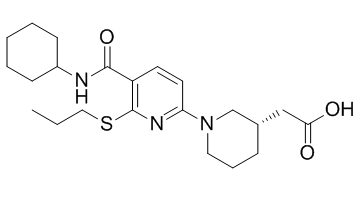
AZD4017, a nicotinic amide derived carboxylic acid, is a novel, potent, selective and effective inhibitor of 11β-Hydroxysteroid Dehydrogenase Type 1 (11β-HSD1) in human adipocytes with an IC50 of 7 nM. It exhibits good druglike properties and as a consequence was selected for clinical development. Inhibition of 11β-HSD1 is an attractive mechanism for the treatment of obesity and other elements of the metabolic syndrome. AZD4017 has good potency, selectivity, and pharmacokinetic characteristics.
Physicochemical Properties
| Molecular Formula | C22H33N3O3S |
| Molecular Weight | 419.58100 |
| Exact Mass | 419.224 |
| Elemental Analysis | C, 62.98; H, 7.93; N, 10.01; O, 11.44; S, 7.64 |
| CAS # | 1024033-43-9 |
| PubChem CID | 24946280 |
| Appearance | Light yellow to yellow solid powder |
| LogP | 4.793 |
| Hydrogen Bond Donor Count | 2 |
| Hydrogen Bond Acceptor Count | 6 |
| Rotatable Bond Count | 8 |
| Heavy Atom Count | 29 |
| Complexity | 541 |
| Defined Atom Stereocenter Count | 1 |
| SMILES | O=C(O)C[C@H]1CN(C2=NC(SCCC)=C(C(NC3CCCCC3)=O)C=C2)CCC1 |
| InChi Key | NCDZABJPWMBMIQ-INIZCTEOSA-N |
| InChi Code | InChI=1S/C22H33N3O3S/c1-2-13-29-22-18(21(28)23-17-8-4-3-5-9-17)10-11-19(24-22)25-12-6-7-16(15-25)14-20(26)27/h10-11,16-17H,2-9,12-15H2,1H3,(H,23,28)(H,26,27)/t16-/m0/s1 |
| Chemical Name | 2-[(3S)-1-[5-(cyclohexylcarbamoyl)-6-propylsulfanylpyridin-2-yl]piperidin-3-yl]acetic acid |
| Synonyms | AZD4017; AZD-4017; AZD 4017. |
| HS Tariff Code | 2934.99.9001 |
| Storage |
Powder-20°C 3 years 4°C 2 years In solvent -80°C 6 months -20°C 1 month |
| Shipping Condition | Room temperature (This product is stable at ambient temperature for a few days during ordinary shipping and time spent in Customs) |
Biological Activity
| ln Vitro | AZD 4017 displays no detectable activity against glucocorticoid and mineralocorticoid receptors, but demonstrates remarkable selectivity against related enzymes 11-βHSD2, 17β-HSD1, and 17β-HSD3 (all IC50>30 μM). With the exception of cynomolgus monkeys (IC50=0.029 μM), AZD 4017 has markedly reduced activity in various species, despite its high potency against the human version of 11β-HSD1. Furthermore, as adipose tissue is believed to be an important target organ, suppression of 11β-HSD1 activity was assessed in isolated human adipocytes from individuals without diabetes. There is considerable certainty that AZD 4017 is not restricted by adipose tissue because of its acidic nature because it was demonstrated to be a strong inhibitor of this important target tissue (IC50=0.002 μM), which is in good accord with the potency of the enzyme [1]. |
| ln Vivo | Only a few preclinical pharmacodynamic evaluations were carried out because of AZD 4017's low efficacy against the mouse enzyme. Increasing the doses further produced a maximal effect of about 70% inhibition at 1500 mg/kg, which is comparable to 10×IC50 in mice. This indicates that AZD 4017 inhibits 11β-HSD1 in this model in a dose-dependent manner [1]. |
| References |
[1]. Discovery of a potent, selective, and orally bioavailable acidic 11β-hydroxysteroid dehydrogenase type 1 (11β-HSD1) inhibitor: discovery of 2-[(3S)-1-[5-(cyclohexylcarbamoyl)-6-propylsulfanylpyridin-2-yl]-3-piperidyl]acetic acid (AZD4017). J Med Chem. 2012 Jun 28;55(12):5951-64. |
| Additional Infomation |
AZD-4017 is under investigation in clinical trial NCT01173471 (A Phase IIa Study to Assess the Tolerability, Safety, and Efficacy of AZD4017 for Raised Intra-ocular Pressure). 11beta-hydroxysteroid Dehydrogenase Type 1 Inhibitor AZD4017 is a selective, orally bioavailable inhibitor of the enzyme 11beta-hydroxysteroid dehydrogenase type 1 (11b-HSD1; 11bHSD1; HSD11B1), with potential protective activity. Upon administration, AZD4017 selectively binds to and inhibits the activity of 11b-HSD1. This prevents the conversion of cortisone to the active hormone cortisol that activates glucocorticoid receptors. By blocking cortisol production in metabolic tissues, AZD4017 may inhibit the adverse metabolic effects, such as glucose intolerance, hyperinsulinemia, systolic hypertension, increased adiposity, myoatrophy and dermal atrophy, caused by exogenous administration of glucocorticoids in these tissues. 11bHSD1 is highly expressed in metabolic tissues, such as liver, skeletal muscle, and adipose tissue. It plays a crucial role in regenerating active glucocorticoid from circulating glucocorticoids and regulates the production of cortisol to activate the glucocorticoid receptors. AZD4017 does not inhibit the anti-inflammatory activity of the administered glucocorticoids. |
Solubility Data
| Solubility (In Vitro) | DMSO : ~125 mg/mL (~297.92 mM) |
| Solubility (In Vivo) |
Solubility in Formulation 1: ≥ 2.08 mg/mL (4.96 mM) (saturation unknown) in 10% DMSO + 40% PEG300 + 5% Tween80 + 45% Saline (add these co-solvents sequentially from left to right, and one by one), clear solution. For example, if 1 mL of working solution is to be prepared, you can add 100 μL of 20.8 mg/mL clear DMSO stock solution to 400 μL PEG300 and mix evenly; then add 50 μL Tween-80 to the above solution and mix evenly; then add 450 μL normal saline to adjust the volume to 1 mL. Preparation of saline: Dissolve 0.9 g of sodium chloride in 100 mL ddH₂ O to obtain a clear solution. Solubility in Formulation 2: ≥ 2.08 mg/mL (4.96 mM) (saturation unknown) in 10% DMSO + 90% Corn Oil (add these co-solvents sequentially from left to right, and one by one), clear solution. For example, if 1 mL of working solution is to be prepared, you can add 100 μL of 20.8 mg/mL clear DMSO stock solution to 900 μL of corn oil and mix evenly. (Please use freshly prepared in vivo formulations for optimal results.) |
| Preparing Stock Solutions | 1 mg | 5 mg | 10 mg | |
| 1 mM | 2.3833 mL | 11.9167 mL | 23.8334 mL | |
| 5 mM | 0.4767 mL | 2.3833 mL | 4.7667 mL | |
| 10 mM | 0.2383 mL | 1.1917 mL | 2.3833 mL |