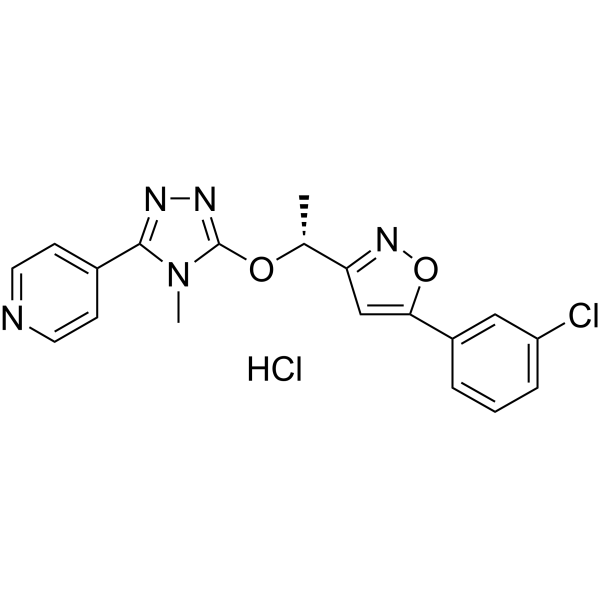
Physicochemical Properties
| Molecular Formula | C19H17CL2N5O2 |
| Molecular Weight | 418.28 |
| CAS # | 934338-70-2 |
| Related CAS # | AZD 2066;934282-55-0 |
| Appearance | Typically exists as solids at room temperature |
| SMILES | ClC1=CC=CC(=C1)C1=CC([C@@H](C)OC2=NN=C(C3C=CN=CC=3)N2C)=NO1.Cl |
| HS Tariff Code | 2934.99.9001 |
| Storage |
Powder-20°C 3 years 4°C 2 years In solvent -80°C 6 months -20°C 1 month |
| Shipping Condition | Room temperature (This product is stable at ambient temperature for a few days during ordinary shipping and time spent in Customs) |
Biological Activity
| Targets | mGluR5 |
| ln Vitro | AZD 2066 (1-10 μM) hydrochloride inhibits Ca2+ responses with IC50 values of 27.2, 3.56, 96.2 and 380 nM in mGlu5/HEK cells and striatal, hippocampal and cortical cultures, respectively[4]. AZD 2066 (1-10 μM) hydrochloride inhibits DHPG bath-induced Ca2+ oscillatory responses and blocks the effects of DHPG or Quis in mGlu5/HEK cells[4]. |
| ln Vivo | AZD 2066 (0.3-30 mg/kg, oral, 60 min) hydrochloride has a discriminative effect in rats[2]. AZD-2066 (10 µM, brain slice perfusion) hydrochloride alleviates dihydroxyphenylglycine (DHPG)-induced long-term depression (LTD) in mice treated with chronic social defeat stress (CSDS) via the BDNF/trkB signaling pathway[5]. AZD-2066 (5 mg/kg, intraperitoneal injection, 2 × 12 h) hydrochloride can alleviate the depressive behavior induced by chronic social defeat stress (CSDS) in mice[5]. |
| Animal Protocol |
Animal/Disease Models: Male Wistar rats (weighing 240-250 g)[2] Doses: 0.03, 0.1, 0.3, 1, 3, 10, 30 mg/kg Route of Administration: Oral gavage (p.o.) Experimental Results: Caused full and dose-dependent AZD9272-appropriate responding. Animal/Disease Models: Depressive model (C57BL/6 mice were subjected to physical defeats that were generated by a CD-1 aggressor for 5 min every day for 10 days)[5] Doses: 5 mg/kg Route of Administration: Intraperitoneal injection (i.p.), 2 × 12 h Experimental Results: Increased social interaction ratio. Reversed time spent in interaction zone. Increased sucrose preference scores. |
| References |
[1]. A positron emission tomography study in healthy volunteers to estimate mGluR5 receptor occupancy of AZD2066-estimating occupancy in the absence of a reference region. Neuroimage. 2013 Nov 15;82:160-9. [2]. AZD9272 and AZD2066: selective and highly central nervous system penetrant mGluR5 antagonists characterized by their discriminative effects. J Pharmacol Exp Ther. 2014 Aug;350(2):212-22. [3]. Antoniu SA. Discontinued drugs for pulmonary, allergy, gastrointestinal, arthritis (2012). Expert Opin Investig Drugs. 2013 Nov;22(11):1453-64. [4]. Location and Cell-Type-Specific Bias of Metabotropic Glutamate Receptor, mGlu5, Negative Allosteric Modulators. ACS Chem Neurosci. 2019 Nov 20;10(11):4558-4570. [5]. mGluR5 Facilitates Long-Term Synaptic Depression in a Stress-Induced Depressive Mouse Model. Can J Psychiatry. 2020 May;65(5):347-355. |
Solubility Data
| Solubility (In Vitro) | May dissolve in DMSO (in most cases), if not, try other solvents such as H2O, Ethanol, or DMF with a minute amount of products to avoid loss of samples |
| Solubility (In Vivo) |
Note: Listed below are some common formulations that may be used to formulate products with low water solubility (e.g. < 1 mg/mL), you may test these formulations using a minute amount of products to avoid loss of samples. Injection Formulations (e.g. IP/IV/IM/SC) Injection Formulation 1: DMSO : Tween 80: Saline = 10 : 5 : 85 (i.e. 100 μL DMSO stock solution → 50 μL Tween 80 → 850 μL Saline) *Preparation of saline: Dissolve 0.9 g of sodium chloride in 100 mL ddH ₂ O to obtain a clear solution. Injection Formulation 2: DMSO : PEG300 :Tween 80 : Saline = 10 : 40 : 5 : 45 (i.e. 100 μL DMSO → 400 μLPEG300 → 50 μL Tween 80 → 450 μL Saline) Injection Formulation 3: DMSO : Corn oil = 10 : 90 (i.e. 100 μL DMSO → 900 μL Corn oil) Example: Take the Injection Formulation 3 (DMSO : Corn oil = 10 : 90) as an example, if 1 mL of 2.5 mg/mL working solution is to be prepared, you can take 100 μL 25 mg/mL DMSO stock solution and add to 900 μL corn oil, mix well to obtain a clear or suspension solution (2.5 mg/mL, ready for use in animals). Injection Formulation 4: DMSO : 20% SBE-β-CD in saline = 10 : 90 [i.e. 100 μL DMSO → 900 μL (20% SBE-β-CD in saline)] *Preparation of 20% SBE-β-CD in Saline (4°C,1 week): Dissolve 2 g SBE-β-CD in 10 mL saline to obtain a clear solution. Injection Formulation 5: 2-Hydroxypropyl-β-cyclodextrin : Saline = 50 : 50 (i.e. 500 μL 2-Hydroxypropyl-β-cyclodextrin → 500 μL Saline) Injection Formulation 6: DMSO : PEG300 : castor oil : Saline = 5 : 10 : 20 : 65 (i.e. 50 μL DMSO → 100 μLPEG300 → 200 μL castor oil → 650 μL Saline) Injection Formulation 7: Ethanol : Cremophor : Saline = 10: 10 : 80 (i.e. 100 μL Ethanol → 100 μL Cremophor → 800 μL Saline) Injection Formulation 8: Dissolve in Cremophor/Ethanol (50 : 50), then diluted by Saline Injection Formulation 9: EtOH : Corn oil = 10 : 90 (i.e. 100 μL EtOH → 900 μL Corn oil) Injection Formulation 10: EtOH : PEG300:Tween 80 : Saline = 10 : 40 : 5 : 45 (i.e. 100 μL EtOH → 400 μLPEG300 → 50 μL Tween 80 → 450 μL Saline) Oral Formulations Oral Formulation 1: Suspend in 0.5% CMC Na (carboxymethylcellulose sodium) Oral Formulation 2: Suspend in 0.5% Carboxymethyl cellulose Example: Take the Oral Formulation 1 (Suspend in 0.5% CMC Na) as an example, if 100 mL of 2.5 mg/mL working solution is to be prepared, you can first prepare 0.5% CMC Na solution by measuring 0.5 g CMC Na and dissolve it in 100 mL ddH2O to obtain a clear solution; then add 250 mg of the product to 100 mL 0.5% CMC Na solution, to make the suspension solution (2.5 mg/mL, ready for use in animals). Oral Formulation 3: Dissolved in PEG400 Oral Formulation 4: Suspend in 0.2% Carboxymethyl cellulose Oral Formulation 5: Dissolve in 0.25% Tween 80 and 0.5% Carboxymethyl cellulose Oral Formulation 6: Mixing with food powders Note: Please be aware that the above formulations are for reference only. InvivoChem strongly recommends customers to read literature methods/protocols carefully before determining which formulation you should use for in vivo studies, as different compounds have different solubility properties and have to be formulated differently. (Please use freshly prepared in vivo formulations for optimal results.) |
| Preparing Stock Solutions | 1 mg | 5 mg | 10 mg | |
| 1 mM | 2.3907 mL | 11.9537 mL | 23.9074 mL | |
| 5 mM | 0.4781 mL | 2.3907 mL | 4.7815 mL | |
| 10 mM | 0.2391 mL | 1.1954 mL | 2.3907 mL |