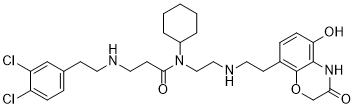
Physicochemical Properties
| Molecular Formula | C29H38CL2N4O4 |
| Molecular Weight | 577.542425632477 |
| Exact Mass | 576.227 |
| CAS # | 1035227-43-0 |
| Related CAS # | AZ505 ditrifluoroacetate;1035227-44-1 |
| PubChem CID | 24961094 |
| Appearance | Off-white to light brown solid powder |
| LogP | 5.412 |
| Hydrogen Bond Donor Count | 4 |
| Hydrogen Bond Acceptor Count | 6 |
| Rotatable Bond Count | 13 |
| Heavy Atom Count | 39 |
| Complexity | 772 |
| Defined Atom Stereocenter Count | 0 |
| InChi Key | LIBVHXXKHSODII-UHFFFAOYSA-N |
| InChi Code | InChI=1S/C29H38Cl2N4O4/c30-23-8-6-20(18-24(23)31)10-13-32-15-12-27(38)35(22-4-2-1-3-5-22)17-16-33-14-11-21-7-9-25(36)28-29(21)39-19-26(37)34-28/h6-9,18,22,32-33,36H,1-5,10-17,19H2,(H,34,37) |
| Chemical Name | N-cyclohexyl-3-((3,4-dichlorophenethyl)amino)-N-(2-((2-(5-hydroxy-3-oxo-3,4-dihydro-2H-benzo[b][1,4]oxazin-8-yl)ethyl)amino)ethyl)propanamide |
| Synonyms | AZ-505 free base AZ-505 AZ505 AZ 505 |
| HS Tariff Code | 2934.99.9001 |
| Storage |
Powder-20°C 3 years 4°C 2 years In solvent -80°C 6 months -20°C 1 month |
| Shipping Condition | Room temperature (This product is stable at ambient temperature for a few days during ordinary shipping and time spent in Customs) |
Biological Activity
| ln Vitro | In vitro, AZ505 has submicromolar doses of action and is a highly selective drug. AZ505 has a greater IC50 (0.12) against SMYD2 than it does against other groups of methyltransferases (IC50>83.3 μM), DOT1L (IC50>83.3 μM), and EZH2 (IC50>83.3 μM) [1]. AZ505 has an IC50 of 0.12 μM, making it a powerful SMYD2 conjugate. There are five members of the human SMYD (SET and MYND domain-containing proteins) family of protein lysine transferases (SMYD1-5). Furthermore, protein lysine methyltransferase's enzymatic activity cannot be inhibited by AZ505. AZ505 with a Kd of 0.5 μM is assigned for ITC binding investigations. By contrast, the p53 substrate peptide's predicted Kd is 3.7 μM. The predominant entropy-driven binding of AZ505 to SMYD2 typically implies that binding is mediated by adjacency to a limited number of distinct hydrogen bonds [2]. |
| References |
[1]. Overexpression of SMYD2 contributes to malignant outcome in gastric cancer. Br J Cancer. 2015 Jan 20;112(2):357-64. [2]. Structural basis of substrate methylation and inhibition of SMYD2. Structure. 2011 Sep 7;19(9):1262-73. [3]. Lysine methyltransferase SMYD2 promotes cyst growth in autosomal dominant polycystic kidney disease. J Clin Invest. 2017 Jun 30;127(7):2751-2764. |
| Additional Infomation | AZ505 is a benzoxazine that is 2H-1,4-benzoxazin-3(4H)-one substituted by a hydroxy group at position 5 and a 2-{[2-(cyclohexyl{N-[2-(3,4-dichlorophenyl)ethyl]-beta-alanyl}amino)ethyl]amino}ethyl group at position 8. It is a potent and selective inhibitor of SMYD2. It has a role as an EC 2.1.1.354 ([histone H3]-lysine(4) N-trimethyltransferase) inhibitor and an antineoplastic agent. It is a dichlorobenzene, a tertiary carboxamide, a secondary amino compound, a benzoxazine and an organic hydroxy compound. |
Solubility Data
| Solubility (In Vitro) | DMSO : ≥ 250 mg/mL (~432.87 mM) |
| Solubility (In Vivo) |
Solubility in Formulation 1: 6.25 mg/mL (10.82 mM) in 10% DMSO + 40% PEG300 + 5% Tween80 + 45% Saline (add these co-solvents sequentially from left to right, and one by one), clear solution; with sonication. For example, if 1 mL of working solution is to be prepared, you can add 100 μL of 62.5 mg/mL clear DMSO stock solution to 400 μL PEG300 and mix evenly; then add 50 μL Tween-80 to the above solution and mix evenly; then add 450 μL normal saline to adjust the volume to 1 mL. Preparation of saline: Dissolve 0.9 g of sodium chloride in 100 mL ddH₂ O to obtain a clear solution. Solubility in Formulation 2: 6.25 mg/mL (10.82 mM) in 10% DMSO + 90% (20% SBE-β-CD in Saline) (add these co-solvents sequentially from left to right, and one by one), clear solution; with ultrasonication. For example, if 1 mL of working solution is to be prepared, you can add 100 μL of 62.5 mg/mL clear DMSO stock solution to 900 μL of 20% SBE-β-CD physiological saline solution and mix evenly. Preparation of 20% SBE-β-CD in Saline (4°C,1 week): Dissolve 2 g SBE-β-CD in 10 mL saline to obtain a clear solution. Solubility in Formulation 3: 6.25 mg/mL (10.82 mM) in 10% DMSO + 90% Corn Oil (add these co-solvents sequentially from left to right, and one by one), clear solution; with ultrasonication. For example, if 1 mL of working solution is to be prepared, you can add 100 μL of 62.5 mg/mL clear DMSO stock solution to 900 μL corn oil and mix evenly. (Please use freshly prepared in vivo formulations for optimal results.) |
| Preparing Stock Solutions | 1 mg | 5 mg | 10 mg | |
| 1 mM | 1.7315 mL | 8.6574 mL | 17.3148 mL | |
| 5 mM | 0.3463 mL | 1.7315 mL | 3.4630 mL | |
| 10 mM | 0.1731 mL | 0.8657 mL | 1.7315 mL |