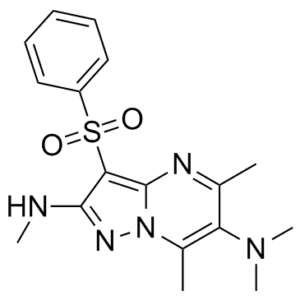
AVN-492 is a highly specific, selective and orally bioavailable antagonist of the 5-HT6R with Ki of 91 pM. AVN-492 exhibits a binding affinity of over three orders of magnitude higher to 5-HT6R (Ki=91 pM) than it does to 5-HT2BR (Ki=170 nM), which is the only other target. Because of this, the compound AVN-492 demonstrated excellent 5-HT6R selectivity against all other subtypes of serotonin receptors and exhibited extreme specificity against all other receptor types, including adrenergic, GABAergic, dopaminergic, histaminergic, and others. In rodents, AVN-492 exhibits a good ADME profile both in vitro and in vivo, along with high oral bioavailability and good brain permeability. An extremely promising method for assessing the possible contribution of the 5-HT6 receptor to cognitive and neurodegenerative impairments is AVN-492. AVN-492 is a promising drug candidate undergoing Phase I trials to be tested for treating these kinds of illnesses.
Physicochemical Properties
| Molecular Formula | C17H21N5O2S | |
| Molecular Weight | 359.44594168663 | |
| Exact Mass | 359.14 | |
| Elemental Analysis | C, 56.81; H, 5.89; N, 19.48; O, 8.90; S, 8.92 | |
| CAS # | 1220646-23-0 | |
| Related CAS # |
|
|
| PubChem CID | 56655571 | |
| Appearance | Solid powder | |
| LogP | 2.9 | |
| Hydrogen Bond Donor Count | 1 | |
| Hydrogen Bond Acceptor Count | 6 | |
| Rotatable Bond Count | 4 | |
| Heavy Atom Count | 25 | |
| Complexity | 558 | |
| Defined Atom Stereocenter Count | 0 | |
| InChi Key | SNPPEHMSSOEYDH-UHFFFAOYSA-N | |
| InChi Code | InChI=1S/C17H21N5O2S/c1-11-14(21(4)5)12(2)22-17(19-11)15(16(18-3)20-22)25(23,24)13-9-7-6-8-10-13/h6-10H,1-5H3,(H,18,20) | |
| Chemical Name | 3-(benzenesulfonyl)-2-N,6-N,6-N,5,7-pentamethylpyrazolo[1,5-a]pyrimidine-2,6-diamine | |
| Synonyms |
|
|
| HS Tariff Code | 2934.99.9001 | |
| Storage |
Powder-20°C 3 years 4°C 2 years In solvent -80°C 6 months -20°C 1 month |
|
| Shipping Condition | Room temperature (This product is stable at ambient temperature for a few days during ordinary shipping and time spent in Customs) |
Biological Activity
| Targets | 5-HT6 Receptor ( Ki = 91 pM ) | |
| ln Vitro |
|
|
| ln Vivo |
|
|
| Enzyme Assay | AVN-492 is dissolved to a concentration of 10 mM in 100% DMSO. After that, this DMSO solution is diluted 50 times using either MQ water or a pH-appropriate buffer. The MultiScreen 96-well plates are used for the Caco-2 permeability assay. Simply put, each well with a porous membrane bottom is seeded with Caco-2 cells (ATCC, Cat. No. HTB-37). The cells are grown in a CO2 thermostat at 37°C for 20–23 days, or until they reach total confluence. Every two to three days, the growth medium is swapped. Using Lucifer Yellow CH, a "leak test" is used to determine the physical integrity of the cell monolayer that has been established on the well-porous membrane. The permeability of AVN-492 (200μM) is assessed in both directions: from basal to apical and from apical to basal. The permeabilities of propranolol (which has a high permeability) and ranitidine (which has a low permeability) are only measured in the apical-to-basal direction. Verapamil (100 μM), a Pgp inhibitor, is used with or without Rhodamine 123 (30 μM) to measure its Pgp-dependent permeability. The apical-to-basal and basalto-apical permeabilities are also measured in the presence of verapamil in order to evaluate the Pgp pump's potential involvement in an AVN-492 efflux. LC/MS/MS API2000 is used to determine the concentrations of AVN-322 in donor and acceptor chambers. | |
| Animal Protocol |
|
|
| References |
[1]. AVN-492, A Novel Highly Selective 5-HT6R Antagonist: Preclinical Evaluation. J Alzheimers Dis. 2017;58(4):1043-1063. |
Solubility Data
| Solubility (In Vitro) |
|
|||
| Solubility (In Vivo) |
Solubility in Formulation 1: ≥ 3.75 mg/mL (10.43 mM) (saturation unknown) in 10% DMSO + 40% PEG300 + 5% Tween80 + 45% Saline (add these co-solvents sequentially from left to right, and one by one), clear solution. For example, if 1 mL of working solution is to be prepared, you can add 100 μL of 37.5 mg/mL clear DMSO stock solution to 400 μL PEG300 and mix evenly; then add 50 μL Tween-80 to the above solution and mix evenly; then add 450 μL normal saline to adjust the volume to 1 mL. Preparation of saline: Dissolve 0.9 g of sodium chloride in 100 mL ddH₂ O to obtain a clear solution. Solubility in Formulation 2: ≥ 3.75 mg/mL (10.43 mM) (saturation unknown) in 10% DMSO + 90% Corn Oil (add these co-solvents sequentially from left to right, and one by one), clear solution. For example, if 1 mL of working solution is to be prepared, you can add 100 μL of 37.5 mg/mL clear DMSO stock solution to 900 μL of corn oil and mix evenly. (Please use freshly prepared in vivo formulations for optimal results.) |
| Preparing Stock Solutions | 1 mg | 5 mg | 10 mg | |
| 1 mM | 2.7820 mL | 13.9101 mL | 27.8203 mL | |
| 5 mM | 0.5564 mL | 2.7820 mL | 5.5641 mL | |
| 10 mM | 0.2782 mL | 1.3910 mL | 2.7820 mL |