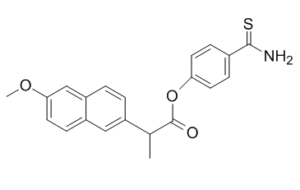
ATB-346, a structural analog of naproxen (one of the NSAIDs-Nonsteroidal anti-inflammatory drugs), is anti-inflammatory agent. ATB-346 was as effective as naproxen in adjuvant-induced arthritis in rats, with a more rapid onset of action. Unlike naproxen, ATB-346 did not increase blood pressure in hypertensive rats. Treatement with ATB-346 achieved a significantly more rapid and sustained recovery of motor function, obtaining greater than double the increase in locomotion score of the naproxen group by the 10th day of treatment. ATB-346 also significantly reduced the severity of inflammation (proinflammatory cytokines, apoptosis of neural tissue, and nitrosative stress) that characterized the secondary effects of SCI (spinal cord injury).
Physicochemical Properties
| Molecular Formula | C21H19NO3S | |
| Molecular Weight | 365.45 | |
| Exact Mass | 365.108 | |
| CAS # | 1226895-20-0 | |
| Related CAS # |
|
|
| PubChem CID | 25065981 | |
| Appearance | Light yellow to yellow solid powder | |
| Density | 1.3±0.1 g/cm3 | |
| Boiling Point | 561.4±60.0 °C at 760 mmHg | |
| Flash Point | 293.3±32.9 °C | |
| Vapour Pressure | 0.0±1.5 mmHg at 25°C | |
| Index of Refraction | 1.664 | |
| LogP | 4.32 | |
| Hydrogen Bond Donor Count | 1 | |
| Hydrogen Bond Acceptor Count | 4 | |
| Rotatable Bond Count | 6 | |
| Heavy Atom Count | 26 | |
| Complexity | 504 | |
| Defined Atom Stereocenter Count | 0 | |
| InChi Key | YCNMAPLPQYQJFC-UHFFFAOYSA-N | |
| InChi Code | InChI=1S/C21H19NO3S/c1-13(21(23)25-18-8-5-14(6-9-18)20(22)26)15-3-4-17-12-19(24-2)10-7-16(17)11-15/h3-13H,1-2H3,(H2,22,26) | |
| Chemical Name | (4-carbamothioylphenyl) 2-(6-methoxynaphthalen-2-yl)propanoate | |
| Synonyms |
|
|
| HS Tariff Code | 2934.99.9001 | |
| Storage |
Powder-20°C 3 years 4°C 2 years In solvent -80°C 6 months -20°C 1 month |
|
| Shipping Condition | Room temperature (This product is stable at ambient temperature for a few days during ordinary shipping and time spent in Customs) |
Biological Activity
| ln Vitro | At 100 μM, otenaproxesul suppresses the growth of human melanoma cells by blocking pro-survival pathways linked to Akt and NF-B activation[2]. Otenaproxesul (100 μM) causes human melanoma cells to undergo apoptosis[2]. Otenaproxesul (100 M) inhibits nuclear translocation of NF-kB and IkB degradation, as shown by a decrease in the p65 subunit's band intensity in A375 cells[2]. |
| ln Vivo | Similar to naproxen, otenaproxesul has anti-inflammatory qualities, but it is much less harmful to the gastrointestinal tract[1]. Melanoma tumor growth is inhibited in vivo by otenaproxesul (43 μmol/kg), which also lowers plasma levels of chemokines linked to melanoma[2]. (orally, 16 mg/kg) significantly inhibits bone defect and other histological features (including gingival epithelium flatness, chronic inflammatory cell infiltration, and gingival papillae connective tissue loss). Otenaproxesul does not alter IL-10 levels, but it does suppress the rise in gingival IL-1β and IL-6 brought on by periodontitis[3]. |
| Cell Assay |
Cell Proliferation Assay[2] Cell Types: A375 cells. Tested Concentrations: 100 μM. Incubation Duration: 24, 48 and 72 h. Experimental Results: Caused an inhibition of cell proliferation by 38.2%, 63.2% and 66%, respectively (P < 0.001). |
| Animal Protocol |
Animal/Disease Models: Male, Wistar rats (200-225 g)[1]. Doses: 30, 60, 120 and 2740 μmol/kg. Route of Administration: Orally once. Experimental Results: Inhibited PGE2 levels. Suppressed TXB2 synthesis. Animal/Disease Models: Male, Wistar rats (200-225 g)[1]. Doses: 4 μmol/kg. Route of Administration: Orally twice (two times) daily, on days 7 to 21 . Experimental Results: Dramatically decreased paw oedema at days 14 and 21 (*P < 0.05 vs. the vehicle-treated group). Caused markedly less gastric damage at all doses tested than naproxen. |
| References |
[1]. Markedly reduced toxicity of a hydrogen sulphide-releasing derivative of naproxen (ATB-346). Br J Pharmacol. 2010 Mar;159(6):1236-46. [2]. ATB-346, a novel hydrogen sulfide-releasing anti-inflammatory drug, induces apoptosis of human melanoma cells and inhibits melanoma development in vivo. Pharmacol Res. 2016 Dec;114:67-73. [3]. The H2S-releasing naproxen derivative, ATB-346, inhibits alveolar bone loss and inflammation in rats with ligature-induced periodontitis. Med Gas Res. 2015 Feb 27;5:4. [4]. P4 Antiinflammatory and antinociceptive effects of ATB-346, a gastric sparing hydrogen sulfide-releasing naproxen, in rats with carrageenan-induced knee joint synovitis. Nitric Oxide. Volume 27, Supplement 2, 15 September 2012, Page S13. |
| Additional Infomation |
ATB-346 is under investigation in clinical trial NCT03220633 (Study To Assess Safety, Tolerability And PK Of ATB-346 In Healthy Subjects). Drug Indication Treatment of chronic idiopathic arthritis (including rheumatoid arthritis , psoriatic arthritis , ankylosing spondylarthritis and juvenile idiopathic arthritis ) |
Solubility Data
| Solubility (In Vitro) |
|
|||
| Solubility (In Vivo) |
Solubility in Formulation 1: ≥ 2.5 mg/mL (6.84 mM) (saturation unknown) in 10% DMSO + 40% PEG300 +5% Tween-80 + 45% Saline (add these co-solvents sequentially from left to right, and one by one), clear solution. For example, if 1 mL of working solution is to be prepared, you can add 100 μL of 25.0 mg/mL clear DMSO stock solution to 400 μL PEG300 and mix evenly; then add 50 μL Tween-80 + to the above solution and mix evenly; then add 450 μL normal saline to adjust the volume to 1 mL. Preparation of saline: Dissolve 0.9 g of sodium chloride in 100 mL ddH₂ O to obtain a clear solution. (Please use freshly prepared in vivo formulations for optimal results.) |
| Preparing Stock Solutions | 1 mg | 5 mg | 10 mg | |
| 1 mM | 2.7364 mL | 13.6818 mL | 27.3635 mL | |
| 5 mM | 0.5473 mL | 2.7364 mL | 5.4727 mL | |
| 10 mM | 0.2736 mL | 1.3682 mL | 2.7364 mL |