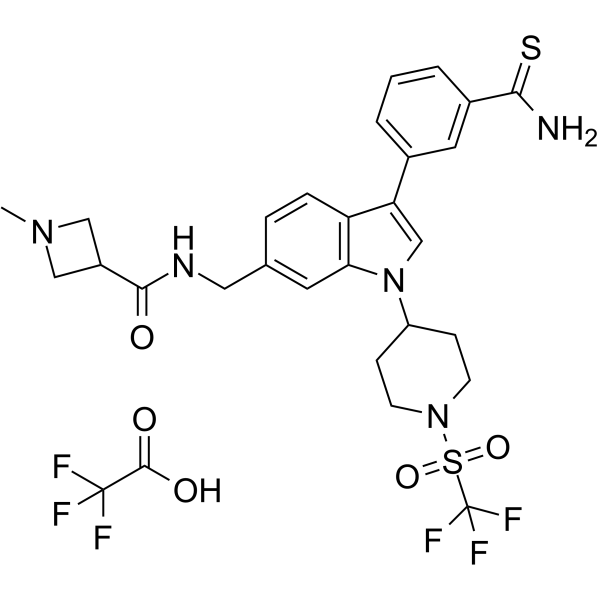
Physicochemical Properties
| Molecular Formula | C29H31F6N5O5S2 |
| Molecular Weight | 707.71 |
| Related CAS # | AS-99 free base;2323623-93-2;AS-99 |
| Appearance | Light yellow to yellow solid powder |
| HS Tariff Code | 2934.99.9001 |
| Storage |
Powder-20°C 3 years 4°C 2 years In solvent -80°C 6 months -20°C 1 month Note: Please store this product in a sealed and protected environment, avoid exposure to moisture. |
| Shipping Condition | Room temperature (This product is stable at ambient temperature for a few days during ordinary shipping and time spent in Customs) |
Biological Activity
| Targets | 0.79 µM (ASH1L histone methyltransferase)[1] |
| ln Vitro | AS-99 TFA is measured against a panel comprising NSD1, NSD2, NSD3, and SETD2, among other 20 histone methyltransferases. At 50 µM of AS-99 TFA, no discernible inhibition is seen on any of the examined histone methyltransferases, suggesting a selectivity of over 100 times for ASH1L[1]. At 10 µM and greater concentrations, AS-99 exhibits little or very little influence on the growth of leukemia cells without MLL1 translocations, such as SET2 and K562[1]. (1–8 µM; 7 days) According to the quantification of Annexin V positive cells, TFA also causes apoptosis in MLL leukemia cells but not in K562 cells[1]. MLL fusion-driven transcriptional pathways are suppressed by AS-99 TFA[1]. Compared to the cells treated with DMSO, AS-99 produces less H3K36me2 peaks[1]. |
| ln Vivo | In mice, leukemia burden is decreased by AS-99 (30 mg/kg; ip; qd, administered for 14 consecutive days) TFA[1]. When administered intravenously (IV) and intraperitoneally (IP) to mice, AS-99 TFA exhibits good exposure in plasma (AUC = 9701 hr* ng/mL and 10,699 hr* ng/mL, respectively), a reasonable half-life (~5–6 h), and a Cmax >10 µM[1]. |
| Cell Assay |
RT-PCR[1] Cell Types: MOLM13 cells Tested Concentrations: 2-6 µM Incubation Duration: 7 days Experimental Results: Led to a dose-dependent downregulation of canonical MLL fusion target genes required for leukemogenesis including MEF2C, DLX2, FLT3, and HOXA9. |
| Animal Protocol |
Animal/Disease Models: 8- to 10 -week old female NSG mice (bearing MV4;11 cells)[1] Doses: 30 mg/kg Route of Administration: Ip; qd, treated for 14 days Experimental Results: decreased the leukemia burden in the xenotransplantation mouse model of MLL leukemia without affecting blood counts in normal mice. |
| References |
[1]. Discovery of first-in-class inhibitors of ASH1L histone methyltransferase with anti-leukemic activity. Nat Commun. 2021 May 14;12(1):2792. |
Solubility Data
| Solubility (In Vitro) |
DMSO :~100 mg/mL (~141.30 mM) H2O :~12.5 mg/mL (~17.66 mM) |
| Solubility (In Vivo) |
Solubility in Formulation 1: 2.5 mg/mL (3.53 mM) in 10% DMSO + 90% (20% SBE-β-CD in Saline) (add these co-solvents sequentially from left to right, and one by one), clear solution; with sonication. For example, if 1 mL of working solution is to be prepared, you can add 100 μL of 25.0 mg/mL clear DMSO stock solution to 900 μL of 20% SBE-β-CD physiological saline solution and mix evenly. Preparation of 20% SBE-β-CD in Saline (4°C,1 week): Dissolve 2 g SBE-β-CD in 10 mL saline to obtain a clear solution. Solubility in Formulation 2: ≥ 2.08 mg/mL (2.94 mM) (saturation unknown) in 10% DMSO + 40% PEG300 + 5% Tween80 + 45% Saline (add these co-solvents sequentially from left to right, and one by one), clear solution. For example, if 1 mL of working solution is to be prepared, you can add 100 μL of 20.8 mg/mL clear DMSO stock solution to 400 μL PEG300 and mix evenly; then add 50 μL Tween-80 to the above solution and mix evenly; then add 450 μL normal saline to adjust the volume to 1 mL. Preparation of saline: Dissolve 0.9 g of sodium chloride in 100 mL ddH₂ O to obtain a clear solution. (Please use freshly prepared in vivo formulations for optimal results.) |
| Preparing Stock Solutions | 1 mg | 5 mg | 10 mg | |
| 1 mM | 1.4130 mL | 7.0650 mL | 14.1301 mL | |
| 5 mM | 0.2826 mL | 1.4130 mL | 2.8260 mL | |
| 10 mM | 0.1413 mL | 0.7065 mL | 1.4130 mL |