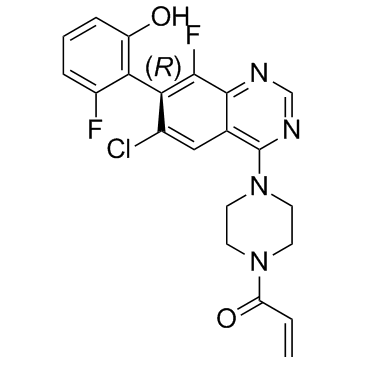
ARS-1630 (ARS1630) is the less active isomer of ARS-1620, which is a novel and potent inhibitor of mutant K-ras G12C found in patent WO 2015054572 A1. It might possess anticancer properties.
Physicochemical Properties
| Molecular Formula | C21H17CLF2N4O2 |
| Molecular Weight | 430.835090398788 |
| Exact Mass | 430.1 |
| CAS # | 1698055-86-5 |
| Related CAS # | ARS-1323; 1698024-73-5; ARS-1620; 1698055-85-4 |
| PubChem CID | 137003167 |
| Appearance | White to yellow solid powder |
| LogP | 4 |
| Hydrogen Bond Donor Count | 1 |
| Hydrogen Bond Acceptor Count | 7 |
| Rotatable Bond Count | 3 |
| Heavy Atom Count | 30 |
| Complexity | 636 |
| Defined Atom Stereocenter Count | 0 |
| SMILES | O=C(N1CCN(C2C3C(=C(C(C4C(O)=CC=CC=4F)=C(C=3)Cl)F)N=CN=2)CC1)C=C |
| InChi Key | ZRPZPNYZFSJUPA-UHFFFAOYSA-N |
| InChi Code | InChI=1S/C21H17ClF2N4O2/c1-2-16(30)27-6-8-28(9-7-27)21-12-10-13(22)17(19(24)20(12)25-11-26-21)18-14(23)4-3-5-15(18)29/h2-5,10-11,29H,1,6-9H2 |
| Chemical Name | 1-[4-[6-chloro-8-fluoro-7-(2-fluoro-6-hydroxyphenyl)quinazolin-4-yl]piperazin-1-yl]prop-2-en-1-one |
| Synonyms | ARS1630;ARS 1630; ARS-1630 |
| HS Tariff Code | 2934.99.9001 |
| Storage |
Powder-20°C 3 years 4°C 2 years In solvent -80°C 6 months -20°C 1 month |
| Shipping Condition | Room temperature (This product is stable at ambient temperature for a few days during ordinary shipping and time spent in Customs) |
Biological Activity
| Targets | KRAS(G12C) |
| ln Vitro | Recent research has revealed that KRASG12C may be druggable through allele-specific covalent targeting of Cys-12 close to an inducible allosteric switch II pocket (S-IIP). Since the S-IIP is only accessible in the GDP-bound state, the effectiveness of this strategy depends on KRASG12C actively cycling between its active-GTP and inactive-GDP conformations. In vitro, this approach shows promise for suppressing mutant KRAS [2]. |
| References |
[1]. Inhibitors of kras g12c. WO 2015054572 A1. [2]. Targeting KRAS Mutant Cancers with a Covalent G12C-Specific Inhibitor. Cell. 2018 Jan 25;172(3):578-589.e17. |
| Additional Infomation |
ARS-1620 is a qinazoline derivative carrying chloro and fluoro substituents at positions 6 and 8 respectively, a 2-fluoro-6-hydroxyphenyl group at position 7, and a 4-(prop-2-enoyl)piperazin-1-yl group at position 4. A potent, selective, and orally bioavailable covalent KRAS-G12C inhibitor, it inhibits the protein coding gene KRAS (Kirsten rat sarcoma virus) with high potency in cells and animals. It has a role as an inhibitor, an antiviral agent and an antineoplastic agent. KRASG12C was recently identified to be potentially druggable by allele-specific covalent targeting of Cys-12 in vicinity to an inducible allosteric switch II pocket (S-IIP). Success of this approach requires active cycling of KRASG12C between its active-GTP and inactive-GDP conformations as accessibility of the S-IIP is restricted only to the GDP-bound state. This strategy proved feasible for inhibiting mutant KRAS in vitro; however, it is uncertain whether this approach would translate to in vivo. Here, we describe structure-based design and identification of ARS-1620, a covalent compound with high potency and selectivity for KRASG12C. ARS-1620 achieves rapid and sustained in vivo target occupancy to induce tumor regression. We use ARS-1620 to dissect oncogenic KRAS dependency and demonstrate that monolayer culture formats significantly underestimate KRAS dependency in vivo. This study provides in vivo evidence that mutant KRAS can be selectively targeted and reveals ARS-1620 as representing a new generation of KRASG12C-specific inhibitors with promising therapeutic potential.[2] |
Solubility Data
| Solubility (In Vitro) | DMSO: ≥ 100 mg/mL (~232.1 mM) |
| Solubility (In Vivo) |
Solubility in Formulation 1: ≥ 2.5 mg/mL (5.80 mM) (saturation unknown) in 10% DMSO + 40% PEG300 + 5% Tween80 + 45% Saline (add these co-solvents sequentially from left to right, and one by one), clear solution. For example, if 1 mL of working solution is to be prepared, you can add 100 μL of 25.0 mg/mL clear DMSO stock solution to 400 μL PEG300 and mix evenly; then add 50 μL Tween-80 to the above solution and mix evenly; then add 450 μL normal saline to adjust the volume to 1 mL. Preparation of saline: Dissolve 0.9 g of sodium chloride in 100 mL ddH₂ O to obtain a clear solution. Solubility in Formulation 2: 2.5 mg/mL (5.80 mM) in 10% DMSO + 90% (20% SBE-β-CD in Saline) (add these co-solvents sequentially from left to right, and one by one), suspension solution; with ultrasonication. For example, if 1 mL of working solution is to be prepared, you can add 100 μL of 25.0 mg/mL clear DMSO stock solution to 900 μL of 20% SBE-β-CD physiological saline solution and mix evenly. Preparation of 20% SBE-β-CD in Saline (4°C,1 week): Dissolve 2 g SBE-β-CD in 10 mL saline to obtain a clear solution. Solubility in Formulation 3: ≥ 2.5 mg/mL (5.80 mM) (saturation unknown) in 10% DMSO + 90% Corn Oil (add these co-solvents sequentially from left to right, and one by one), clear solution. For example, if 1 mL of working solution is to be prepared, you can add 100 μL of 25.0 mg/mL clear DMSO stock solution to 900 μL of corn oil and mix evenly. (Please use freshly prepared in vivo formulations for optimal results.) |
| Preparing Stock Solutions | 1 mg | 5 mg | 10 mg | |
| 1 mM | 2.3210 mL | 11.6052 mL | 23.2105 mL | |
| 5 mM | 0.4642 mL | 2.3210 mL | 4.6421 mL | |
| 10 mM | 0.2321 mL | 1.1605 mL | 2.3210 mL |