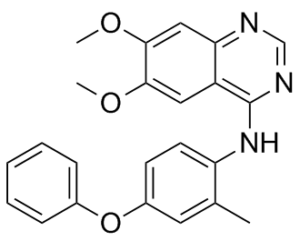
APS-2-79 (APS-279) is a potent antagonist of MAPK (mitogen-activated protein kinase) with antitumor activity. It influences KSR-dependent MAPK signaling by inhibiting RAF heterodimerization and the conformational alterations necessary for phosphorylating and activating KSR-bound MEK. KSR-induced phosphorylation of MEK and ERK was found to be suppressed by APS-2-79. The direct targeting of KSR as an active site mutant by APS-2-79, which has been shown to stimulate KSR-based MAPK outputs independently of ATP-binding, was necessary for the MAPK signaling suppression that APS-2-79 caused. This direct targeting of KSR could significantly reduce the activity of APS-2-79. Additionally, the addition of APS-2-79 significantly decreased the RAF-caused KSR-stimulated MEK phosphorylation. APS-2-79 may be used as a treatment option for Ras-driven cancers and has the potential to enhance the effectiveness of current MAPK inhibitors.
Physicochemical Properties
| Molecular Formula | C23H21N3O3 | |
| Molecular Weight | 387.44 | |
| Exact Mass | 387.158 | |
| Elemental Analysis | C, 71.30; H, 5.46; N, 10.85; O, 12.39 | |
| CAS # | 2002381-25-9 | |
| Related CAS # | APS-2-79 hydrochloride;2002381-31-7 | |
| PubChem CID | 121499159 | |
| Appearance | White to off-white solid powder | |
| Density | 1.2±0.1 g/cm3 | |
| Boiling Point | 528.6±50.0 °C at 760 mmHg | |
| Flash Point | 273.5±30.1 °C | |
| Vapour Pressure | 0.0±1.4 mmHg at 25°C | |
| Index of Refraction | 1.656 | |
| LogP | 5.36 | |
| Hydrogen Bond Donor Count | 1 | |
| Hydrogen Bond Acceptor Count | 6 | |
| Rotatable Bond Count | 6 | |
| Heavy Atom Count | 29 | |
| Complexity | 502 | |
| Defined Atom Stereocenter Count | 0 | |
| SMILES | O(C1C([H])=C([H])C([H])=C([H])C=1[H])C1C([H])=C([H])C(=C(C([H])([H])[H])C=1[H])N([H])C1C2=C([H])C(=C(C([H])=C2N=C([H])N=1)OC([H])([H])[H])OC([H])([H])[H] |
|
| InChi Key | PEKZLFZZBGBOPJ-UHFFFAOYSA-N | |
| InChi Code | InChI=1S/C23H21N3O3/c1-15-11-17(29-16-7-5-4-6-8-16)9-10-19(15)26-23-18-12-21(27-2)22(28-3)13-20(18)24-14-25-23/h4-14H,1-3H3,(H,24,25,26) | |
| Chemical Name | 6,7-dimethoxy-N-(2-methyl-4-phenoxyphenyl)quinazolin-4-amine | |
| Synonyms |
|
|
| HS Tariff Code | 2934.99.9001 | |
| Storage |
Powder-20°C 3 years 4°C 2 years In solvent -80°C 6 months -20°C 1 month |
|
| Shipping Condition | Room temperature (This product is stable at ambient temperature for a few days during ordinary shipping and time spent in Customs) |
Biological Activity
| Targets | MEK1; KSR2 (IC50 = 120 nM) | ||
| ln Vitro |
APS-2-79 (5 μM) suppresses KSR-stimulated MEK and ERK phosphorylation in 293H cells[1]. APS-2-79 (1 μM) enhances the clinical MEK inhibitor trametinib's effectiveness in cancer cell lines with K-Ras mutations.[1] |
||
| ln Vivo |
|
||
| Enzyme Assay | APS-2-79 acts as an antagonist of RAF-mediated MEKphosphorylation and a kinase suppressor of Ras (KSR)-dependent. With an IC50 for KSR2 of 120±23 nM, APS-2–79 binds specifically to KSR2 within the KSR2-MEK1 complex. | ||
| Cell Assay | In 96-well plates, cell viability assays are carried out. In order to achieve linear growth over the course of the assays, the optimal cell densities for 96-well plate assays are identified. A549, HCT-116, A375, SK-MEL-239, COLO-205, LOVO, SK-MEL-2, CALU-6, MEWO, SW620, and SW1417 cells are plated at 500 cells per well and treated for 72 hours with inhibitors (e.g., APS-2-79; 100-3,000 nM) before viability measurements are taken. 2000 H2087 and HEPG2 cells are plated in wells, and they are then exposed to inhibitors (such as APS-2-79; 100–3,000 nM) for 72 hours. Resazurin is used to measure cell viability, and the percent of viable cells is calculated by comparing inhibitor-treated samples to DMSO controls[1]. | ||
| Animal Protocol |
|
||
| References |
[1]. Small molecule stabilization of the KSR inactive state antagonizes oncogenic Ras signalling. Nature. 2016 Aug 24;537(7618):112-116. |
Solubility Data
| Solubility (In Vitro) |
|
|||
| Solubility (In Vivo) |
Solubility in Formulation 1: ≥ 2 mg/mL (5.16 mM) (saturation unknown) in 10% DMSO + 40% PEG300 + 5% Tween80 + 45% Saline (add these co-solvents sequentially from left to right, and one by one), clear solution. For example, if 1 mL of working solution is to be prepared, you can add 100 μL of 20.0 mg/mL clear DMSO stock solution to 400 μL PEG300 and mix evenly; then add 50 μL Tween-80 to the above solution and mix evenly; then add 450 μL normal saline to adjust the volume to 1 mL. Preparation of saline: Dissolve 0.9 g of sodium chloride in 100 mL ddH₂ O to obtain a clear solution. Solubility in Formulation 2: ≥ 2 mg/mL (5.16 mM) (saturation unknown) in 10% DMSO + 90% (20% SBE-β-CD in Saline) (add these co-solvents sequentially from left to right, and one by one), clear solution. For example, if 1 mL of working solution is to be prepared, you can add 100 μL of 20.0 mg/mL clear DMSO stock solution to 900 μL of 20% SBE-β-CD physiological saline solution and mix evenly. Preparation of 20% SBE-β-CD in Saline (4°C,1 week): Dissolve 2 g SBE-β-CD in 10 mL saline to obtain a clear solution. Solubility in Formulation 3: ≥ 2 mg/mL (5.16 mM) (saturation unknown) in 10% DMSO + 90% Corn Oil (add these co-solvents sequentially from left to right, and one by one), clear solution. For example, if 1 mL of working solution is to be prepared, you can add 100 μL of 20.0 mg/mL clear DMSO stock solution to 900 μL of corn oil and mix evenly. (Please use freshly prepared in vivo formulations for optimal results.) |
| Preparing Stock Solutions | 1 mg | 5 mg | 10 mg | |
| 1 mM | 2.5810 mL | 12.9052 mL | 25.8104 mL | |
| 5 mM | 0.5162 mL | 2.5810 mL | 5.1621 mL | |
| 10 mM | 0.2581 mL | 1.2905 mL | 2.5810 mL |