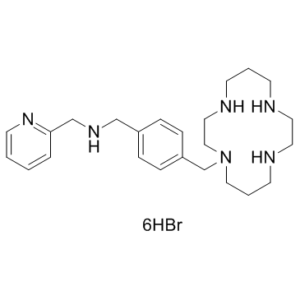
AMD3465 hexahydrobromide (AMD-3465; GENZ-644494 6-HBr) is a novel monomacrocyclic antagonist of CXCR4 that has potential anticancer and anti-HIV activity. It effectively prevents CXCL12 from binding to SupT1 cells, with an IC50 of 18 nM. With an IC50 of 17 nM, AMD3465 blocks both MAPK phosphorylation and CXCL12-induced calcium signaling in SupT1 cells. However, in U87.CD4.CCR5 cells, AMD3465 was unable to inhibit the intracellular calcium fluxes induced by the CCR5 ligands RANTES, LD78β, and MIP-1β. AMD3465 inhibits the chemotaxis that human T-lymphoid SupT1 cells experience when exposed to CXCL12 and stops U87.CD4 cells from internalizing CXCR4 due to chemokines. Furthermore, AMD3465 exhibits activity against the X4 HIV-1 strains IIIB, NL4.3, RF, and HE, with an IC50 ranging from 6 to 12 nM. With an IC50 of 12.3 nM, AMD3465 inhibits the HIV-2 strains ROD and EHO.
Physicochemical Properties
| Molecular Formula | C24H44BR6N6 | |
| Molecular Weight | 896.07 | |
| Exact Mass | 889.872 | |
| Elemental Analysis | C, 32.17; H, 4.95; Br, 53.50; N, 9.38 | |
| CAS # | 185991-07-5 | |
| Related CAS # | AMD 3465; 185991-24-6 | |
| PubChem CID | 9897616 | |
| Appearance | Light yellow to yellow solid powder | |
| Density | 1.022g/cm3 | |
| Boiling Point | 571.3ºC at 760 mmHg | |
| Flash Point | 299.3ºC | |
| Vapour Pressure | 5.1E-13mmHg at 25°C | |
| Index of Refraction | 1.533 | |
| LogP | 8.799 | |
| Hydrogen Bond Donor Count | 10 | |
| Hydrogen Bond Acceptor Count | 6 | |
| Rotatable Bond Count | 6 | |
| Heavy Atom Count | 36 | |
| Complexity | 413 | |
| Defined Atom Stereocenter Count | 0 | |
| SMILES | C1(CNCC2=CC=C(CN3CCNCCCNCCNCCC3)C=C2)=NC=CC=C1.[6HBr] |
|
| InChi Key | ARHBIBDGWDRBJH-UHFFFAOYSA-N | |
| InChi Code | InChI=1S/C24H38N6.6BrH/c1-2-13-29-24(5-1)20-28-19-22-6-8-23(9-7-22)21-30-17-4-12-26-15-14-25-10-3-11-27-16-18-30;;;;;;/h1-2,5-9,13,25-28H,3-4,10-12,14-21H2;6*1H | |
| Chemical Name | N-(pyridin-2-ylmethyl)-1-[4-(1,4,8,11-tetrazacyclotetradec-1-ylmethyl)phenyl]methanamine;hexahydrobromide | |
| Synonyms |
|
|
| HS Tariff Code | 2934.99.9001 | |
| Storage |
Powder-20°C 3 years 4°C 2 years In solvent -80°C 6 months -20°C 1 month Note: Please store this product in a sealed and protected environment, avoid exposure to moisture. |
|
| Shipping Condition | Room temperature (This product is stable at ambient temperature for a few days during ordinary shipping and time spent in Customs) |
Biological Activity
| Targets |
12G5 mAb-CXCR4 ( IC50 = 1.1 nM ); CXCL12AF647-CXCR4 ( IC50 = 1.7 nM ); X4 HIV-1 (NL4.3) ( IC50 = 121 nM ); X4 HIV-1 (RF) ( IC50 = 1.1 nM ); X4 HIV-1 (HE) ( IC50 = 1.7 nM ); X4 HIV-1 (IIIB) ( IC50 = 121 nM ); X4 HIV-1 (NL4.3AMD3100) ( IC50 = 1.1 nM ); HIV-2 (ROD) ( IC50 = 1.7 nM ); HIV-2 (EHO) ( IC50 = 121 nM ) |
|
| ln Vitro |
|
|
| ln Vivo |
|
|
| Enzyme Assay | In order to conduct competition binding studies against CXCR4, a concentration range of AMD3465 is incubated for three hours at 4°C in binding buffer (PBS containing pH 7.4, 0.25% BSA, 1 mM CaCl2, and 5 ×10⁵ CCRF-CEM cells) in Millipore DuraporeTM filter plates. Washing with cold 50 mM HEPES and 0.5 M NaCl pH 7.4 removes unbound 125I-SDF-1α. Membranes from CHO-S cells that express recombinant BLT1 are used for the competition binding assay against that protein. The membranes are prepared using mechanical cell lysis, high-speed centrifugation, resuspension in a buffer containing 50 mM HEPES and 5 mM MgCl2, and flash freezing. The assay mixture comprising 50 mM Tris, pH 7.4, 10 mM MgCl2, 10 mM CaCl2, 4 nM LTB4 combined with 1 nM 3H-LTB4, and 8 μg membrane is incubated with AMD3465 for 1 hour at room temperature. Filtration is used to separate the unbound 3H-LTB4 on Millipore Type GF-C filter plates. A Liquid Scintillation Counter (LKB Rackbeta 1209), is used to count the bound radioactivity. MCE has not independently verified these techniques' accuracy. They are merely meant to be used as references. | |
| Cell Assay | After a 24-hour serum starvation period, 1 μg/mL CXCL12, 2.5 ng/mL AMD 3465, 200 μM rolipram, or 10 μM forskolin are administered to astrocytes, granule cells, U87 cells, and Daoy cells. After 24 and 48 hours of treatment, respectively, trypan blue exclusion is used to measure the growth of Daoy and U87 cells in culture[2]. | |
| Animal Protocol |
|
|
| References |
[1]. AMD3465, a monomacrocyclic CXCR4 antagonist and potent HIV entry inhibitor. Biochem Pharmacol. 2005 Sep 1;70(5):752-61. [2]. Blocking CXCR4-mediated cyclic AMP suppression inhibits brain tumor growth in vivo. Cancer Res. 2007 Jan 15;67(2):651-8. |
Solubility Data
| Solubility (In Vitro) |
|
|||
| Solubility (In Vivo) |
Solubility in Formulation 1: ≥ 2.5 mg/mL (2.79 mM) (saturation unknown) in 10% DMSO + 40% PEG300 + 5% Tween80 + 45% Saline (add these co-solvents sequentially from left to right, and one by one), clear solution. For example, if 1 mL of working solution is to be prepared, you can add 100 μL of 25.0 mg/mL clear DMSO stock solution to 400 μL PEG300 and mix evenly; then add 50 μL Tween-80 to the above solution and mix evenly; then add 450 μL normal saline to adjust the volume to 1 mL. Preparation of saline: Dissolve 0.9 g of sodium chloride in 100 mL ddH₂ O to obtain a clear solution. Solubility in Formulation 2: ≥ 2.5 mg/mL (2.79 mM) (saturation unknown) in 10% DMSO + 90% Corn Oil (add these co-solvents sequentially from left to right, and one by one), clear solution. For example, if 1 mL of working solution is to be prepared, you can add 100 μL of 25.0 mg/mL clear DMSO stock solution to 900 μL of corn oil and mix evenly. Solubility in Formulation 3: 100 mg/mL (111.60 mM) in PBS (add these co-solvents sequentially from left to right, and one by one), clear solution; with ultrasonication. (Please use freshly prepared in vivo formulations for optimal results.) |
| Preparing Stock Solutions | 1 mg | 5 mg | 10 mg | |
| 1 mM | 1.1160 mL | 5.5799 mL | 11.1598 mL | |
| 5 mM | 0.2232 mL | 1.1160 mL | 2.2320 mL | |
| 10 mM | 0.1116 mL | 0.5580 mL | 1.1160 mL |