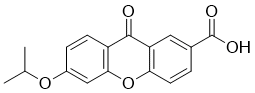
AH6809 (AH-6809) is a novel and potent DP/EP prostanoid receptor antagonist with a Ki of 1217, 1150, 1597, and 1415 nM for the cloned human EP1, EP2, EP3-III, and DP receptor respectively, and with a Ki of 350 nM for mouse EP2 receptor.
Physicochemical Properties
| Molecular Formula | C17H14O5 |
| Molecular Weight | 298.29006 |
| Exact Mass | 298.084 |
| Elemental Analysis | C, 68.45; H, 4.73; O, 26.82 |
| CAS # | 33458-93-4 |
| PubChem CID | 119461 |
| Appearance | White to off-white solid powder |
| Density | 1.3±0.1 g/cm3 |
| Boiling Point | 514.2±50.0 °C at 760 mmHg |
| Flash Point | 192.9±23.6 °C |
| Vapour Pressure | 0.0±1.4 mmHg at 25°C |
| Index of Refraction | 1.618 |
| LogP | 3.91 |
| Hydrogen Bond Donor Count | 1 |
| Hydrogen Bond Acceptor Count | 5 |
| Rotatable Bond Count | 3 |
| Heavy Atom Count | 22 |
| Complexity | 446 |
| Defined Atom Stereocenter Count | 0 |
| SMILES | O=C1C2=C(C=CC(C(O)=O)=C2)OC3=CC(OC(C)C)=CC=C31 |
| InChi Key | AQFFXPQJLZFABJ-UHFFFAOYSA-N |
| InChi Code | InChI=1S/C17H14O5/c1-9(2)21-11-4-5-12-15(8-11)22-14-6-3-10(17(19)20)7-13(14)16(12)18/h3-9H,1-2H3,(H,19,20) |
| Chemical Name | 9-oxo-6-propan-2-yloxyxanthene-2-carboxylic acid |
| Synonyms | AH-6809; AH6809; AH 6809; 33458-93-4; AH 6809; 6-Isopropoxy-9-oxoxanthene-2-carboxylic acid; AH-6809; AH6809; 6-isopropoxy-9-oxo-9h-xanthene-2-carboxylic acid; 9-oxo-6-propan-2-yloxyxanthene-2-carboxylic acid; 6-(1-Methylethoxy)-9-oxo-9H-xanthene-2-carboxylic acid; |
| HS Tariff Code | 2934.99.9001 |
| Storage |
Powder-20°C 3 years 4°C 2 years In solvent -80°C 6 months -20°C 1 month |
| Shipping Condition | Room temperature (This product is stable at ambient temperature for a few days during ordinary shipping and time spent in Customs) |
Biological Activity
| Targets | EP/DP receptor |
| ln Vitro | AH 6809 (1 μM; 30 min) suppresses the production of cAMP and IL-1β in macrophages that is stimulated by T. serrulatus venom (TsV) and amplified by PGE2[4]. AH 6809 (30-300 μM) inhibits PGD2's anti-aggregatory activity in whole blood with an apparent pA2 of 5.35[5]. |
| ln Vivo | AH 6809 (5 mg/kg; i.p.) reduces TsV-induced mortality, PGE2 and IL-1β production, and neutrophil infiltration in the lungs of mice[4]. |
| Enzyme Assay | 1. Eight types and subtypes of the mouse prostanoid receptor, the prostaglandin D (DP) receptor, the prostaglandin F (FP) receptor, the prostaglandin I (IP) receptor, the thromboxane A (TP) receptor and the EP1, EP2, EP3 and EP4 subtypes of the prostaglandin E receptor, were stably expressed in Chinese hamster ovary cells. Their ligand binding characteristics were examined with thirty two prostanoids and their analogues by determining the Ki values from the displacement curves of radioligand binding to the respective receptors. 2. The DP, IP and TP receptors showed high ligand binding specificity and only bound their own putative ligands with high affinity such as PGD2, BW245C and BW868C for DP, cicaprost, iloprost and isocabacyclin for IP, and S-145, I-BOP and GR 32191 for TP. 3. The FP receptor bound PGF2 alpha and fluprostenol with Ki values of 3-4 nM. In addition, PGD2, 17-phenyl-PGE2, STA2, I-BOP, PGE2 and M&B-28767 bound to this receptor with Ki values less than 100 nM. 4. The EP1 receptor bound 17-phenyl-PGE2, sulprostone and iloprost in addition to PGE2 and PGE1, with Ki values of 14-36 nM. 16,16-dimethyl-PGE2 and two putative EP1 antagonists, AH6809 and SC-19220, did not show any significant binding to this receptor. M&B-28767, a putative EP3 agonist, and misoprostol, a putative EP2/EP3 agonist, also bound to this receptor with Ki values of 120 nM. 5. The EP2 and EP4 receptors showed similar binding profiles. They bound 16,16-dimethyl PGE2 and 11-deoxy-PGE1 in addition to PGE2 and PGE1. The two receptors were discriminated by butaprost, AH-13205 and AH-6809 that bound to the EP2 receptor but not to the EP4 receptor, and by 1-OH-PGE1 that bound to the EP4 but not to the EP2 receptor. 6. The EP3 receptor showed the broadest binding profile, and bound sulprostone, M&B-28767, GR63799X, 11-deoxy-PGE1, 16,16-dimethyl-PGE2 and 17-phenyl-PGE2, in addition to PGE2 and PGE1, with Ki values of 0.6-3.7 nM. In addition, three IP ligands, iloprost, carbacyclin and isocarbacyclin, and one TP ligand, STA2, bound to this receptor with Ki values comparable to the Ki values of these compounds for the IP and TP receptors, respectively. 7. 8-Epi-PGF2 alpha showed only weak binding to the IP, TP, FP, EP2 and EP3 receptor at 10 microM concentration[2]. |
| Cell Assay |
In vitro pharmacological treatments J774.1 macrophages were plated at the density of 2 × 10⁵ cells per well in 200 μl of serum-free RPMI supplemented with antibiotics. The cells were then cultured at 37 °C in 5% CO2 for 2 h. Next, the supernatants were removed, and the cells were treated or not with specific inhibitors/antagonists for 30 min: indomethacin (10 μM); AH6809 (1 μM); AH23848 (1 μM); U-75302 (0.1 and 1 μM); and NFκB Activation Inhibitor (20 nM). H89 dihydrochloride hydrate (25 μM) was added for 2 h in the cell culture medium before stimulation. AH6809 and U-75302 from ethanol stock solutions were diluted in cell culture medium and the same concentration of ethanol (maximum 0.1%) was added to the medium only (control). The AH23848 and NFκB inhibitor from DMSO stock solutions were diluted in the cell culture medium and the same concentration of DMSO (maximum 0.1%) was added to the medium only (control). All compounds were diluted in 200 μl of serum-free DMEM, and the same solution with solvent diluents was used as control. After treatment, the cells were stimulated with TsV (50 μg ml−1) under the same experimental conditions and after 24 h at 37 °C in a humidified atmosphere 5% of CO2, the supernatants were collected for IL-1β quantification.[4] 1. The effect of AH6809 (6-isopropoxy-9-oxoxanthene-2-carboxylic acid) has been studied upon the anti-aggregatory and aggregatory actions of various agents on human platelets in whole blood. 2. Prostaglandin D2 (PGD2), BW245C, 9 alpha, 11 beta-PGF2, PGI2 and 5'-N-ethylcarboxamide adenosine (NECA) all inhibited ADP-induced platelet aggregation in whole blood. The anti-aggregatory activity of PGD2, BW245C and 9 alpha, 11 beta-PGF2 but not PGI2 or NECA was antagonized by AH6809. NECA was antagonized by AH6809. 3. The antagonism of the anti-aggregatory activity of PGD2 by AH6809 was concentration-related and could be overcome by increasing the concentration of PGD2. Analysis of the data yielded an apparent pA2 for AH6809 of 5.35. 4. At approximately 10 fold higher concentrations than those required to antagonize the action of PGD2, AH6809 also antagonized the aggregatory effect of U-46619 in whole blood (pA2 = 4.45). However, concentrations of AH6809 up to 300 microM were without effect upon either ADP- or platelet activating factor (Paf)-induced aggregation (pA2 less than 3.5). 5. The potency of AH6809 against PGD2 and U-46619 was increased in a resuspended platelet preparation suggesting that the drug is extensively bound to plasma proteins. However, in resuspended platelets the specificity of AH6809 relative to that seen in whole blood was reduced since aggregation by ADP and Paf was also slightly antagonized. 6. In conclusion, AH6809 appears to be a weak but specific DP-receptor blocking drug on human platelets and should prove to be a useful drug tool for defining the involvement of endogenous PGD2 in platelet aggregation and classifying the mode of action of anti-aggregatory prostanoids[5]. |
| Animal Protocol | IL-1r−/−, Casp1/11−/− and C57Bl/6 (WT) mice without treatment were inoculated with a sublethal or lethal dose of TsV (or PBS) as described above. Alox5−/− mice and 129sv mice were pre-treated or not with IL-1 receptor antagonist (IL-1Ra) at 10 mg kg−1, i.p., 1 h before and again 1 h after the sublethal or lethal TsV injection. IL-1Ra was kindly provided by Dr Stephen Poole, from the National Institute for Biological Standards and Control. In a specific experiment, the mice were either treated or not treated with MK886 (5-LO inhibitor, 5 mg kg−1 i.p., in 200 μl of 1% alcohol in water), indomethacin (COX1/2 inhibitor, 2 mg kg−1 i.p. in 200 μl of Tris[hydroxymethyl]aminomethane-HCl; TRIS-HCl, pH 8.2), SC-560 (selective COX1 inhibitor, 3 mg kg−1 i.p., in 200 μl of PBS), celecoxib (COX2 inhibitor, 5 mg kg−1 i.p., in 200 μl of water) or EP2 antagonist (AH6809, 5 mg kg−1 i.p., in 200 μl of PBS)67. The drugs (MK886 or indomethacin) or vehicles were administered four times, at 4 h and 0.5 h before and again 4 and 8 h after the lethal dose of TsV. The others drugs (SC-560, celecoxib, and EP2 antagonist) or vehicles were administered 1 day and again 1 h before the i.p. injection of lethal dose of TsV (180 μg kg−1). In other experiments, the Alox5−/− mice were treated or not with LTB4 (50 ng per mice, intranasal (i.n.) administration, in 20 μl of PBS). The LTB4 or vehicle (PBS+0.05% of ethanol) were administered 2 h and 0.5 h before the dose lethal of TsV (180 μg kg−1). The lungs were excised immediately after death or from mice survivors that were killed 8–12 h after the injection of TsV or vehicle. In some sets of experiments, two groups of mice were inoculated with PBS or a sublethal (120 μg kg−1) dose of TsV and, in only one, BAL fluids were collected 4 h later, to count the total cell number and neutrophils, as described previously47. In the other group, without BAL, the lungs were excised and weighed and 2 mg of tissue was homogenized in 2 ml of incomplete RPMI. After centrifugation (400g for 10 min), the supernatants were transferred to new tubes, split into two samples of 1 ml and stored at −80 °C until use. One sample was used for IL-1β and protein quantification analysis and the other for PGE2 and LTB4 measurement. For analysis of MPO activity, one lobule of a lung was cut out, immediately frozen in liquid nitrogen, and stored at −80 °C until use. In the therapeutic protocol, the lethal dose (180 μg kg−1) and superdose (360 μg kg−1) of TsV were injected and indomethacin (2 mg kg−1 i.p.) or vehicle were administered either 15 or 30 min after and again 4 and 8 h later. Mice survivors were killed 12 h after the envenomation.[4] |
| References |
[1]. The utilization of recombinant prostanoid receptors to determine the affinities and selectivities of prostaglandins and related analogs. Biochim Biophys Acta. 2000 Jan 17;1483(2):285-93. [2]. Ligand binding specificities of the eight types and subtypes of the mouse prostanoid receptors expressed in Chinese hamster ovary cells. Br J Pharmacol. 1997 Sep;122(2):217-24. [3]. 6-Isopropoxy-9-oxoxanthene-2-carboxylic acid (AH 6809), a human EP2 receptor antagonist. Biochem Pharmacol. 1995 Nov 9;50(10):1731-3. [4]. Opposing roles of LTB4 and PGE2 in regulating the inflammasome-dependent scorpion venom-induced mortality. Nat Commun. 2016 Feb 23;7:10760. [5]. AH6809, a prostaglandin DP-receptor blocking drug on human platelets. Br J Pharmacol. 1988 Jul;94(3):745-54. |
| Additional Infomation | 9-oxo-6-propan-2-yloxy-2-xanthenecarboxylic acid is a member of xanthones. |
Solubility Data
| Solubility (In Vitro) |
DMSO: ~25 mg/mL (~83.8 mM) H2O: ~0.1 mg/mL (~0.3 mM) |
| Solubility (In Vivo) |
Solubility in Formulation 1: 2.5 mg/mL (8.38 mM) in 10% DMSO + 40% PEG300 + 5% Tween80 + 45% Saline (add these co-solvents sequentially from left to right, and one by one), suspension solution; with sonication. For example, if 1 mL of working solution is to be prepared, you can add 100 μL of 25.0 mg/mL clear DMSO stock solution to 400 μL PEG300 and mix evenly; then add 50 μL Tween-80 to the above solution and mix evenly; then add 450 μL normal saline to adjust the volume to 1 mL. Preparation of saline: Dissolve 0.9 g of sodium chloride in 100 mL ddH₂ O to obtain a clear solution. Solubility in Formulation 2: 2.5 mg/mL (8.38 mM) in 10% DMSO + 90% Corn Oil (add these co-solvents sequentially from left to right, and one by one), suspension solution; with ultrasonication. For example, if 1 mL of working solution is to be prepared, you can add 100 μL of 25.0 mg/mL clear DMSO stock solution to 900 μL of corn oil and mix evenly. (Please use freshly prepared in vivo formulations for optimal results.) |
| Preparing Stock Solutions | 1 mg | 5 mg | 10 mg | |
| 1 mM | 3.3524 mL | 16.7622 mL | 33.5244 mL | |
| 5 mM | 0.6705 mL | 3.3524 mL | 6.7049 mL | |
| 10 mM | 0.3352 mL | 1.6762 mL | 3.3524 mL |