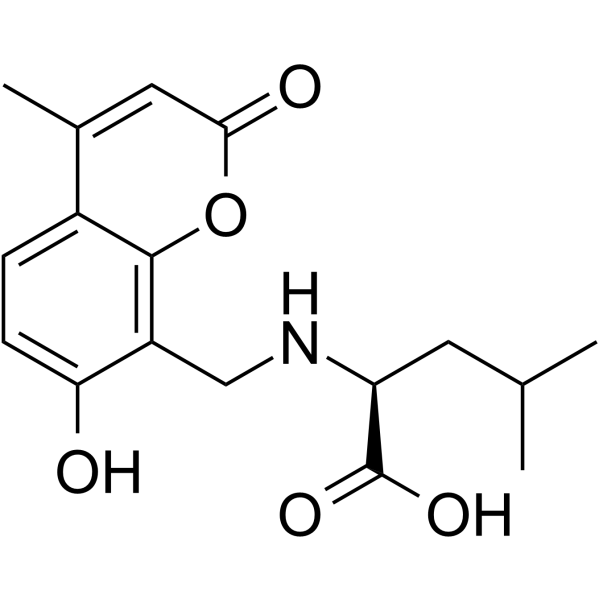
Physicochemical Properties
| Molecular Formula | C17H21NO5 |
| Molecular Weight | 319.3523 |
| Exact Mass | 319.141 |
| CAS # | 181125-92-8 |
| PubChem CID | 5391672 |
| Appearance | White to off-white solid powder |
| LogP | 0.4 |
| Hydrogen Bond Donor Count | 3 |
| Hydrogen Bond Acceptor Count | 6 |
| Rotatable Bond Count | 6 |
| Heavy Atom Count | 23 |
| Complexity | 487 |
| Defined Atom Stereocenter Count | 1 |
| SMILES | O1C(C([H])=C(C([H])([H])[H])C2C([H])=C([H])C(=C(C1=2)C([H])([H])N([H])[C@]([H])(C(=O)O[H])C([H])([H])C([H])(C([H])([H])[H])C([H])([H])[H])O[H])=O |
| InChi Key | YPJLUCAXHFPZJD-ZDUSSCGKSA-N |
| InChi Code | InChI=1S/C17H21NO5/c1-9(2)6-13(17(21)22)18-8-12-14(19)5-4-11-10(3)7-15(20)23-16(11)12/h4-5,7,9,13,18-19H,6,8H2,1-3H3,(H,21,22)/t13-/m0/s1 |
| Chemical Name | (2S)-2-[(7-hydroxy-4-methyl-2-oxochromen-8-yl)methylamino]-4-methylpentanoic acid |
| Synonyms | AF40431; 181125-92-8; N-[(7-Hydroxy-4-Methyl-2-Oxo-2h-Chromen-8-Yl)methyl]-L-Leucine; CHEMBL3098769; (2S)-2-[(7-hydroxy-4-methyl-2-oxochromen-8-yl)methylamino]-4-methylpentanoic acid; ((7-Hydroxy-4-methyl-2-oxo-2H-chromen-8-yl)methyl)-L-leucine; BDBM50445039; EiM07-28733; |
| HS Tariff Code | 2934.99.9001 |
| Storage |
Powder-20°C 3 years 4°C 2 years In solvent -80°C 6 months -20°C 1 month |
| Shipping Condition | Room temperature (This product is stable at ambient temperature for a few days during ordinary shipping and time spent in Customs) |
Biological Activity
| Targets | IC50: 4.4 µM (sortilin) Kd: 0.7 µM (sortilin)[1] |
| ln Vitro | Sortilin is a type I membrane glycoprotein belonging to the vacuolar protein sorting 10 protein (Vps10p) family of sorting receptors and is most abundantly expressed in the central nervous system. Sortilin has emerged as a key player in the regulation of neuronal viability and has been implicated as a possible therapeutic target in a range of disorders. Here, the identification of AF40431, the first reported small-molecule ligand of sortilin, is reported. Crystals of the sortilin-AF40431 complex were obtained by co-crystallization and the structure of the complex was solved to 2.7 Å resolution. AF40431 is bound in the neurotensin-binding site of sortilin, with the leucine moiety of AF40431 mimicking the binding mode of the C-terminal leucine of neurotensin and the 4-methylumbelliferone moiety of AF40431 forming π-stacking with a phenylalanine [1]. |
| Enzyme Assay |
Scintillation proximity assay [1] The compound affinity was determined by measuring the displacement of 3H-neurotensin binding to sortilin using a scintillation proximity assay (SPA). Experiments were performed in assay buffer (50 mM HEPES pH 7.4, 100 mM NaCl, 2.0 mM CaCl2, 0.1% BSA, 0.1% Tween-20) with a total volume of 40 µl. The compound was pre-incubated for 30 min at room temperature with 150 nM sortilin before 5 nM 3H-neurotensin and Ni-chelate imaging beads were added. After 6 h, the plate was read on a ViewLux with 360 s exposure time. Unlabelled neurotensin and a DMSO blank were used as positive and negative controls, respectively. Dose-response evaluation of compounds was performed with ten concentrations of 1a–1h and AF40431 (covering concentrations between 2.5 nM and 50 µM). The half-maximal inhibitory concentration (IC50) values were calculated by nonlinear regression using the sigmoid concentration response (variable slope) in XLfit 4. All values reported are the averages of at least four determinations. Isothermal titration calorimetry [1] The binding of AF40431 to sortilin was measured by isothermal titration calorimetry (ITC). The titration experiments were performed on a MicroCal iTC200 isothermal titration calorimeter. Sortilin was dialysed against PBS buffer pH 7.4. AF40431 was dissolved in PBS buffer pH 7.4 supplemented with 4%(v/v) dimethyl sulfoxide (DMSO). All solutions were filtered and degassed to avoid bubble formation and were equilibrated to the corresponding temperature before each experiment. Sortilin (30 µM) supplemented with 4%(v/v) DMSO was titrated at 25°C with AF40431 (500 µM) in 20 steps of 2 µl (first step, 0.4 µl). The time between injections was set to 150 s and the syringe mixing speed was set to 1000 rev min−1. Heat evolving from dilution was measured by injecting the ligand into PBS supplemented with 4% DMSO. This heat was subtracted from the heat of reaction to obtain the effective heat of binding. Finally, the binding stoichiometry (n), equilibrium dissociation constant (K d), molar enthalpy and entropy changes for the binding processes were determined by analyzing the titration data using Origin software. AF40431 fluorescence spectroscopy [1] AF40431 and sortilin were diluted in PBS buffer pH 7.4 to a final concentration of 0.1 µM. Fluorescence was recorded on a RF-5301PC spectrofluorophotometer maintained at 23 ± 1°C using 3 and 5 nm excitation and emission slit widths, respectively. The excitation and emission wavelengths were determined by scanning the ranges 250–430 and 370–600 nm, respectively. |
| References |
[1]. Identification of the first small-molecule ligand of the neuronal receptor sortilin and structure determination of the receptor-ligand complex. Acta Crystallogr D Biol Crystallogr. 2014 Feb;70(Pt 2):451-60. |
| Additional Infomation |
The phenol group of the 4-methylumbelliferone moiety of AF40431 is located in the position corresponding to that of Ile12 of NTS in the sortilin–NTS complex (Figs. 5 ▶ a and 5 ▶ b) and, similar to Ile12, the phenol does not seem to contribute to the binding (Quistgaard et al., 2009 ▶). A parallel π-stacking interaction is formed between the 2-pyrone of the 4-methylumbelliferone moiety of AF40431 and sortilin. An off-centre stacking is caused by the two electron-rich systems of 2-pyrone and Phe281 (Hunter & Sanders, 1990 ▶). The hydroxyl, ketone and methyl groups of 4-methylumbelliferone are not involved in interactions with sortilin and hence the structure–activity relationship should be explored for this two-ring system. [1] NTS binds to G-coupled neurotensin receptors (NTSRs) via amino acids 8–13, with the C-terminal leucine forming an electrostatic interaction with an arginine in the binding site (White et al., 2012 ▶). Hence, off-target reactions of AF40431 with the NTSRs could be expected. However, the Ile12 pocket of NTSR1 is narrow and steric clashes between the 4-methylumbelliferone moiety of AF40431 and Phe128 of transmembrane helix 2 (TM2) and Tyr351 of TM7 in NTSR1 were identified when AF40431 was superimposed on NTS in the NTSR1–NTS complex structure (White et al., 2012 ▶; Fig. 6 ▶ b). No competition of NTS binding to NTSR1 was observed for AF40431 (IC50 > 50 µM; data not shown).[1] The Calcein Blue moiety has previously been applied as a tracer in cellular and tissue studies (O’Malley et al., 1999 ▶). The fluorescent property of Calcein Blue is retained in AF40431 and the fluorescence is not statically quenched by the π-stacking with Phe317 upon binding to sortilin (Fig. 6 ▶ c). Hence, AF40431 could be applied as a molecular tracer of sortilin. The identification of AF40431 suggests that sortilin is ligandable by small molecules and thus provides a stimulus to further small-molecule ligand discovery efforts for sortilin.[1] |
Solubility Data
| Solubility (In Vitro) | DMSO: 25 mg/mL (78.28 mM) |
| Solubility (In Vivo) |
Note: Listed below are some common formulations that may be used to formulate products with low water solubility (e.g. < 1 mg/mL), you may test these formulations using a minute amount of products to avoid loss of samples. Injection Formulations (e.g. IP/IV/IM/SC) Injection Formulation 1: DMSO : Tween 80: Saline = 10 : 5 : 85 (i.e. 100 μL DMSO stock solution → 50 μL Tween 80 → 850 μL Saline) *Preparation of saline: Dissolve 0.9 g of sodium chloride in 100 mL ddH ₂ O to obtain a clear solution. Injection Formulation 2: DMSO : PEG300 :Tween 80 : Saline = 10 : 40 : 5 : 45 (i.e. 100 μL DMSO → 400 μLPEG300 → 50 μL Tween 80 → 450 μL Saline) Injection Formulation 3: DMSO : Corn oil = 10 : 90 (i.e. 100 μL DMSO → 900 μL Corn oil) Example: Take the Injection Formulation 3 (DMSO : Corn oil = 10 : 90) as an example, if 1 mL of 2.5 mg/mL working solution is to be prepared, you can take 100 μL 25 mg/mL DMSO stock solution and add to 900 μL corn oil, mix well to obtain a clear or suspension solution (2.5 mg/mL, ready for use in animals). Injection Formulation 4: DMSO : 20% SBE-β-CD in saline = 10 : 90 [i.e. 100 μL DMSO → 900 μL (20% SBE-β-CD in saline)] *Preparation of 20% SBE-β-CD in Saline (4°C,1 week): Dissolve 2 g SBE-β-CD in 10 mL saline to obtain a clear solution. Injection Formulation 5: 2-Hydroxypropyl-β-cyclodextrin : Saline = 50 : 50 (i.e. 500 μL 2-Hydroxypropyl-β-cyclodextrin → 500 μL Saline) Injection Formulation 6: DMSO : PEG300 : castor oil : Saline = 5 : 10 : 20 : 65 (i.e. 50 μL DMSO → 100 μLPEG300 → 200 μL castor oil → 650 μL Saline) Injection Formulation 7: Ethanol : Cremophor : Saline = 10: 10 : 80 (i.e. 100 μL Ethanol → 100 μL Cremophor → 800 μL Saline) Injection Formulation 8: Dissolve in Cremophor/Ethanol (50 : 50), then diluted by Saline Injection Formulation 9: EtOH : Corn oil = 10 : 90 (i.e. 100 μL EtOH → 900 μL Corn oil) Injection Formulation 10: EtOH : PEG300:Tween 80 : Saline = 10 : 40 : 5 : 45 (i.e. 100 μL EtOH → 400 μLPEG300 → 50 μL Tween 80 → 450 μL Saline) Oral Formulations Oral Formulation 1: Suspend in 0.5% CMC Na (carboxymethylcellulose sodium) Oral Formulation 2: Suspend in 0.5% Carboxymethyl cellulose Example: Take the Oral Formulation 1 (Suspend in 0.5% CMC Na) as an example, if 100 mL of 2.5 mg/mL working solution is to be prepared, you can first prepare 0.5% CMC Na solution by measuring 0.5 g CMC Na and dissolve it in 100 mL ddH2O to obtain a clear solution; then add 250 mg of the product to 100 mL 0.5% CMC Na solution, to make the suspension solution (2.5 mg/mL, ready for use in animals). Oral Formulation 3: Dissolved in PEG400 Oral Formulation 4: Suspend in 0.2% Carboxymethyl cellulose Oral Formulation 5: Dissolve in 0.25% Tween 80 and 0.5% Carboxymethyl cellulose Oral Formulation 6: Mixing with food powders Note: Please be aware that the above formulations are for reference only. InvivoChem strongly recommends customers to read literature methods/protocols carefully before determining which formulation you should use for in vivo studies, as different compounds have different solubility properties and have to be formulated differently. (Please use freshly prepared in vivo formulations for optimal results.) |
| Preparing Stock Solutions | 1 mg | 5 mg | 10 mg | |
| 1 mM | 3.1314 mL | 15.6568 mL | 31.3136 mL | |
| 5 mM | 0.6263 mL | 3.1314 mL | 6.2627 mL | |
| 10 mM | 0.3131 mL | 1.5657 mL | 3.1314 mL |